



Data from Nansen reveals that 4,100 out of the 10,000 largest addresses receiving distributions from the L2 network ZKsync have sold all their ZK tokens.


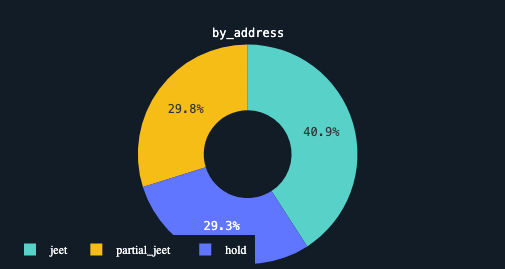
An additional 29.2% have sold only part of their coins, while just over 30% of wallets are still holding their assets.
In total, major airdrop participants have offloaded 491 million ZK, equivalent to approximately $110.1 million at the time of writing.
However, Nansen’s data covers only 1.4% of the 690,951 eligible wallets, leaving the behavior of smaller token recipients unclear.
According to Lookonchain, one “sybil” received over 3 million ZK (~$682,000) across 85 linked wallets.
Someone received an #airdrop of 3.01M $ZK($753K) via 85 wallets!
This airdrop hunter then deposited 2.71M $ZK($678K) into #Binance and sold 300K $ZK for 20 $ETH($69K) via #SyncSwap.https://t.co/U4OKb7bmVWhttps://t.co/VAPmnj9gsj pic.twitter.com/x8YUPAspbK
— Lookonchain (@lookonchain) June 17, 2024
Almost immediately, the user transferred the majority of assets to the Binance exchange and swapped 300,000 ZK for 20 ETH via SyncSwap.
According to a Dune dashboard compiled by Matter Labs data specialist Landon Gingerich, 513,907 addresses have already claimed 2.85 billion ZK.
Participants in the network still have approximately 22% of the allocated 3.675 billion ZK to claim.
The ZKsync protocol encountered technical difficulties amid a surge of users. Binance had to delay its listing twice due to technical issues and deposit delays.
(1/2) The network is currently under high load. Some RPC services may experience degraded performance.
Teams are working to increase RPC capacities.
Stay tuned for updates.
— ZKsync (∎, ∆) (@zksync) June 17, 2024
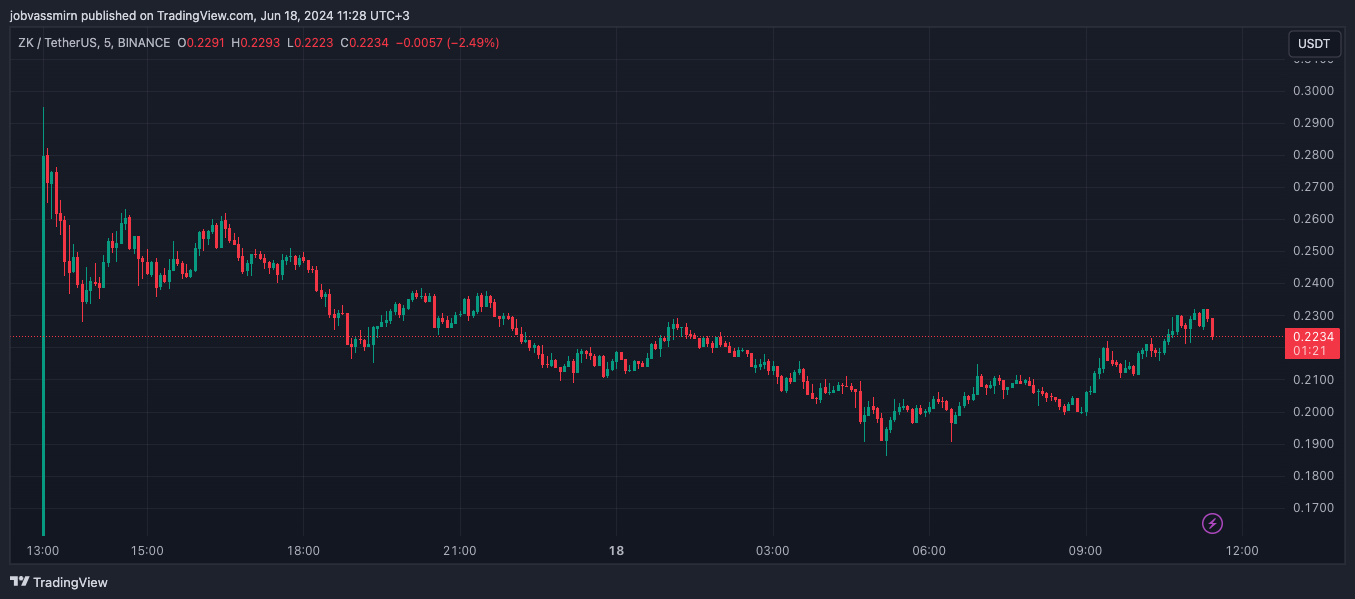
Following an unsuccessful launch and significant “sell-off,” the ZK token fell by 20% in a day to $0.22. At one point, the asset dipped below $0.19 but managed to recover. Trading began at $0.25.

Binance has pledged to distribute an additional 10.5 million ZK among 52,500 users in response to “community concerns about token distribution.”