


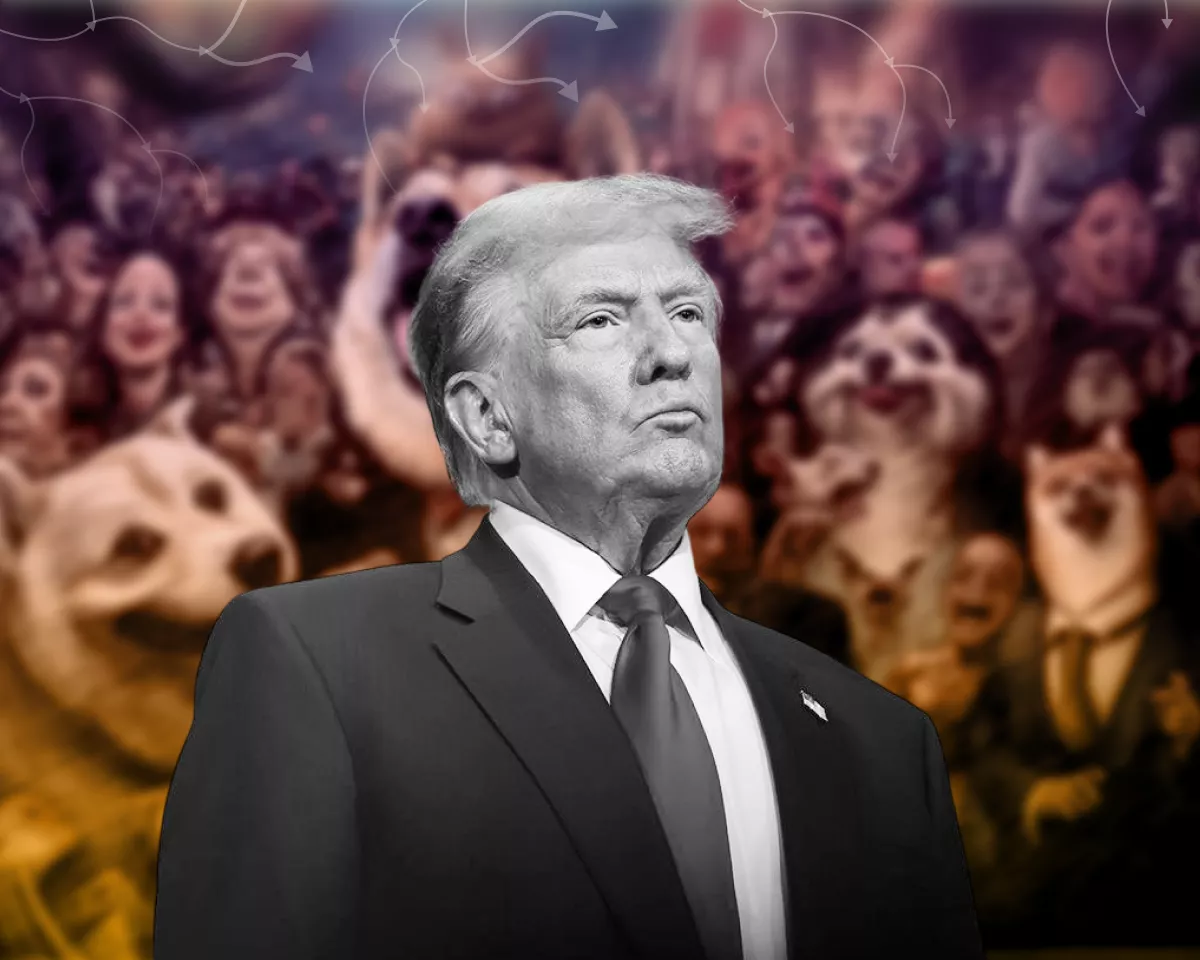
Donald Trump: eccentric populist, or a herald of crypto’s new era?
On January 20, Donald Trump was officially sworn in as the 47th president of the United States. During his election campaign he touted ambitious crypto initiatives and, on the eve of his inauguration, launched one of the most talked‑about memecoins.
ForkLog rounds up what matters about the ascent of the leader of the world’s biggest economy, his entanglement with digital assets and the “new era” for cryptocurrencies.
Trump’s campaign platform
Between his first and second terms, Trump went from a critic of digital assets to a self‑styled “crypto‑president”—and the first head of state with his own memecoin.
Experts reckon Trump is concerned with preserving the dollar’s dominance in the global economy. He had seen cryptocurrencies as a threat to the status quo, which shaped his scepticism toward the asset class.
His view “softened” as the community’s frustration with the Biden administration’s approach to crypto regulation grew. By the start of the 2024 race Trump had become an open supporter of digital assets.
“Apparently, the politician recognised the economic potential of cryptocurrencies, the role of the United States in this industry, and its problems. There came an understanding that they will not threaten America’s hegemony if the States can control the market and set the trends,” noted at the time SHARD’s head of analytics, Fedor Ivanov.
His campaign then leaned into the crypto electorate and focused its messaging accordingly.
“Almost certainly, Donald Trump sought to attract potential voters who were positively disposed toward cryptocurrencies. He likely also aimed to win favour with Elon Musk’s fans, who might have expected concrete statements and actions in their favour,” BestChange analyst Nikita Zuborev told ForkLog.
In the expert’s view, the president‑elect remains personally sceptical about the industry’s prospects. But his advisers have persuaded him of the asset class’s advantages, including its potential to reduce the US national debt.
“For him it’s just another ‘toy’, as it is for Elon Musk. But it can bring in millions of dollars, which Trump does not disdain. At the official level, though, his support for the crypto market is still too limited,” the analyst added.
Even so, during the campaign Trump’s team announced a series of crypto initiatives that piqued the community’s interest. Which of them will be implemented—and with what impact—remains an open question.
Blum CEO Gleb Kostarev expects the shift to become palpable soon.
“Trump moves fast, which is typical of his management style. If the rumours about signed crypto orders are true, this could be a turning point for the industry. Still, impulsive decisions can yield both positive changes and unexpected risks,” he stressed.
Some promised changes are already under way.
Personnel reshuffles
One of the campaign’s industry‑relevant planks was a shake‑up at the top of key agencies.
The loudest pledge was to fire then‑chair of the SEC, Gary Gensler, aired from the stage at the Bitcoin 2024 conference in June 2024. Widely disliked in crypto circles for his critical stance and strict approach to oversight, Gensler’s prospective ouster drew applause.
In November 2024 Gensler said he would step down on the 47th president’s inauguration day—a year before the end of a standard term.
Among possible successors were mentioned Robinhood’s chief legal officer Dan Gallagher, former chair of the CFTC Christopher Giancarlo, SEC commissioner Hester Peirce and the agency’s former general counsel Robert Stebbins. Billionaire Mark Cuban also expressed interest in the role.
In December the president‑elect nominated former SEC commissioner Paul Atkins—a crypto supporter and a board member of the industry lobby group The Digital Chamber—to chair the SEC. His nomination was well received across both the crypto community and political circles.
Until Congress confirms Atkins, commissioner Mark Uyeda will serve as acting chair.
Change is coming to the futures watchdog, too: CFTC chair Rostin Behnam has announced his resignation.
On his watch, the agency proved more accommodating than Gensler’s SEC. It pursued several major cases against crypto firms, including FTX and Binance.
Behnam has repeatedly called for tighter oversight of the industry, including decentralised exchanges and DeFi, and sought expanded authority over cryptocurrencies.
In November 2024, reports surfaced of the Trump team’s plans to shift part of the digital‑assets market under the CFTC’s remit.
The leading contender to chair the CFTC is Brian Quintenz—a former commissioner and policy chief for a16z’s crypto arm. He has described his stance on the industry as “positive” and criticised the SEC’s approach.
Pending confirmation of a new chair, commissioner Caroline Pham—a former Citibank executive—will serve as acting head of the CFTC.
“Appointing new leaders like the heads of the SEC and CFTC is a chance for a reset. If professionals with a deeper understanding of crypto join the administration, it could speed up proper legal integration,” Kostarev said.
In November 2024 Trump nominated hedge‑fund manager Scott Bessent as treasury secretary.
The president‑elect also floated allies and crypto sympathisers for other key posts. Robert Francis Kennedy Jr. was nominated to be head of the Department of Health, political commentator and National Guard officer Pete Hegseth for minister of defense, and Cantor Fitzgerald CEO Howard Lutnick was appointed minister of commerce.
Beyond changing the guard at existing agencies, the Trump team set up a new one—the Department of Government Efficiency (DOGE).
Devised by ally Elon Musk, the body will be co‑chaired by the billionaire himself and former presidential candidate Vivek Ramaswamy.
A bitcoin reserve
The idea of a national strategic bitcoin reserve was another marquee plank of Trump’s crypto rhetoric.
He floated adding digital gold to the state balance sheet at Bitcoin 2024, alongside his vow to fire Gensler.
He also said he would not allow the sale of 213,239 BTC seized by the authorities and held in US government wallets, calling them the future “core of a national strategic reserve”.
Soon after, word surfaced of a draft bill by senator Cynthia Lummis, tentatively titled “The Stimulating Innovation, Technology, and Competitiveness Through Streamlined Nationwide Investments Act of 2024,” or the “Bitcoin Act of 2024” for short.
In November the proposal was submitted to Congress.
The plan envisaged buying up to 200,000 BTC a year for five years to amass 1m coins, tapping Federal Reserve gold reserves. A 20‑year holding period was proposed, with some exceptions.
In December 2024 Satoshi Action Fund CEO Dennis Porter said Trump was considering an executive order establishing a strategic bitcoin reserve funded via the Exchange Stabilization Fund (ESF).
Before year‑end, several US states announced their own strategic crypto‑accumulation initiatives.
Binance founder Changpeng Zhao backed the US reserve idea, saying the same was “inevitable” for many countries that had yet to show interest.
Former US treasury secretary Lawrence Summers, by contrast, criticised it. He called bitcoin a “barren commodity” and suggested the only motivation for a strategic reserve might be “indulging generous campaign donors” to Trump.
Trader Vladimir Koen believes the notion is, for now, mere populist sloganeering.
“In the near term, a bitcoin reserve is nothing more than a slogan Trump needed to raise donations and draw in the crypto crowd,” the expert stressed.
He argues the Lummis bill will not pass Congress, even if Trump signs such an order. Lawmakers’ chief task is to restore the dollar’s global dominance to prior levels.
“The goal of the United States is to sell more of its dollar‑denominated bonds. Using bitcoin creates unnecessary competition for those bonds,” Koen added.
In his view, too many factors militate against a US national bitcoin reserve: volatility and its impact on sovereign‑bond ratings, an unfit legal framework, and technical risks tied to custody.
As an alternative, Koen suggests issuing US Treasuries denominated in digital gold:
“Even if they deliver minimal yield thanks to crypto’s price appreciation, they will find buyers. That is, the authorities will denominate debt in bitcoin, pay no interest on it, and the Fed’s balance sheet will grow on the back of rising quotes.”
However, even that does not solve the control problem, the expert believes.
“The lack of control over the coin runs counter to both Trump’s character and US policy. They use the dollar as a lever over other countries, which is impossible with bitcoin. From this it follows that only a cryptocurrency fully controlled by the US government can make it into the state reserve for now,” he emphasised.
Opposition to a CBDC
On the trail Trump also pledged he would not allow the Fed to launch a national digital currency (CBDC).
US officials had taken an interest in a digital dollar as early as 2020 amid a flurry of state and international CBDC initiatives.
In early 2022 the Federal Reserve presented a report on the features and prospects of a digital dollar. It said such an instrument could “fundamentally change the US financial system,” reshaping the roles of the central bank and the private sector.
Staff suggested a digital analogue could help the US dollar retain its status as the world’s leading currency. A CBDC might also improve cross‑border payments and financial inclusion.
However, they warned it could spur deposit flight from banks and compromise the privacy of citizens’ transactions. And the tool’s “extremely complex infrastructure” compared with existing payment rails could attract criminals.
The report did not conclude that a US CBDC should be launched.
Some of Trump’s allies also opposed a digital dollar, including cabinet nominees Bessent and Kennedy Jr., as well as congressman Tom Emmer.
Trump’s team argues such an instrument could be used to surveil citizens’ private financial activity and curtail their freedoms.
Libertarian economist Yevgeny Romanenko shares that view.
“CBDC is fiat 2.0, an attempt to make society’s money even worse, finally emptying them of meaning,” the expert said.
He argues turning the dollar into a CBDC would give the authorities even more scope to intervene in the economy and private life. It would also swell government spending and the national debt.
“Ideally, the United States would proclaim a return to the gold standard, but I fear Trump lacks both the knowledge and the will,” the economist added.
Implications for the traditional economy
According to Romanenko, the $36trn national debt is America’s paramount economic problem. Such obligations entail dollar devaluation and significant inflation.
“In this sense the legacy handed to Trump resembles what Javier Milei in Argentina inherited. But Milei’s task is easier: Argentina’s role in the world does not entail fighting wars across the planet, so cutting the bureaucratic parasite off from the economy will be easier,” the expert argues.
In his view, Trump is up against the system’s “inertia” in the United States and beyond.
“To stop debt growth, Trump needs to slash spending radically—for example, by abandoning the role of world policeman and returning the US to isolationism, as 250 years ago,” the economist said.
Yet he calls renouncing involvement in global conflicts “a kind of betrayal of a civilising mission”, warning it could spark a sharp rise in the number of armed conflicts worldwide.
“Radical cuts to American spending are not in sight, and selective cuts do not fix the fundamentals,” Romanenko stressed.
He believes crypto could help find ways to tackle state spending and debts, but the task of rooting out “parasitic” bureaucracy lies with the Trump administration.
The “presidential memecoins”
On January 18 Trump launched his own memecoin, TRUMP, on Solana. Amid relative torpor elsewhere in crypto, the token jumped 220% on day one, with FDV hitting $62bn.
Within 24 hours the frenzy around the memecoin helped push SOL to an all‑time high of $270.
Major centralised exchanges including Binance, Bybit, HTX, Gate and Bitget announced listings for TRUMP.
The president’s spouse, Melania Trump, followed suit. On January 19 she announced the launch of her MELANIA memecoin.
The token’s price topped out at $13.14 within three hours, and FDV exceeded $12bn on the first day. Liquidity shifting into MELANIA knocked down several other assets, including TRUMP, which fell from $61 to $38.9 amid the debut of the first family’s second memecoin.
Trader activity around the tokens on December 18 and 19 produced Solana’s “craziest weekend”. DEX volume on the network hit $27bn in a day, the chain’s TVL rose to $11bn, and aggregate fees on TRUMP’s launch day reached $57m.
By January 21, drawdowns from the peak in Official Trump (TRUMP) and Melania Meme (MELANIA) stood at 29.8% and 53.8%, respectively. Both slid as the community balked at Trump’s inaugural address, in which he did not mention crypto once.
The “presidential memecoins” have proved contentious for both the industry and US politics.
Some in the community saw potential for state and international corruption; others accused the president and his wife of excessive greed.
TradeZella founder Umar Ashraf argued that launching and promoting such assets is unbefitting of someone in so high an office.
CNBC and Yahoo Finance journalist Zack Guzman saw in TRUMP and MELANIA a potential violation of the US Constitution. He noted the coins were purposefully launched before the inauguration—doing so as a sitting president could have constituted a crime.
Exved CEO Sergey Mendeleev believes the Securities and Exchange Commission should have taken an interest in the Trumps’ projects.
“I’ll just remind you that only five years ago the SEC rather harshly twisted both Pavel Durov’s and Mark Zuckerberg’s tails for stunts of this kind, and Elon Musk was fined quite seriously—he almost ended up in jail—for shilling Dogecoin and similar things on Twitter,” the expert noted.
He also argues that TRUMP and MELANIA open wide avenues for market manipulation and fraud:
“Now anyone engaging in similar things will ask: ‘Why is Trump allowed to, but I’m not?’ What is the difference between issuing some shitcoin where people will steal a few million dollars, and Trump’s coin where he made several billion? Why did Trump ‘make money’ while they ‘stole’? For me, for example, that difference is absolutely not obvious.”
It is unlikely to get worse
Allbridge.io co‑founder Andriy Velykyy says the state of the US crypto industry already resembles a worst‑plausible scenario.
He pointed to Europe’s handling of AI—where over‑regulation drove firms away—and said Trump “understands” the consequences.
Velykyy sees the right ingredients in the US to foster friendlier conditions for crypto businesses, and expects the legislative climate and government attitude to improve.
“We may not get the ‘Wild West’ the market hopes for. But almost the entire Senate is friendly to cryptocurrencies, open accusations are being levelled at Gensler, and there is an understanding that if America stays out of crypto, everything will move to Asia,” he said.
He does not expect the president‑elect to flip his views on crypto overnight, but hopes his behaviour in office will be “more civilised” than his campaign promises.
“Crypto firms will be able to open and operate normally in the US. The market will respond positively, simply because Trump, as a businessman, is interested in capital flowing into the country,” Velykyy stressed.
In January, it emerged that Trump plans to issue an order declaring cryptocurrency a “national priority”.
Рассылки ForkLog: держите руку на пульсе биткоин-индустрии!