



Cointelegraph forecasts: bitcoin at $150,000, altcoins at $3trn and DEX volumes above $4trn
After a transformational 2024, the crypto industry is set for further growth. Bitcoin will climb to $150,000, the altcoin market cap will reach $3 trillion and DEX trading volumes will exceed $4 trillion, according to a Cointelegraph report.
Bitcoin goes mainstream
The authors note that 2024 will be remembered as one of the most important periods in Bitcoin’s history. The cryptocurrency broke through the $100,000 mark, ETFs launched at the start of the year amassed more than 1 million BTC, and governments around the world began discussing adding the coin to national reserves.
Bitcoin’s dominance continued to rise over the year, though the trend may be near its limits, analysts reckon:
“Dominance seems to have little room left to grow, as stablecoins alone account for 17.5% of total crypto market capitalisation, while Bitcoin already stands at roughly 60%.”
At the time of writing, the dominance index is 59.5%.
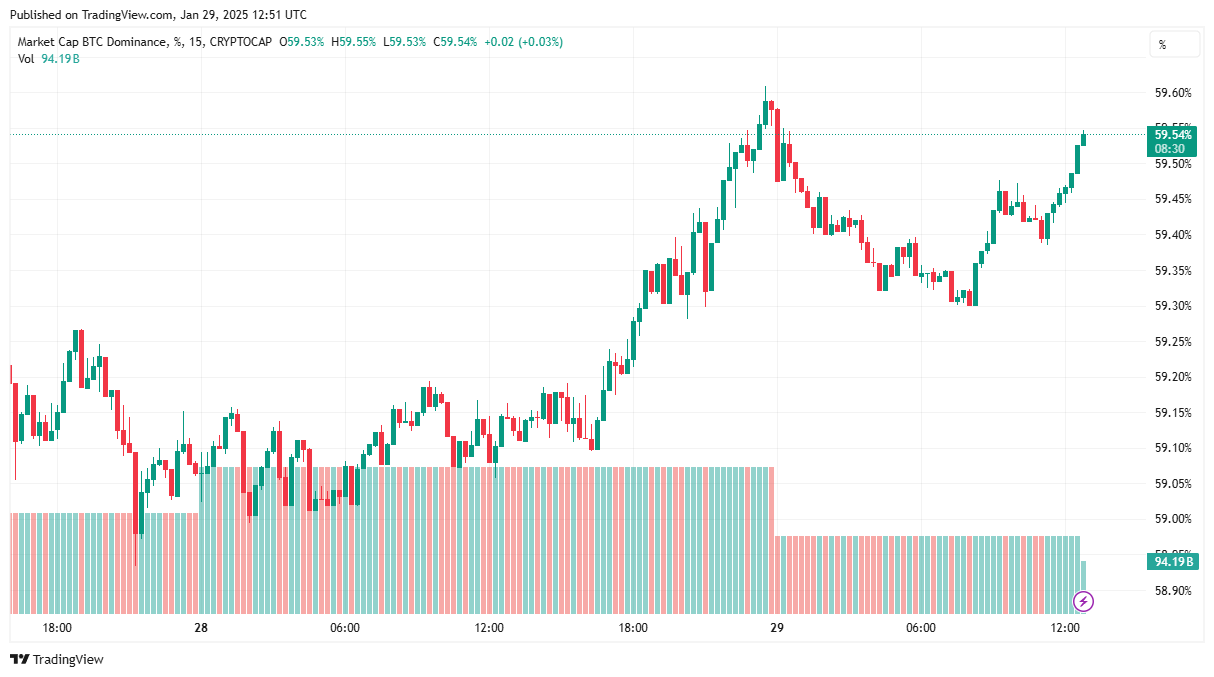
Analysts expect the bull cycle to persist in 2025, with Bitcoin reaching $150,000, even as the euphoria after breaching $100,000 has cooled and interest has shifted toward altcoins.
Rising interest in altcoins
In 2024, the altcoin market cap jumped 76% to top $1.5 trillion for the first time, despite headwinds — institutional money flowed mostly into Bitcoin while retail focused on meme coins. Large-cap tokens SOL, XRP, SUI and TON had the biggest impact on performance.
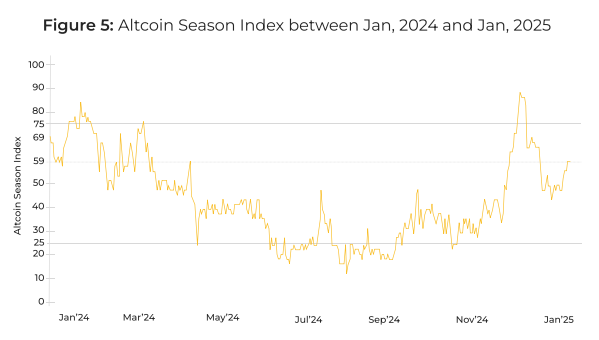
In December, the Blockchain Center’s Altcoin Season Index briefly entered altcoin territory before reverting to neutral.
Meme coins were the best-performing segment. The cumulative price increase of the 900 largest assets, adjusted for market cap, was about 1,600%. This does not include the many failed projects launched on platforms such as Pump.fun and Moonshot.
AI projects ranked second; RWA came third.

DeFi and smart-contract platforms underperformed Bitcoin. Despite ETF launches, ETH also lagged the leading cryptocurrency.
As Bitcoin’s dominance eases, a “long-awaited altcoin-centric phase” among traders could begin, the authors suggest. Historically, early in the year has been a favourable period for Ethereum, and a change of administration in the United States is likely to bring fresh money into crypto.
RWA: a bridge between TradFi and blockchain
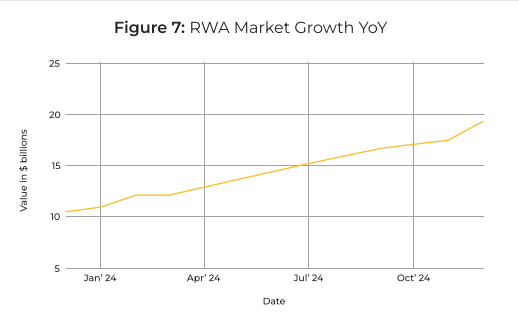
With the advance of blockchain technologies and rising institutional adoption in 2024, the RWA segment posted unprecedented growth.
The total value of tokenised assets rose 85% to more than $19 billion.
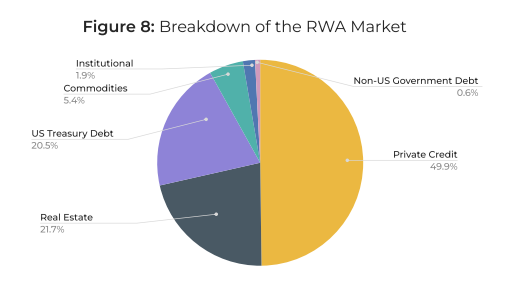
Private credit was the most popular category at 49.9%, followed by real estate at 21.7% and U.S. Treasury bonds at 20.5%.
Amid high yields, tokenised bonds grew 400% versus 2023. The ability to fractionalise bonds down to $10 attracted retail investors.
More than 90% of the market sits on Ethereum (57.2%) and ZKsync Era (26.4%). Stellar is third with 4.1%.
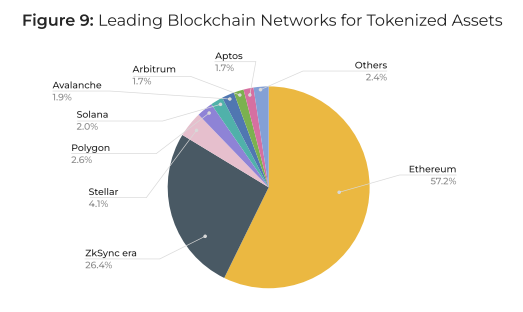
Analysts see the RWA segment reaching $50 billion or more in 2025. At the current pace, it could hit $1.3 trillion by 2030.
A boom in DePIN and AI agents
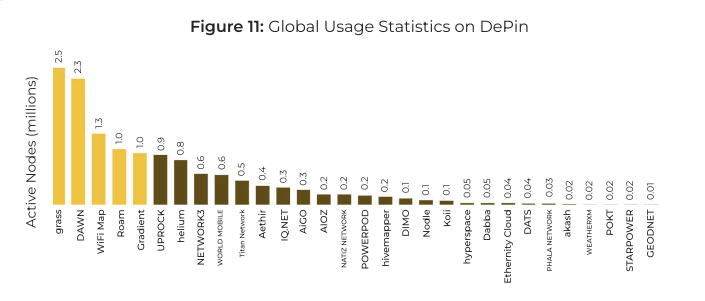
In 2024, revenues across DePIN projects grew 100-fold. The total number of nodes in the ecosystem surpassed 13 million.
Five projects supported more than 1 million active nodes, and over 20 others had 100,000 each.
The market capitalisation of AI-agent projects rose 224% in the fourth quarter alone — from $4.8 billion in October to $15.5 billion in December. About 56% of the market ($8.44 billion) sits on the Solana ecosystem.
The worst performer among the “new technology sectors” was DeSci. The niche is worth about $1.43 billion, half of which is concentrated in two projects — BIO Protocol and OriginTrail at $440 million and $320 million, respectively.
If clearer use cases emerge in 2025, these technologies could integrate more deeply into mainstream industries, the authors say. The greatest upside lies at the intersection of niches — for example, AI and DePIN.
Crypto-equity performance was mixed
Shares of crypto companies diverged widely in 2024.
Stock in Bitcoin accumulator MicroStrategy jumped 400%. Mining firm MARA raised more than $1 billion through a convertible-bond sale.
Most other Bitcoin miners, however, faced negative trends as costs rose and profits shrank.
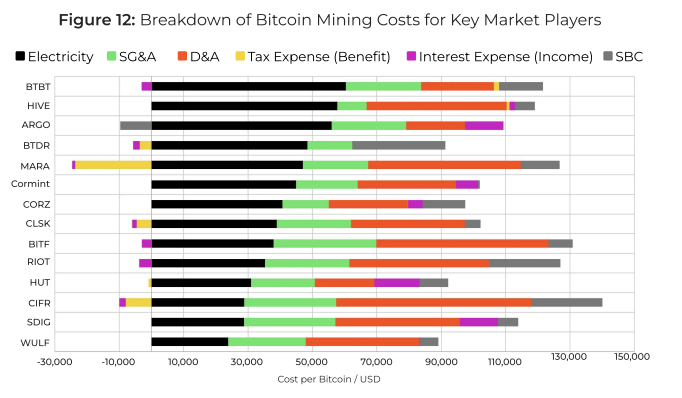
Cointelegraph concludes the market is in “cautious optimism” mode. Future performance hinges on improved energy efficiency and hardware productivity.
Regulation in the EU and the US
Analysts argue that the rollout of MiCA in the EU benefits larger firms with existing compliance departments; for smaller businesses, such costs are too high.
With a change of leadership at the SEC and a friendlier stance from U.S. authorities, the environment is, by contrast, becoming more favourable for crypto projects. Several cases against industry participants have already been closed. In addition, if passed, the FIT21 law would limit the Commission’s powers in the market.
DeFi recovers
For DeFi, 2024 marked a recovery. TVL rose 118% to $185 billion, while trading volumes on decentralised exchanges climbed 165%.
Liquid-staking projects were among the main drivers. Over the year, locked assets doubled from $30 billion to $60 billion. The category leads DeFi with 33.4% of total TVL.
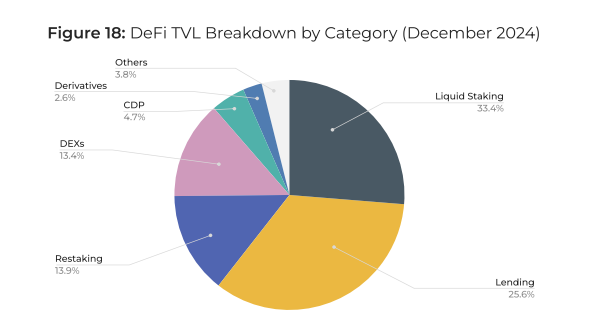
Lending ranked second at 25.6%, with restaking third at 13.9%.
Volumes on decentralised exchanges also climbed sharply. In December 2024, monthly turnover topped $350 billion — up 165% year on year.
Analysts linked the increase to the broader crypto-market upswing and lower blockchain transaction costs.
Forecasts call for DeFi TVL to exceed $200 billion in 2025. DEX trading volumes will reach $4 billion with a market share of around 20%.
In January, Bernstein analysts pointed to a renewed interest in cryptocurrencies among traditional investors.
Рассылки ForkLog: держите руку на пульсе биткоин-индустрии!