



The week: crypto summit, a US digital-asset reserve and the Garantex freeze
The White House hosted its first crypto summit, President Donald Trump signed an order to create a national digital-asset reserve, Tether froze wallets belonging to the Garantex exchange, and other events of the week.
Did Washington’s rhetoric disappoint investors?
Bitcoin began the week at $94,000—the result of a price spike following Mr Trump’s remarks about creating a crypto reserve that would include SOL, XRP and ADA alongside BTC and ETH.
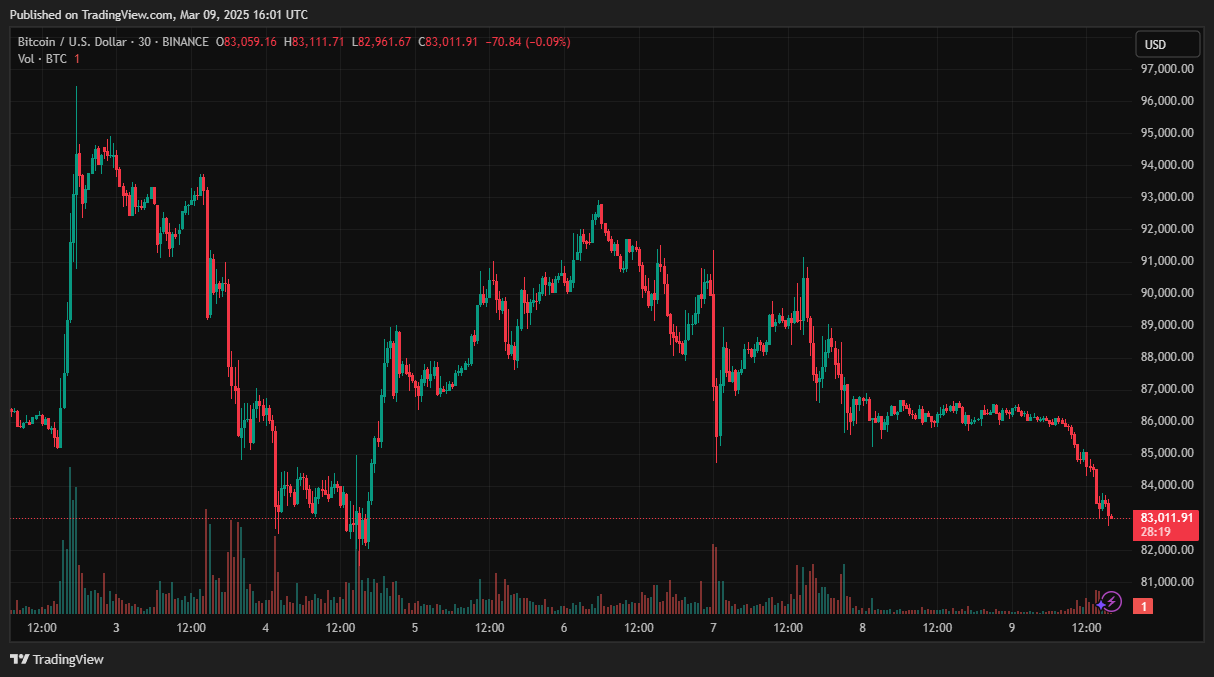
On the evening of March 3 the market was hit further by reports that the White House would introduce new trade tariffs. Selling intensified across risk assets; the S&P 500 closed down 1.8%.
By the morning of March 4 the price of the digital gold had slipped below $84,000, but after the summit was announced and more details on the bitcoin reserve were promised, it climbed back above $90,000.
On March 6, after the US president signed the order establishing the reserve, the price fell from $91,000 to $85,000 before recovering to $90,000.
On Friday, March 7, after the summit, the leading cryptocurrency resumed its decline, likely reflecting investor disappointment with elements of the government’s strategy for the digital-asset reserve.
At the time of writing, bitcoin trades at $83,000 with a market capitalization of $1.65 trillion.
Ether moved largely in step with bitcoin. At the start of the week it was $2,500; at one point the price dipped to $2,000.
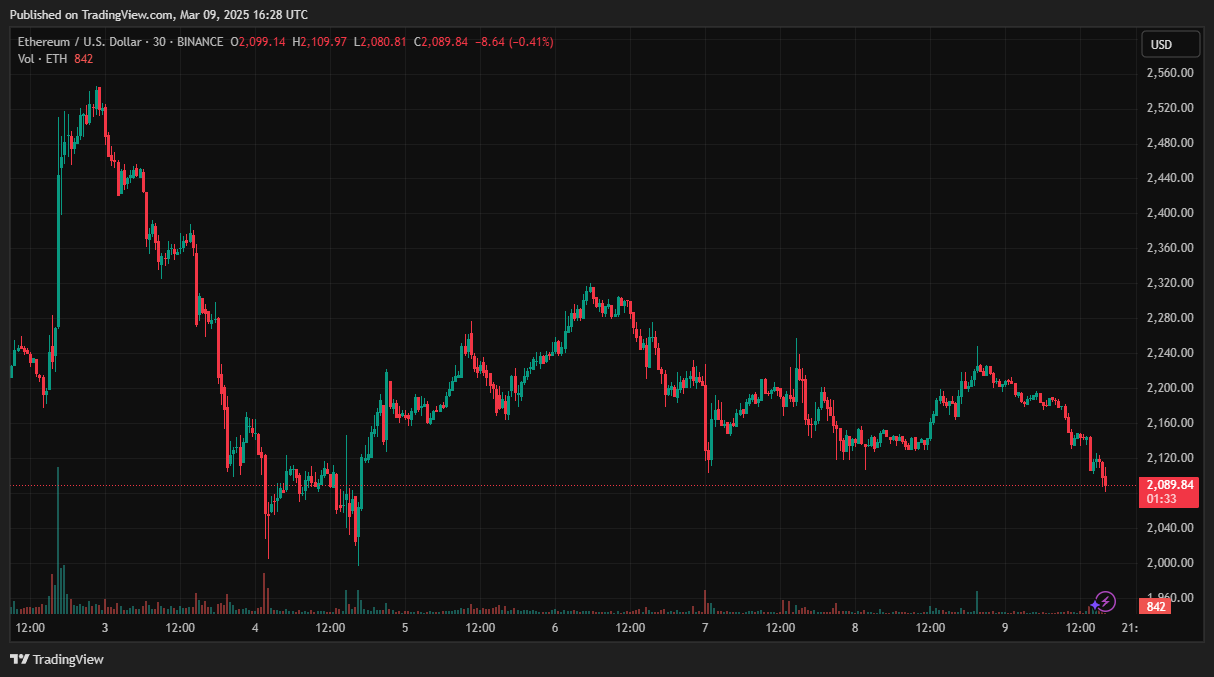
At the time of writing, Ether changes hands at $2,090 with a market capitalization of $252.36 billion.
According to CryptoQuant, the unrealized profit ratio among Ether whales fell to levels not seen since the last bear market.
Analysts noted the “challenging period” continues for holders of the second-largest crypto amid a further decline in the ETH/BTC ratio and significant uncertainty.
Social-media sentiment toward the second-largest coin fell to a one-year low. Santiment’s experts say this can signal a reversal as the market stabilizes.
? Ethereum sentiment has declined to year-low levels as the asset has underperformed relative to other top caps. For those patiently holding their $ETH, the bearishness being projected across social media is a good sign of a potential turnaround once crypto markets stabilize. pic.twitter.com/iRaKTvb0Tu
— Santiment (@santimentfeed) March 6, 2025
Over the past week, every top‑10 asset by market cap fell except TRX, which rose 0.6%.
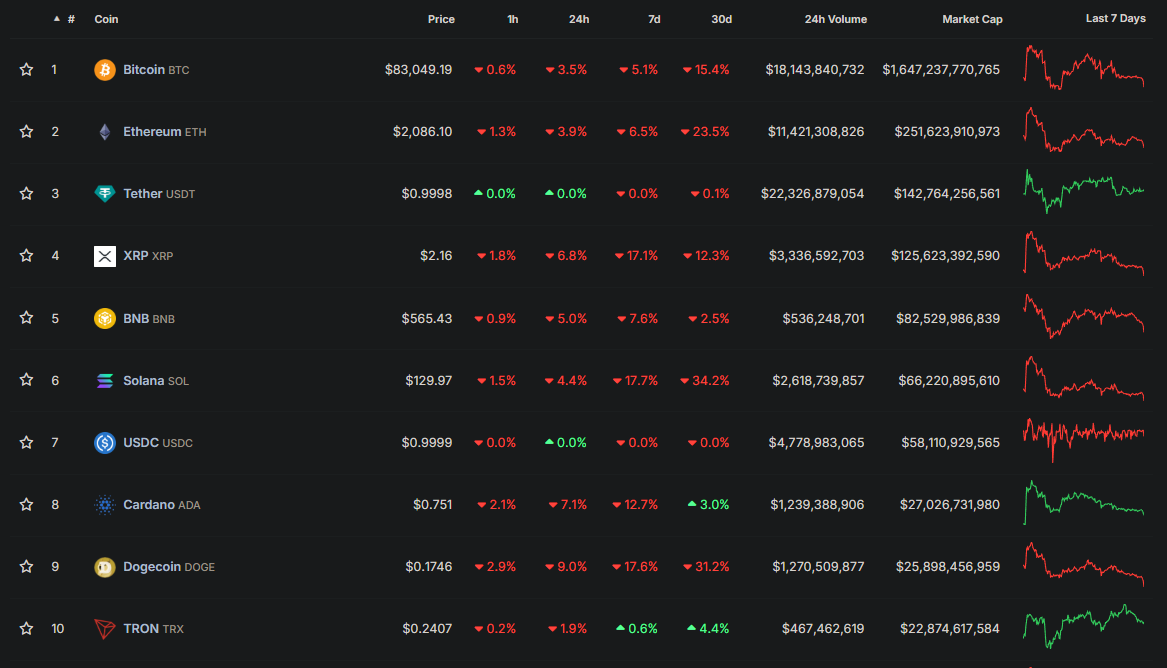
The steepest drawdowns were in SOL (-17.7%), DOGE (-17.6%) and XRP (-17.1%). ADA—another candidate for inclusion in the US reserve—fell 12.7%.
An “end to the war on crypto” in the US
On March 7 the White House hosted the first crypto summit, focused on a shift in the US government’s approach to digital assets.
Attendees included Donald Trump’s special adviser on AI and crypto, David Sacks; Hester Peirce, head of the SEC crypto task force; Commerce Secretary Howard Lutnick; Treasury Secretary Scott Bessent; and other members of the US government.
The industry was represented, among others, by Strategy founder Michael Saylor, Coinbase head Brian Armstrong, Ripple CEO Brad Garlinghouse and the Winklevoss brothers, founders of the Gemini exchange.
In his speech Mr Trump said the previous administration’s “war” on digital assets is over, and stressed his intention to make the US the “crypto capital of the world”.
The president pledged to end Operation Chokepoint 2.0—an initiative to limit crypto firms’ access to traditional banking.
“Regulators forced banks to close the accounts of crypto businesses and entrepreneurs, effectively blocking certain money transfers. […] All this will end soon; we are winding down Operation Chokepoint 2.0,” Trump said.
After the summit the OCC rescinded the relevant guidance and said it does not intend to oppose banks working with companies in the digital-asset industry.
Ok some pro-crypto guidance now rolling out post-WH Summit:@USOCC rescinds previous guidance that prevented banks from engaging in any crypto activity.
Goodbye, Operation Chokepoint 2.0https://t.co/trIJeUo2Aa
— Alexander Grieve (@AlexanderGrieve) March 7, 2025
By August 2025 Mr Trump plans to sign legislation for dollar stablecoins.
“[Lawmakers] are working very hard on it. It is a colossal opportunity for economic growth and innovation in our financial sector, and it really will make a big difference,” he said.
America’s crypto reserve becomes reality
On March 6, a day before the White House summit, Mr Trump signed an order establishing a national crypto reserve.
The directive provides for storing assets seized by the Treasury in criminal and civil cases. Selling cryptocurrency from the new fund is prohibited—it will be used as a long-term store of national assets.
The order also creates a separate vault for altcoins. These assets must come only from seizures and not be purchased. They may be sold on the market only in exceptional cases, if the Treasury deems it necessary.
Government agencies were required to provide a full report on their crypto holdings for subsequent data consolidation. This should prevent chaotic management of seized digital funds, and improve transparency and efficiency in the state’s interest.
The inclusion of altcoins in the national reserve raised questions in the community.
On March 2 Mr Trump said he had instructed the digital-asset markets task force to “green‑light” the creation of a strategic crypto reserve that would include XRP, SOL and ADA. He later added that “obviously BTC and ETH, as well as other valuable cryptocurrencies” are also on the list.
Casa CEO Nick Neuman argues the digital gold is the only crypto asset that makes “any logical sense” as part of reserves.
“Digital assets with unlimited supply, especially those that have no utility, do not meet the requirements,” he said.
Riot Platforms vice-president of research Pierre Rochard struck a similar tone. He believes altcoins “will inevitably demonetize and depreciate relative to bitcoin”, from which the reserve will “naturally” be composed.
Bitwise head of alpha strategies Jeff Park called it “a huge political miscalculation” for Mr Trump to underestimate bitcoin’s uniqueness. He noted that including altcoins risks arousing suspicions of insider dealing.
Mint Ventures partner Alex Xu drew attention to the significant sponsorship support that companies behind XRP, SOL and ADA provided to Mr Trump before and after the election. He suggested this may explain their inclusion in the national crypto fund.
“But this absurd approach will only weaken the seriousness of the strategic bitcoin reserve and further reduce the likelihood of the relevant bill being passed at the federal level,” Xu believes.
After Mr Trump’s statements about the reserve, noted bitcoin critic Peter Schiff urged Congress to investigate the president’s actions in the crypto sphere.
He called it “the biggest crypto scam in history,” and demanded to find out how much money pre‑informed persons put into XRP, ADA, SOL, BTC and ETH, and what profits they made from subsequent sales.
Despite debates over potential conflicts of interest, experts see the reserve as a positive for the industry.
Bitwise CIO Matt Hougan believes the United States strategic reserve of digital assets (SBR) reduces the likelihood of a government ban on bitcoin.
He said the initiative will make the cryptocurrency more legitimate in the eyes of investors and regulators. The reserve will force other countries to consider buying the digital gold so they can accumulate it before the US begins large-scale purchases, Mr Hougan added.
Coinbase CEO Brian Armstrong is confident that many G20 countries will follow the US example. He believes this will give new impetus to the legalization of the digital gold.
Bitwise head of research Ryan Rasmussen noted that creating the reserve eliminates the risk of mass bitcoin sales by the US government. This will spur institutional investors, pension funds and large organizations to use the cryptocurrency, he said.
Coinbase director of product Conor Grogan said the SBR’s size could reduce market pressure by $18 billion if the state decides to hold the assets.
According to Arkham, at the time of writing the US government holds crypto assets worth about $16.9 billion.
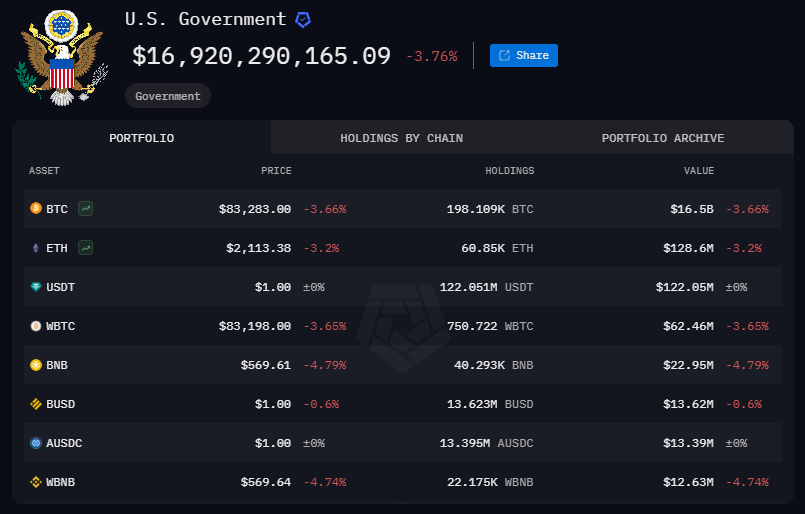
Galaxy Digital head of research Alex Thorn clarified that only 88,000 BTC can be used as reserves. Around 112,000 BTC from the stash must be returned to the Bitfinex exchange. He drew attention to the difference between “seized” and “forfeited” assets.
What to discuss with friends?
- Ronaldinho launched the STAR10 token. Smart-contract researchers warned of risks.
- In the US, more than 1,200 bitcoin ATMs were shut down in three days.
- An OnlyFans model became the victim of an armed attack over cryptocurrency.
- Mt.Gox transferred more than $1 billion in bitcoin to an unknown address.
The Garantex freeze is a “signal for regulation”
On March 6 Tether blocked wallets of the Russian exchange Garantex worth more than 2.5 billion roubles. The platform suspended operations.
On March 7 the US Department of Justice confirmed the seizure of Garantex domains and the freezing of $26 million in the exchange’s wallets.
According to the press release, the trading platform facilitated money laundering by transnational criminal organizations, including terrorist ones, and violated international sanctions. Since 2019 turnover in digital assets on the exchange amounted to at least $96 billion.
The DOJ also reported the confiscation of the domains Garantex.org, Garantex.io and Garantex.academy, as they are connected to administration of the platform. Law enforcement in Germany and Finland seized servers that hosted the exchange’s operations.
“Authorities separately obtained earlier copies of Garantex servers, including customer and accounting databases. In addition, US law enforcement froze more than $26 million in funds that were used to facilitate money-laundering activity,” the document says.
The US Secret Service and the FBI are conducting the follow-up investigation.
Shard head of analytics Fedor Ivanov told ForkLog the decision has multilayered causes tied to both international sanctions and anti-money-laundering efforts.
The expert noted that American regulators accused Garantex of laundering funds from the Hydra dark‑net marketplace and hacker groups back in April 2022. The US Treasury then added the platform to its sanctions list. In February 2025 the exchange fell under European Union sanctions.
Losses at Garantex, estimated at more than 2 billion roubles, could affect both the company’s finances and user trust. In Ivanov’s view, this should be a signal to Russia’s authorities of the urgent need to formalize and regulate the crypto sphere.
For users, the incident means heightened risks tied to using assets that passed through problematic venues. The expert reminds that even if Garantex resumes operations, cryptocurrency associated with the exchange will remain “high risk”.
Although this is most relevant for coins like USDT and USDC, similar risks also apply to bitcoin, Ivanov says.
On March 8 the Garantex team invited users to its Moscow office to resolve issues. Clients were asked to submit an application via a Telegram bot.
Argentina’s prosecutor takes on Libra
Argentina’s chief prosecutor Eduardo Taiano demanded that assets linked to LIBRA worth about $100 million be frozen and that deleted messages be restored, including a post by the country’s president, Javier Milei, promoting the memecoin.
Taiano also demanded detailed information on the project’s transactions.
To implement these measures, the prosecutor requested assistance from international crypto platforms, law-enforcement bodies and regulators.
On February 14 the token promoted by Mr Milei reached a market capitalization of $4.56 billion, then the price plunged 94% within hours. LIBRA’s rally began shortly after Argentina’s president posted on X, linking to the coin’s website and contract address.
Mr Milei later deleted the message and said he never urged people to buy LIBRA. Even so, his actions sparked a scandal. The president was accused of fraud, participating in a pump‑and‑dump scheme, and threatened with impeachment.
Lookonchain reported that some users locked in large losses twice from investing in the “Argentine” memecoin. According to Nansen, the cumulative losses of nearly 86% of LIBRA traders amounted to $251 million.
Hayden Davis, the CEO of Kelsier Ventures behind the token’s launch, withdrew $100 million. He later said he paid the Argentine president’s sister so that her brother would promote the memecoin.
According to media reports, Mr Davis maintained contacts with Mr Milei’s entourage to devise a strategy to neutralize the scandal. The communication continued even after an interview with the head of state in which he denied any role in the project.
On February 17 Bubblemaps linked LIBRA and US First Lady Melania Trump’s coin (MELANIA) to the same team.
Also on ForkLog:
- A vulnerability in a legacy 1inch smart contract led to $5 million lost. The hacker returned the assets.
- The EU regulator said that MiCA does not prohibit working with USDT.
- THORChain swap volume surpassed $4.6 billion after the Bybit hack.
- Bybit’s CEO: 20% of the stolen assets ‘went into the shadows’.
What else to read?
In a new piece with Web3 researcher Vladimir Menaskop, we explained what consensus is not only at a technical but also a social level—and why it is far broader than democracy and various forms of voting.
We explored how global liquidity affects cryptocurrencies.
In our regular digest we compiled the week’s key developments in cybersecurity.
Рассылки ForkLog: держите руку на пульсе биткоин-индустрии!