


Coin Metrics: Arrest of two of BitMEX’s three founders could have led to withdrawal problems
Coin Metrics researchers in a new report disclosed the specifics of how Bitcoin is stored on BitMEX. Thanks to this arrangement, the crypto-derivatives exchange continued to meet its obligations to clients after a lawsuit by U.S. regulators.
Impressive forensics work by @coinmetrics, who used time zone data to make an educated guess about which multsig key each of the @BitMEX founders used for daily exchange withdrawals.
A — Samuel Reed
B — Ben Delo
C — Arthur HayesRead the analysis here: https://t.co/xxlWfdCjvB pic.twitter.com/brW2YX8S8I
— Spencer Noon (@spencernoon) October 13, 2020
On October 1, the U.S. Commodity Futures Trading Commission (CFTC) and the U.S. Department of Justice accused the exchange’s CEO Arthur Hayes and its co-founders Ben Delo and Samuel Reed of deliberate evasion of anti-money-laundering measures and violations of the Bank Secrecy Act. Reed was arrested on that same day; on October 9 he was released on bail.
In the week following these events, the number of bitcoins on BitMEX wallets fell by 38.4%. In the first hours from the exchange, 37,000 BTC were withdrawn from the exchange. Throughout this period the platform duly met its obligations.
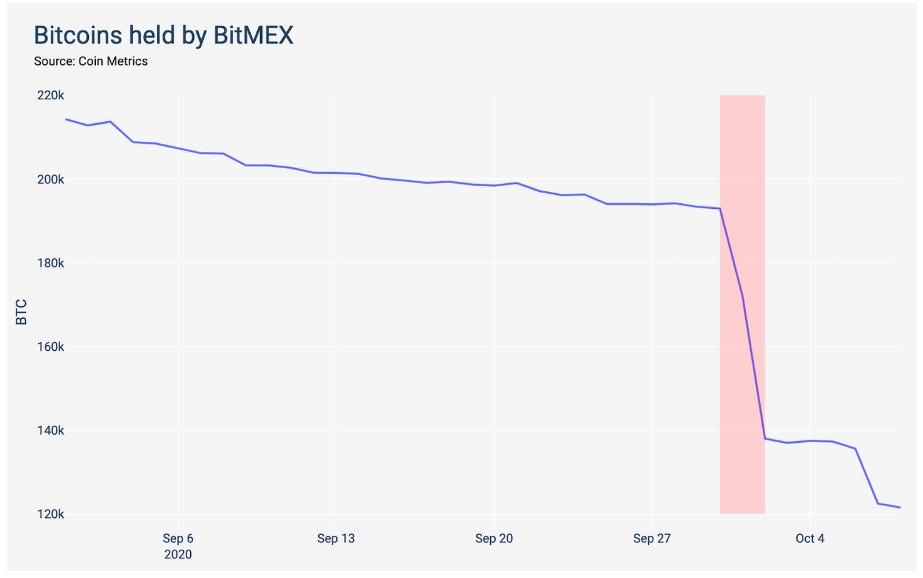
Dynamics of the number of bitcoins on BitMEX wallets. Source: Coin Metrics.
BitMEX stands out among other cryptocurrency exchanges for how it stores Bitcoin. Instead of a system of cold and hot wallets, it uses only cold storage. Withdrawals are made once a day, usually around 16:00 MSK. Approval of withdrawals requires signatures from two of the three founders.
On October 1, BitMEX abandoned its usual practice and carried out six withdrawals over two days, signaling that traders’ funds were safe.
Technically, each BitMEX address corresponds to a multisignature wallet that requires three of four keys. One key belongs to each of the founders. The fourth key is minted to ensure BitMEX addresses begin with a special prefix (3BMEX or 3BiTMEX).
The fourth independent key is always used to sign transactions. Analysts indicate that for this reason only two of the three founders’ keys are required. The fourth key would not be needed at all if all three co-founders signed a transaction. But, according to the researchers, they did not observe such cases during the entire period under review.
Determining which founder owns which key is, according to analysts, not an easy task. By collecting information about recent withdrawals from BitMEX and aligning the keys’ usage over time, Coin Metrics arrived at certain conclusions.
Based on the activity map shown below, indicating which key is signed for which withdrawal party, they conclude that key “A” belongs to Reid. In the image, the transactions conducted at unusual times are highlighted in red. All of them fall on October 1 or 2, when the BitMEX CTO was in custody.
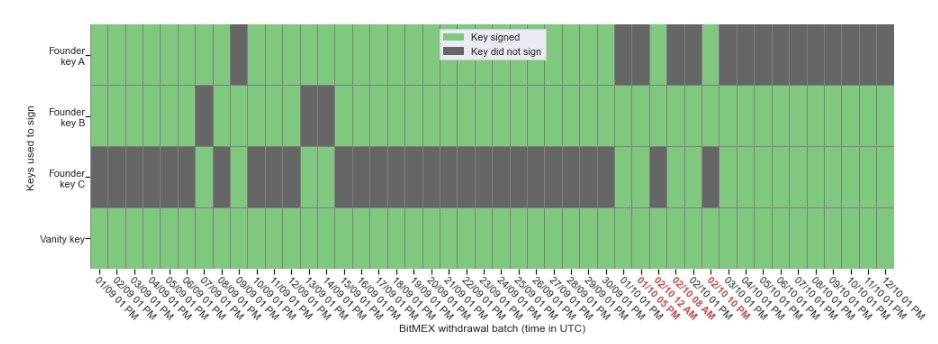
Subsequently, this “A” key was used to sign transactions twice more, when Reid was already free. Analysts also concluded that keys “B” and “C” belong to Ben Delo and Arthur Hayes respectively.
“The fact that all three keys were used to sign transactions after the lawsuits against BitMEX were filed should reassure the platform’s clients. If Reid had not been released on bail, and Hayes or Delo had been arrested, withdrawing cryptocurrency from the platform would probably have been impossible,” the analysts say.
Under the terms of his release, Reid is barred from contacting other defendants without a lawyer present. But as Coin Metrics’ analysis shows, after the CTO’s release on October 1, all founders’ keys were used to sign transactions.
Technically, Bitcoin multisignature is a non-interactive protocol. Signing transactions on BitMEX likely requires some interaction among the founders.
Experts wonder whether these keys have fallen into new hands. The three founders left leadership roles at 100x Group, the parent company of BitMEX, which increases the chances that this has already happened or will happen.
Coin Metrics researchers concluded that BitMEX’s method of storing Bitcoin shielded its customers from the problems that Mt. Gox or QuadrigaCX faced after the arrest or death of its operators.
Follow ForkLog news on Facebook!
Рассылки ForkLog: держите руку на пульсе биткоин-индустрии!