


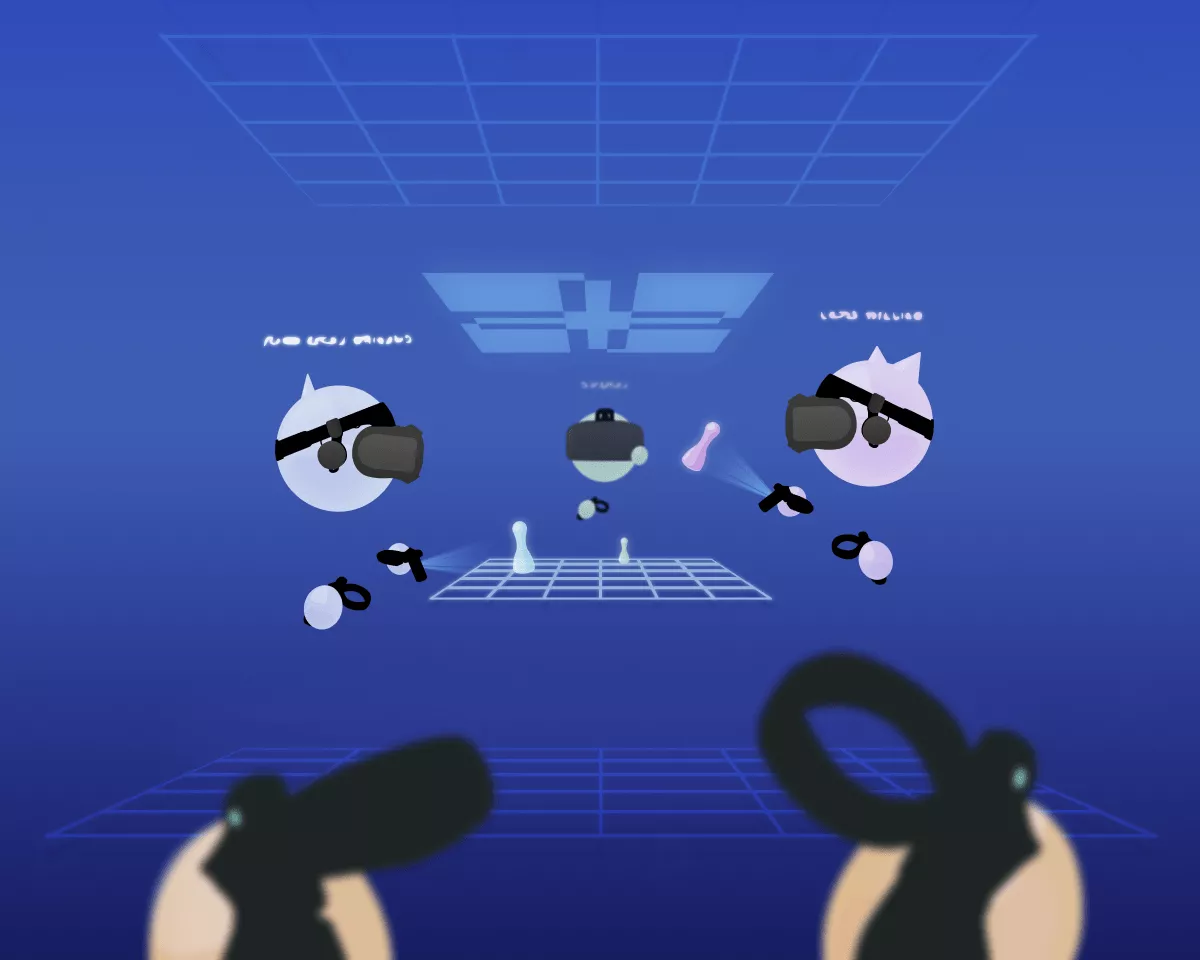
Escaping Reality: The Long Journey from Multiplayer to the Metaverse
Metaverses, virtual worlds that unite billions of people, from the prophecies of science-fiction writers and futurists have today become concrete goals laid out in the roadmaps of IT companies and startups.
ForkLog has examined the history of virtual worlds and the role of cryptocurrencies in this industry of the future.
A Prelude to Virtuality
The fashionable term “metaverse” (English: Metaverse) was first mentioned in Neal Stephenson’s 1992 science-fiction novel Snow Crash. Under this term one understood a single virtual space that mimicked and supplanted the real world, where users interact with digital objects and other users.
Writers and dreamers for centuries invented fantastical worlds with their inhabitants and laws, yet had few ways to share them with others. But as soon as the first computers appeared, it became clear that this was the tool that would help not only create new worlds but invite others into them, using this new medium for creativity, communication, earnings and any other activities.
Imagine: the early 1960s, the term “personal computer” was still found only in science-fiction magazines, while leading minds had already calculated all possible economic and social consequences of the development of computing technologies!
Renowned Polish futurist and writer Stanisław Lem already in the early 60s predicted the appearance of virtual worlds and analyzed the problems of existence of a virtual civilization in the monograph “Summa Technologiae” and in the cycle of stories “Memoirs of Ijon Tikhy”. In the same years another renowned writer Arthur C. Clarke in the book “Profiles of the Future” (1962) foresaw the development of computer technologies and later made a prediction about the creation of full virtual reality by 2025.
These futurists’ ideas were widely disseminated in numerous science-fiction stories, novels, films and series, and those who now head the world’s largest IT companies grew up on them. So one could say that this is one of those prophecies that people believed in so wholeheartedly that it could not fail to come true.
In public consciousness and global culture, the concept of virtual worlds took firm root with Hollywood blockbusters on the topic. In the film “Tron” (1982) virtual reality was shown for the first time, where a person can interact with computer programs. The next famous film on this topic was “The Matrix” (1999), in which billions of people lived in a virtual world indistinguishable from reality (albeit not by their own choice). Since then this topic has been explored from various angles in hundreds of films, series and books.
As is often the case, human imagination outpaced technical progress. Only by the early 2000s did computer capabilities allow creating those virtual worlds that humanity began dreaming of two generations earlier.
Step by Step into Virtuality
The first tentative attempts to approach the creation of virtual worlds began in the 1970s, with the advent of early personal computers and long before the Internet became commonplace.
The multiplayer 3D shooter Maze War, which appeared in 1973 and operated on the computer network ARPANET, can be called the first virtual world where several players could interact with one another (more precisely, kill each other).
In the 1990s, as computing power of personal computers and internet speeds grew, a whole lineup of massively multiplayer online games appeared where hundreds and thousands of players fought bots, communicating with one another for trade and the formation of alliances and guilds. The primitive graphics of early hits such as The Realm Online (1996) or Ultima Online (1997) were offset by the rich imagination of players raised on tabletop role-playing games. EverQuest (1999) became the first commercial game with a 3D engine that allowed gathering on one server of more than 3,000 players, which is the population of a small town.
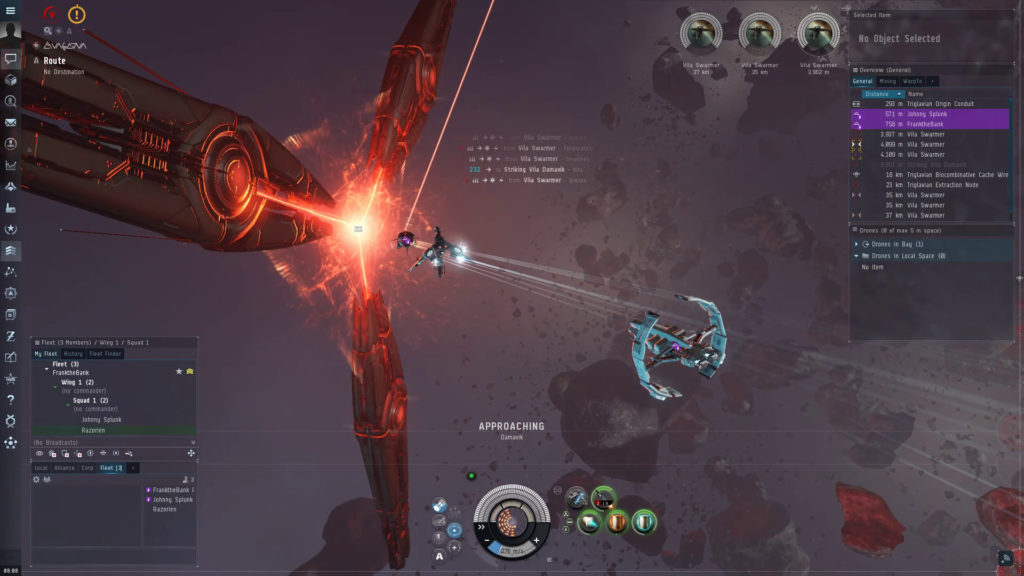
Perhaps the most massively online game, grown into a true virtual galaxy, was EVE Online (2003), which to this day continues to develop and update. Users become captains of spacecraft, exploring star systems, gathering resources, researching technologies, organizing into alliances and factions, fighting, forming alliances and trading. The Eve Online galaxy counts more than 7,000 star systems with more than 60,000 planets. The game’s audience remains above 330,000 active users. At the same time, up to 50,000 players can be online simultaneously, many of whom spend a large part of their free time in this world, literally living in it.
The first online game where the emphasis shifted from violence to social interactions was The Sims Online (2002), the multiplayer version of the famous “life simulator.” In it you could socialize, build a personal life and career, create businesses, earn virtual money, build houses and buy land. The Sims virtual universe included 17 towns across an area of 360 sq km and could simultaneously accommodate hundreds of thousands of users, providing them with maximum freedom of action and self-expression.
From a commercial and technical perspective, the project was a flop. The number of users paying for subscriptions barely exceeded 100,000. Yet in this virtual world for the first time a realistic model of modern society formed, with fierce competition, virtual criminal groups and even virtual prostitution.
In every sense, a more successful massively multiplayer life simulator was the project Second Life, launched in 2003 by Linden Lab. Like The Sims, there were no storylines and no mandatory missions, and users were given near-total freedom of action. The economy of the game world was built on Linden Dollars, which initially exchanged at 1:1 with the US dollar. At the height of the game’s popularity, which arose in the early 2010s, Linden Dollars were the most widely used electronic currency in the world, with annual turnover in the hundreds of millions of dollars.
With Linden Dollars you could buy virtual items, real estate, furniture, virtual land, participate in gambling. In addition, there was a mechanism for converting back into fiat currencies. This gave rise to thousands of businesses in Second Life: workshops creating virtual items, shops, art galleries, banks, gambling houses and casinos. By 2006 the first millionaires had appeared in the game. Users earned and withdrew five- to six-figure sums from Second Life.
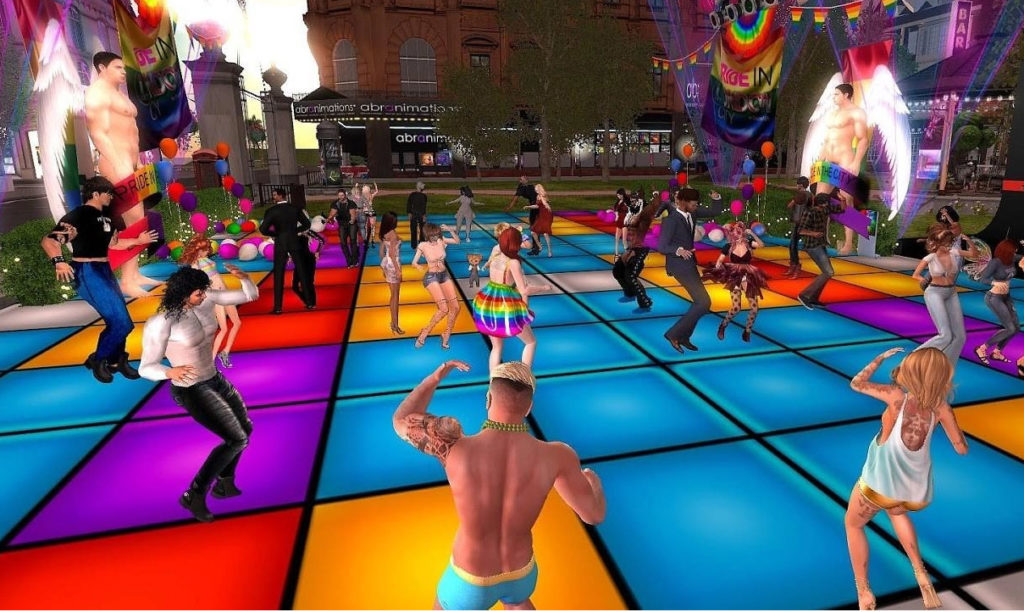
Over nearly 18 years of development, the total number of registered users who have ever logged in exceeded 60 million. Second Life remains one of the most popular virtual worlds with an active economy and up to 40,000 users online at once.
At the height of its popularity, forecasts suggested the platform would become the basis for a “new Internet.” Yet high system requirements and the complexity of managing a character significantly limited its audience.
Nevertheless, Second Life paved the way for many virtual worlds of the next generation, and its successes and problems allowed it to accumulate valuable experience in managing such large IT projects. It became clear that building future metaverses would require a massive amount of work from programmers, game designers, artists, and even economists capable of creating a sustainable virtual economy that would give users enjoyment from gameplay while providing developers and publishers with stable profits.
Parallel to this in American academia, virtual worlds were developed for entirely different purposes. A graduate of the University of Michigan, Bhargav Sri Prakash, founded Vmerse in 2005 and developed the first-ever platform for modeling virtual reality intended for prospective and current college students. It did not include a multiplayer mode or social interactions; essentially it was a detailed interactive three-dimensional copy of the University of Michigan campus. Later in Vmerse there appeared virtual copies of Stanford and Columbia campuses.
Blockchain for Metaverses
So, by the time Bitcoin appeared and blockchain technologies began to develop, commercially successful virtual worlds with millions of users already existed. What is the role of blockchain in this industry?
The well-known problem of massively multiplayer online games and virtual worlds is that users are forced to endure all risks of high centralization: from unexpected bans of game accounts to database failures and physical damage of servers.
As the experience of Second Life and EVE Online shows, players are ready to invest millions of dollars into virtual worlds, thereby supporting the stability of the virtual economy, but at the same time they would like guarantees that their investments will not be wiped out due to admin arbitrariness, a software glitch or force majeure.
These fears are not unfounded. In 2005 a bug during another Sims Online update led to the devaluation of the internal currency, a drop in the value of virtual items and real estate, and thereby destroyed the game economy, triggering a mass exodus of disappointed players. And in the spring of 2021 a fire at the OVH data center in Strasbourg destroyed 25 game servers of the popular massively multiplayer online game Rust. At the same time, a large amount of user data, with all their achievements, was lost.
The solution to the problem of reliability of data storage and digital capital was the transfer of internal game currencies to the blockchain and the implementation of NFT, where each game item has a non-fungible token issued on a decentralized network.
From anonymized savings data and virtual real estate, these become digital assets that in many countries are already recognised as property under law. In addition, storage, use and trading of game items in NFT form receive legal protection.
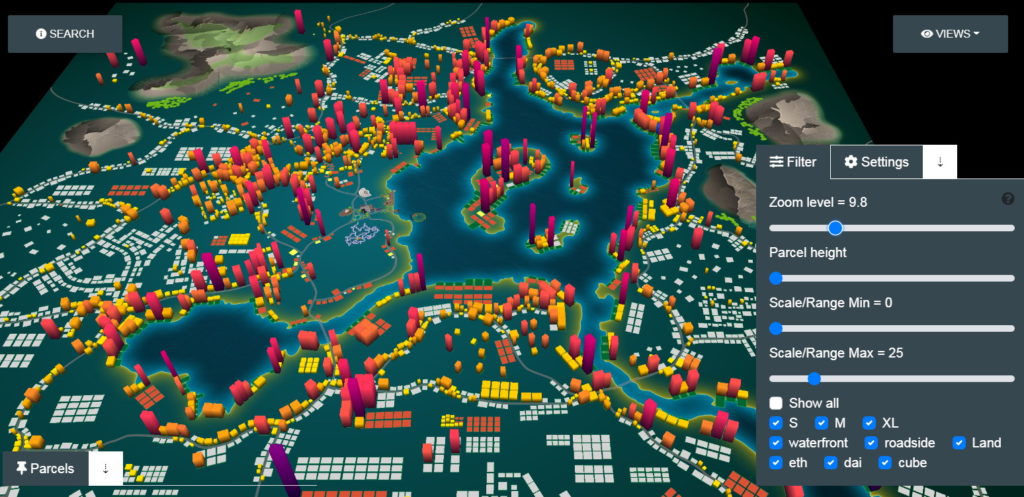
In the crypto industry one can highlight several projects that created virtual worlds with an economy based on blockchain technologies. The most famous of them is Decentraland, whose development started in 2015. The most valuable asset in this metaverse is land parcels represented by non-fungible tokens LAND of the ERC-721 standard. They can be leased, built upon with buildings, shops, casinos, used for advertising. Also in the virtual world Decentraland there is its own currency MANA, which is a token in the Ethereum network, allowing easy withdrawal and exchange for fiat currencies.
The combination of two hot trends — virtual reality and blockchain technologies — in a single project attracted not only crypto enthusiasts but also serious business. Virtual representations in the metaverse Decentraland were opened by such well-known companies as Atari, Sotheby`s, Coca-Cola and others. This spurred the growth of virtual real estate, so the cheapest parcels now cost around $4,000–$5,000. And the most expensive purchase in the project’s history was a block of 259 virtual parcels bought by the investment firm Republic Realm for $913,000.
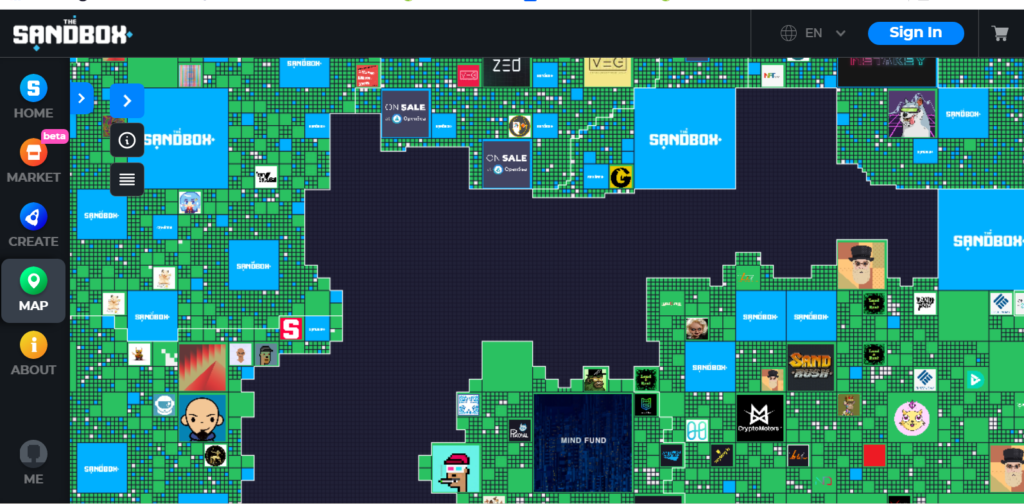
A competitor to Decentraland is the project The Sandbox – a sandbox game that can be described as a blockchain Ethereum-based multiplayer analogue of Minecraft. The emphasis here is on user creativity: the VoxelEdit editor makes it easy to create three-dimensional voxel NFT objects and sell them on the built-in marketplace for the local currency SAND. This has fostered a whole community of 3D artists around The Sandbox who began receiving rewards for their artwork in NFT form. Another important Sandbox tool is the Game Maker editor, enabling users to create fairly sophisticated mini-games and monetise them.
As in Decentraland, the most valuable asset in The Sandbox is land where a variety of commercial activities can be conducted. Its sales fund the game’s development. For example, in an April 2021 auction the team raised more than $2.6 million for 854 parcels and 13 holdings. And the most expensive parcel sold on this platform cost the buyer more than $650,000.
Not as well known, but also actively developed blockchain project Somnium Space with VR headset support offers a three-dimensional world where users can buy land parcels (parcels), create marketplaces, games, cinemas, galleries and develop a shared virtual universe. Objects created in the Builder editor as NFTs can be sold on the Somnium Store marketplace for cryptocurrency CUBE.
“Our ultimate goal is to bring to life humanity’s long-held dream of fully immersing itself in a vast world that is constantly changing and will never be the same, regardless of when you decide to join,” says the project’s founder Artur Sychyov.
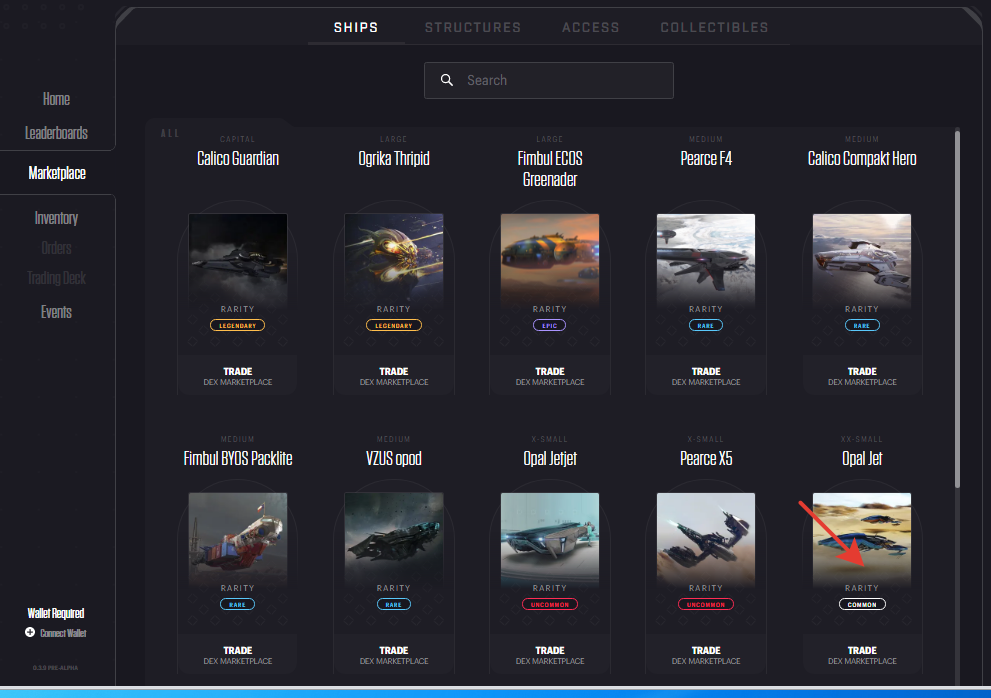
We must not overlook the project that is still in development but has already stirred up a lot of noise in the crypto industry. The multiplayer game Star Atlas, according to its developers, is intended to become the Eve Online analogue on the blockchain: with space battles, battles for planets, politics, trade and resource and technology extraction. All this is planned to be implemented on the Solana blockchain, which differs from Ethereum by orders of magnitude faster and cheaper transactions.
In NFT form, space ships, crew members, orbital stations, mining equipment, parcels on planets and much more will be issued. Also on Solana the in-game currency ATLAS and governance token POLIS.
The blockchain industry is on the cutting edge of progress, offering creators of virtual worlds fast and cheap microtransactions, automation of the digital economy via smart contracts, and digital rights to virtual property with NFT technology. Nevertheless, blockchain technologies are not a magic wand that can instantly cure all the teething troubles of massively multiplayer online games.
Metaverses as the New Internet
In recent decades virtual spaces have developed primarily in the gaming industry, where any innovations are eagerly accepted and paid for by a large army of gamers. But since the era of the futurists Stanisław Lem and Arthur C. Clarke public consciousness has preserved the idea that virtuality can become something far more than simply a pastime.
With the rise of remote work (including during the COVID-19 pandemic), virtual spaces have been viewed as a convenient environment for business meetings or for collaborative work on design and engineering tasks. If all design—from buildings and machines to kettles and toothbrushes—is now conducted in digital form, why not add the possibility to communicate during collaborative work?
That idea underpins the startup Spatial. It developed an application for remote collaborative work in a virtual environment using VR headsets such as the Oculus Quest and other popular models including nReal, Magic Leap and HoloLens, as well as through web browsers on PCs and smartphones. The app is integrated with Google Docs, Figma and Slack and can track hand movements without special controllers. This makes it convenient to manipulate 3D models in Spatial — and corporate clients such as Mettel and Pfizer are already using it.
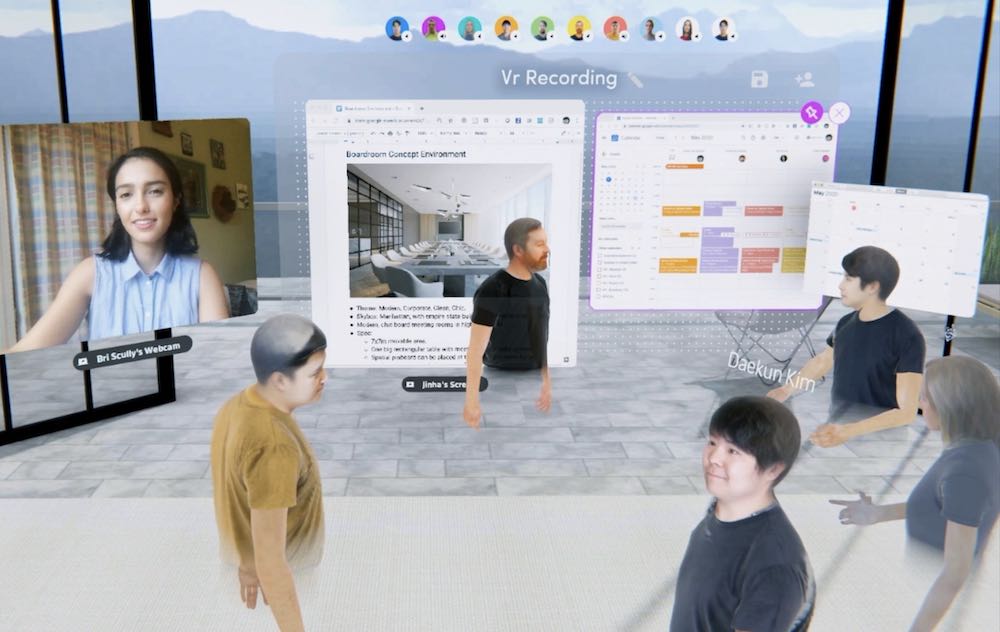
If users take to such solutions, it is easy to imagine they will scale into entire virtual offices and headquarters. Thousands of employees will be able to work on common tasks while being physically on different continents.
In September 2020, the Facebook corporation presented a similar solution: Infinite Office — a virtual office for working from home via the Oculus Quest 2 headset. In August 2021 it demonstrated another tool for remote work — Horizon Workrooms, a virtual meeting room with support for VR headsets and eye, facial, and body movement tracking.
It is precisely Facebook with its 2.89 billion users and vast resources for innovative development that is most often cited as the likely creator of a truly large-scale social metaverse.
Mark Zuckerberg openly states such ambitions:
“We expect that in five to seven years people will talk about Facebook not as a social network, but as a metaverse company.”
He envisions the metaverse as a constantly existing and synchronised environment where billions of users will literally live inside the content.
A Metaverse for Machines
Many tech corporations understand the term “metaverse” differently from the gaming industry or Mark Zuckerberg. For them it is not only and not so much virtual spaces that users access via computers, VR headsets, or neural implants. For them, the metaverse is virtuality that penetrates the real world and affects it in many ways. For example, through the Internet of Things (IoT) – devices with access to the global network. And we are not talking about a smart kettle, air conditioner or microwave that we can control via a mobile app. We mean smart sensors in vehicles, in building engineering systems and urban infrastructure, and in industrial equipment.
This is exactly the view shared by Satya Nadella, the current head of Microsoft. In Microsoft Azure’s cloud services he called it a corporate metaverse, which allows creating digital copies of real objects, organizing collaborative work in virtual spaces, and using the Internet of Things to manage processes in virtual and real worlds.
It is expected that in just a few years up to 55 billion IoT devices will be connected to the global network, which will require new approaches to cybersecurity, storage and processing of enormous data streams. Many technology companies are working on solving these problems, including those from the blockchain industry, for example, IOTA Foundation, IoTeX and Constellation Network.
It seems that much faster, less visible than gaming and social metaverses, a metaverse for machines and various devices is forming, where devices will conduct microtransactions on the blockchain (as in Robonomics), store data in cryptographically secure clouds, and be managed by self-learning expert systems, in lay terms, “artificial intelligence.” And people will occupy a less noticeable place there.
Subscribe to ForkLog news on Telegram: ForkLog Feed — all the news, ForkLog — the most important news, infographics and opinions.
Рассылки ForkLog: держите руку на пульсе биткоин-индустрии!