



Google builds a DALL-E rival, Imagen; Mayflower crosses the Atlantic and other AI news
We aim to inform readers not only about developments in the bitcoin industry but also about what is happening in related tech fields — cybersecurity and the world of artificial intelligence (AI).
ForkLog AI has gathered the most important AI news from the past week.
- At Build 22, Microsoft unveiled a raft of AI innovations.
- Google developed Imagen, a text-to-image generator.
- Samsung will invest $356 billion in AI, biotechnology and chips.
- China’s engineers have created an intelligent fabric to correct posture.
- The Dutch police created a deepfake of a murdered teenager to search for new leads.
- Across New York state, 800 companion robots will be distributed to elderly residents.
- The week’s most important AI deals.
Microsoft unveils a raft of AI innovations
Microsoft, at the Build 2022 conference, unveiled new AI-powered features and products. Among them:
- instrument Power Apps Express Design, which lets users convert sketches, drawings, screenshots and design files from PDF, PowerPoint, Figma into working app elements;
- mini-computer Project Volterra on a Qualcomm Snapdragon chipset and a dedicated neural processing unit;
- extended capabilities of the Azure OpenAI Service, providing access to OpenAI technologies with additional governance features;
- the service Hugging Face Endpoints for deploying Hugging Face models on Azure infrastructure with no code.
Microsoft also provided attendees with unlimited access to the AI tool Codex for three months and free tokens to use other models on the OpenAI API.
Google unveils a text-to-image generator
The Google Brain Team division unveiled the text-to-image generator Imagen from textual prompts.

The system is based on a large pre-trained language model and a cascading diffusion model. The developers stated that Imagen combines a deep understanding of text with an “unprecedented degree of photorealism”.
To evaluate the generator, Google engineers developed the DrawBench test. They compared the presented algorithm with VQ-GAN+CLIP, diffusion models and DALL-E 2. According to the developers, human raters preferred Imagen to the alternatives in head-to-head comparisons.
Metrics used to demonstrate that Imagen “better understands” user prompts included spatial relationships, long text, unusual words and complex prompts.
Samsung invests $356 billion in advanced technologies
By 2026, Samsung will invest $356 billion in AI, chips and biotechnology.
The company said approximately $285 billion would stay in South Korea, with the remainder directed overseas.
Samsung Electronics will use the funding to create advanced chips for AI, supercomputers and robots. In the near term, the tech giant will begin developing 3nm chips and focus on the development of 6G technology.
The investment is expected to create around 1 million jobs, Samsung said.
Amazon installs AI cameras in delivery vans in the United Kingdom
Amazon installed AI-powered cameras in delivery vans in the United Kingdom.
The company uses a pair of sensors to record video inside the cabin and on the road. The AI cameras monitor compliance with traffic rules and “proper” driver behavior. If violations are detected, the system emits an audible alert. Amazon also collects trip data.
The devices do not enable real-time monitoring by operators and do not record sound. Presumably, they can transmit footage to a dedicated security team.
The rights group Big Brother Watch has urged the tech giant to disable the AI system, calling its use “excessive, intrusive and creepy surveillance of workers.”
In China, AI fabric created for real-time posture control
Chinese researchers have developed an AI fabric capable of correcting posture in real time.
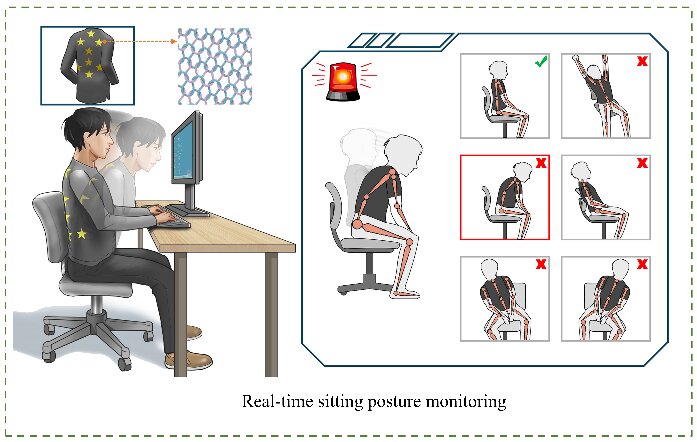
The self-powered system uses triboelectric nanogenerators that harvest energy for powering the sensors from human movement. The devices’ data are processed by an AI algorithm that analyzes spine alignment and notifies the user when to adjust posture.
The fabric was created by weaving nylon and conductive fibers. According to the developers, the material is flexible, durable, breathable and washable, making it suitable for long-term wear.
China launches autonomous vessel carrying drones
In China, an AI-powered vessel for autonomous and remote ocean reconnaissance was launched.
Zhu Hai Yun can carry dozens of drones, unmanned ships and submersibles. The vessel can detect, intercept and neutralize a wide range of targets.
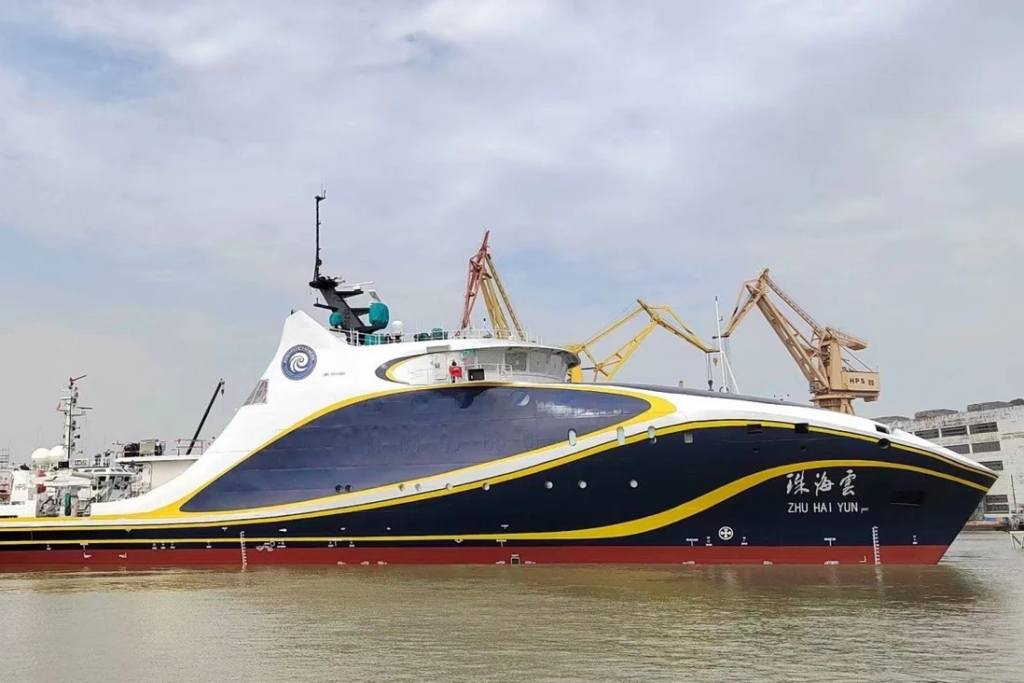
The ship measures 88.5 metres in length, 14 metres in beam and a designed displacement of 2,000 tonnes. It can reach a maximum speed of 18 knots.
The vessel’s equipment forms part of an intelligent mobile stereo-observation system for the ocean, developed by researchers at the Guangdong Provincial Southeast Marine Science and Technology Laboratory.
According to Science and Technology Daily, the ship’s AI platform could serve as a tool to prevent and mitigate the effects of maritime disasters, monitor the ocean environment, and service offshore wind farms at sea.
Dutch police used a deepfake to search for a teenage killer
Dutch police created a deepfake of a murdered 13-year-old to accelerate the investigation.
Law enforcement officials, with parental consent, shot a video in which the slain Sedar Soares pleads with the public to help with the investigation.
Police said the video has already yielded dozens of responses. However, it remains unclear whether the tips can be used.
New York to distribute ElliQ companion robots to the elderly
New York state authorities will distribute ElliQ companion robots to more than 800 elderly people. The initiative aims to address the growing problem of social isolation among the elderly.
The robots are designed to hold conversations, connect with relatives and monitor health-related goals such as exercise and medication adherence. The devices do not assist with physical tasks.

According to the developers, the system can exhibit empathy and form bonds with users. The robot also remembers key aspects of a person’s life and adapts accordingly.
ElliQ consists of two parts. The first features a lamp-shaped face with a microphone and speakers, which lights up and turns toward the user during conversation. The second is a tablet with a touchscreen for viewing pictures, obtaining additional information and video calls.
AI enthusiast created a system for detecting dog feces
Engineer Caleb Olson developed an AI system that detects dog feces and helps the owner locate them.
The programmer collected a dataset of images showing his dog defecating. Using this data, the developer trained the DeepLabCut algorithm to recognise certain dog poses.
The robotic system identifies the dog’s action in real time and highlights the location with a red circle in the surveillance camera feed. The tool also highlights the location with a green laser, activated when a person crosses their arms. If the owner crouches to pick up the feces, the laser moves to the next area.
Autonomous Mayflower sets sail across the Atlantic for the third time
The unmanned trimaran Mayflower has set sail on its third transatlantic voyage from Plymouth in Britain to Virginia Beach, USA.
The vessel is equipped with a multitude of cameras and sensors, operating with computer-vision algorithms for navigation. Status information is transmitted via an online panel, and anyone can track its location and watch live streams via the dashboard.
During its second attempt to cross the Atlantic, the trimaran returned to Orta Port in the Azores due to a mechanical fault. After repairs, the vessel resumed its voyage.
On 20 May 2022, project leaders said Mayflower was expected to complete the remaining 3,500 km in 16 days. By 27 May the vessel had covered just over half the distance to Virginia Beach.
The week’s most notable AI deals
From 22 to 28 May 2022, AI startups raised more than $95 million. Here are the most interesting deals.
- The developers of an AI platform for managing client-support staff Assembled raised $51 million.
- The AI chipmaker SiMa.ai raised $30 million.
- Planet FWD received $10 million to develop a carbon-emissions management platform for consumer goods manufacturers.
- Singularity Energy raised $4.5 million to support a service for tracking carbon footprints in power grids.
Also on ForkLog:
- Hyundai invests $5 billion in autonomous transport and robotics.
- Britain fined Clearview AI $9.5 million.
- In Russia, a covert surveillance complex on people based on social-media activity was developed.
- Clearview AI will offer facial-recognition technology to banks and schools.
- In the UAE, proposals to criminalize “murder” in the metaverse.
Subscribe to ForkLog’s AI news on Telegram: ForkLog AI — all AI world news!
Рассылки ForkLog: держите руку на пульсе биткоин-индустрии!