


Ethereum developers delay activation of the ‘difficulty bomb’.
On June 30, in the Ethereum network at block #15,050,000, the Gray Glacier hard fork occurred. The sole objective of the update was to delay the activation of the ‘difficulty bomb’.
🧊Gray Glacier hard fork is successful 🧊
Nethermind nodes are fine. Block time will go back down to 13 seconds.
Difficulty bomb delayed 🙌 pic.twitter.com/NPkZMYhWHn
— Nethermind (@nethermindeth) June 30, 2022
This concerns the original fragment of the Ethereum protocol code, the implementation of which exponentially increases mining difficulty. It is expected that this will render mining on the Proof-of-Work algorithm unprofitable as the network transitions to Proof-of-Stake (PoS).
Developers repeatedly delayed the ‘difficulty bomb’. In June they decided to do this again with the Gray Glacier update, tying it to the planned transition of the mainnet to the PoS algorithm during the ‘Merge’.
As a result, the automatic increase in mining difficulty was postponed by 700,000 blocks, or about 100 days (to early October).
According to the team, The Merge is set to take place in August. Ethereum co-founder Vitalik Buterin also called that month the most likely time for the transition. However, he allowed for delaying the event to September-October in case of potential risks.
Because the Gray Glacier upgrade occurred as a hard fork, it required node operators to update their software accordingly.
“If you are using an Ethereum client that is not updated to the latest version, it will be synced with the blockchain up to the fork as soon as the update occurs. You will be stuck on an incompatible chain, following the old rules, and you will not be able to send ETH or operate in the network,” the developers warned in the анонсе dated June 16.
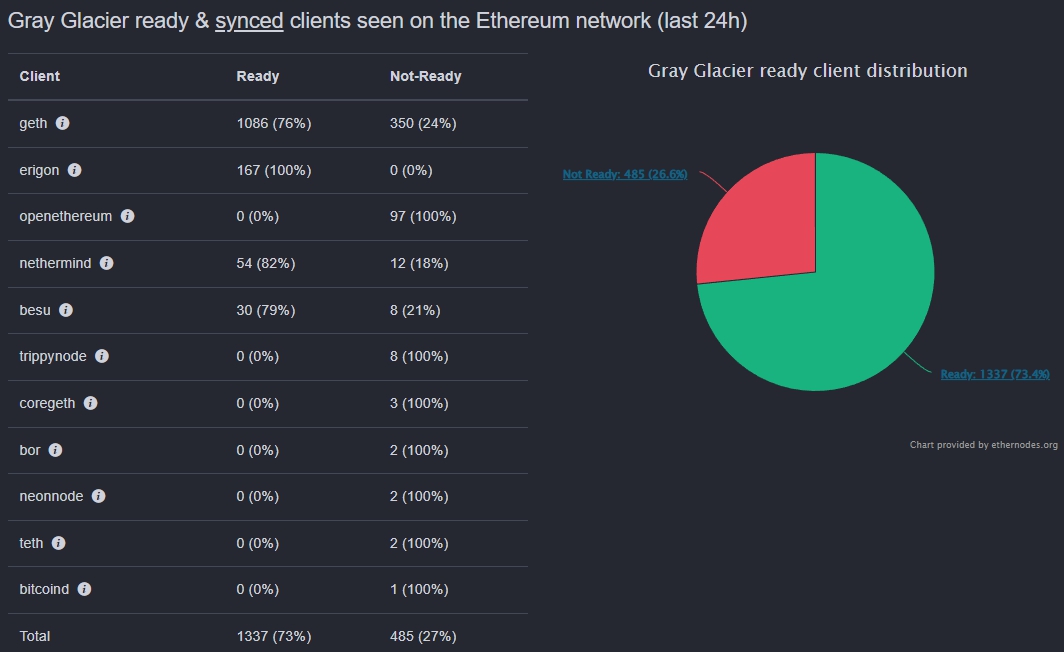
According to Ethernodes, at the time of writing, even after the fork, 73.4% of operators have signalled the software update. For the Erigon client, the figure is 100%, while for the most popular Geth it stands at 76%.
In June, the Ethereum team successfully migrated the Ropsten test network to the PoS algorithm.
Meanwhile, the network was among the test blockchains that the developers decided to shut down. Only the Goerli and Sepolia testnets will remain.
Read ForkLog’s Bitcoin news in our Telegram — news on cryptocurrencies, prices and analytics.
Рассылки ForkLog: держите руку на пульсе биткоин-индустрии!