



Ear recognition, TikTok ban in the United States, and other AI news
We aim to inform readers not only about developments in the bitcoin industry, but also about what is happening in adjacent technology realms — cybersecurity and the world of artificial intelligence (AI).
ForkLog AI has gathered the most important AI news from the past week.
- The U.S. Department of Commerce added 36 Chinese companies to the sanctions list.
- Google CEO Sundar Pichai called AI-powered chatbots ‘immature’.
- American lawmakers proposed banning TikTok.
- Australian artists accused the AI portrait-app Lensa AI of stealing their works.
- Scientists have created a system for identifying people by their ears.
- TikTok algorithms promoted pornographic AI-generated deepfakes of singer Billie Eilish in the For You tab.
- The most significant AI deals of the past week.
The United States has added over 30 Chinese companies to the blacklist
The U.S. Department of Commerce added 36 Chinese entities to the list of companies that cannot import certain American technologies without a license.
According to the department, 30 organisations were involved in upgrading China’s defence-industrial complex. Of them 21 companies deployed AI chips in their operations.
One organisation was restricted for human rights violations, and another for supporting the production of Iranian drones.
The remaining four were added for their ‘negative impact’ on U.S. national security or foreign policy.
Sundar Pichai called AI chatbots immature
Google is not currently planning to roll out a ChatGPT rival due to ‘reputational risk’.
According to CNBC, at a company-wide meeting employees asked whether rolling out OpenAI’s smart chatbot would be a missed opportunity for the tech giant.
Alphabet CEO Sundar Pichai and Google AI chief Jeff Dean said the company’s language models are no less effective than the competitor’s solutions. The tech giant should move more ‘conservatively’ than a small startup, they added.
Pichai and Dean described AI-powered chatbots as ‘immature’ and pointed to issues of bias, toxicity, and the tendency to ‘make things up’.
They also said that in 2023 Google has planned ‘many’ new language AI features, and the field requires the company to be ‘bold and responsible’.
American lawmakers propose banning TikTok
American lawmakers proposed banning TikTok over concerns about Chinese spying.
Senate and House members drafted a bipartisan bill to block any transactions of the service. It would also ban the use of all social networks owned by companies located in or under substantial influence of Venezuela, Iran, China, Cuba, North Korea and Russia.
Lawmakers said such apps could potentially funnel U.S. user data to repressive governments, censor news, and manipulate public opinion.
TikTok representatives expressed concern that lawmakers had introduced the bill before a completed state security review.
On December 15, the Senate passed the bill banning the platform’s use in federal agencies. The House now must approve the document.
Lensa AI popularized AI apps in the App Store
The success of Lensa AI spurred a surge in AI-powered apps in the App Store.
TechCrunch, in its Dec. 12, 2022 report, noted that three of the top spots on the U.S. storefront were AI-powered photo editors. Eight such apps made the top 100 by downloads.
Lensa AI still topped the charts, with 12.6 million worldwide installations in the first 11 days of December, up 600% from 20–30 November.
Second and third places were AI Art: AI Image Generator and Dawn — AI Avatars, downloaded 1.7 million times each. At the end of November downloads stood at 71,000 and 28,000 respectively.
Artists accused the AI app of stealing their works
Australian artists accused the AI portrait-generation app Lensa AI of stealing their works.
The tool is based on the Stable Diffusion algorithm trained on the online database LAION-5B. According to the artists, the dataset includes many works used without permission. The app copies various styles, down to brushwork, colours and compositions.
Artists said they have received no compensation and that this ‘looks like a violation’.
The artists urged tightening copyright laws to ‘not fall behind the development of AI art’.
The company responded that Lensa AI trains to generate content in the same way a person does — studying various artistic styles. The developers said terms such as ‘forgery’, ‘theft of artwork’, or ‘illegal use’ cannot be applied to this process.
Google unveiled an AI algorithm for training robots
Researchers at Google introduced the RT-1 transformer model, enabling robots to perform over 700 tasks with a 97% success rate.
The team trained the algorithm on data including 130,000 videos showing humans performing various actions with 13 Everyday Robots devices from Alphabet. This enabled the model to predict the next most likely movement when a robot performs operations.
The approach enables the system to generalize knowledge from training and apply experience to new tasks. For example, a model trained on many videos about how to pick up a banana could identify and grasp a fruit even in an unfamiliar setting.
Researchers have developed a system for ear recognition
Researchers at the University of Georgia have developed a system for identifying people by their ears. The algorithm’s accuracy is around 99%, depending on the dataset and model.
The software operates similarly to facial recognition. A user provides the algorithm with several ear images to identify the owner.
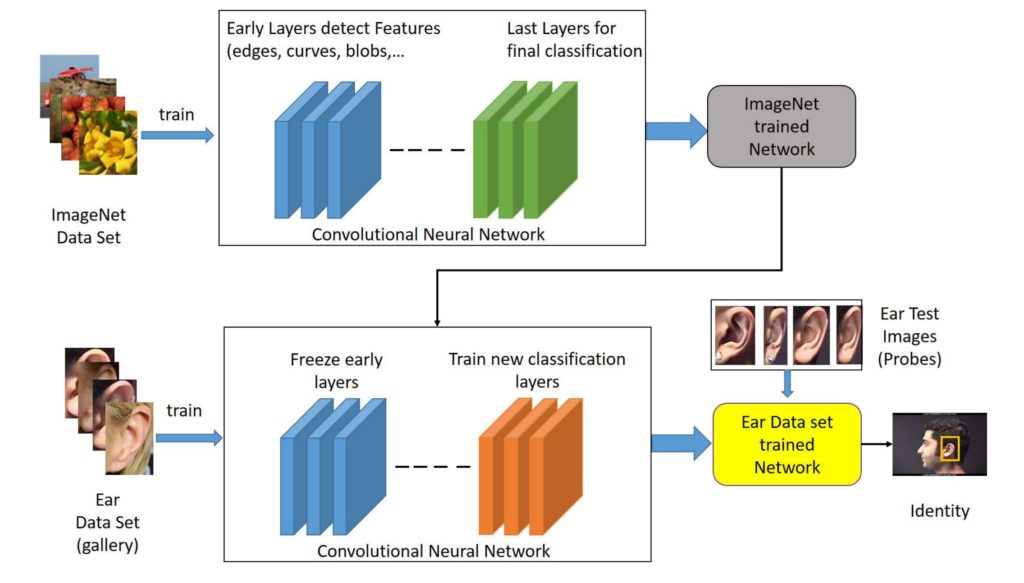
In testing on two existing datasets, the system achieved accuracies of 97.25% and 75.11%, respectively. The researchers also found that the software can handle images with blur, noise and variations in brightness or contrast.
According to the scientists, the technology could be used to enhance existing security systems.
OPPO unveiled the QRIC robot dog
Chinese hardware maker OPPO unveiled the QRIC companion robot dog.
The device can walk, jump, tumble, carry objects and recognise people. The robot supports voice and remote control.
The company planned to reveal technical details of QRIC at OPPO INNO Day 2022, which was to be held on December 14, 2022.
Robot barista rolled out in U.S. offices
Seattle-based startup Artly deployed a robot barista in seven offices in the United States.
The arm brews espresso, pours milk, froths the milk and assembles everything to make a cappuccino. It also adds latte art to the drink.
In each office the developers installed robots with different personalities. They differ in name, ‘personality’, ‘gender’, voice and accent. The devices also use unique approaches to making coffee, having been trained by different baristas.
TikTok spread Billie Eilish deepfake porn for four days
TikTok’s algorithms promoted pornographic AI-generated deepfakes of singer Billie Eilish in the For You tab.
The video included several images of the artist’s face with an artificially ‘sexually stylised’ body. Over four days the clip was viewed by 11 million people before TikTok removed it for violating the platform’s community guidelines.
According to digital-culture professor Tracy Harwood of De Montfort University, the images looked as if they had been created with an AI app.
The account had more than 76,000 followers and was linked to an Instagram account with more than 2,000 followers. There, the author also shared the video and offered to sell ‘uncensored images’ for $20.
Top AI deals of the past week
From December 11 to 17, 2022, AI startups raised more than $620 million. Here are the most notable deals.
- Dataiku, the platform for designing, deploying and managing AI applications, raised $200 million.
- Zappi raised $170 million to expand its consumer-analytics service.
- Shield AI raised $60 million to develop software and hardware for military drones.
- Vic.ai raised $52 million.
- Beamery raised $50 million to grow its people-management service.
- Sana Labs raised $34 million to support the platform for turning working information into training content.
- EnCharge AI raised $21.7 million to develop AI accelerator hardware.
- LexCheck raised $17 million to expand its contract-analysis platform.
- Protect AI raised $13.5 million.
- Anima raised $3 million to support an NFT-project with AR pets.
Also on ForkLog:
- China bans «threatening national security» deepfakes.
- The former head of the U.S. AI commission accused of a conflict of interest.
- Tech: ARM will not sell its latest chips in China.
- DeepMind taught AI to create rough drafts of film scripts.
- OpenAI will label text generated by algorithms.
- AI discovered thousand previously unknown supernovae.
- Death threats: an enthusiast was criticised for selling an AI book.
- The United States imposed sanctions on a Chinese surveillance systems manufacturer.
Subscribe to ForkLog News on Telegram: ForkLog AI — all the news from the AI world!
Рассылки ForkLog: держите руку на пульсе биткоин-индустрии!