



New DAOs are being created every day, and thousands of people quit well-paid jobs in IT firms to participate in these structures. DAOs resemble a Telegram channel with a bank account, yet they already control billions of dollars.
In terms of culture, these organisations are at once like a guild in an MMORPG and like an international organisation. In the coming years the number of DAOs will grow exponentially — millions will work within them, governing trillions of dollars.
For ForkLog, Stepan Gershuni, author of the Telegram channel CryptoEssay, explained how DAOs work, how to distinguish scams from fundamental innovation, and how to verify these claims for yourself. He also explained how to build an effective decentralised team and foster a community culture.
What is a DAO?
A DAO is a self-organising community with decentralised and automatically executed functions for governance and voting, treasury management, participation, compensation, and workflow orchestration, enabled by blockchain.
DAOs are a new form of organisation that allows resources to be coordinated through decentralised and provably neutral mechanisms (see Credible Neutrality by Vitalik Buterin, 2020).
DAOs are not a full replacement for corporations, but they offer an alternative for many types of organisations that can benefit from a programmable model of governance and decentralisation: corporations, cooperatives, religious organisations, schools, NGOs, government agencies and departments, and local communities.
Why DAOs?
A DAO is often chaotic, self-organising, unpredictable, and frequently highly inefficient. Conflicts are common and even founders may not clearly understand its structure. Yet some of the most groundbreaking crypto projects are created as DAOs or become one, discarding their centralised legal structure to do so.
Yet decentralisation by itself does not automatically make an organisation better than its centralised analogue. So why do people choose to work with DAOs?
The main reason is that DAOs can achieve outcomes that no other organisation could. DAOs enable independent participants to coordinate efforts toward a shared mission, guarantee collective ownership and decentralised control. DAOs are, in a sense, about the journey.
DAOs enable sovereign beings to coordinate with shared ownership, decentralized control, and independent autonomy.
They are about the journey.Top-down orgs need to capture, constrain, and coerce workers to achieve their proscribed goals.
They are about the destination.— tracheopteryx.eth (@tracheopteryx) January 6, 2022
By comparison, hierarchical organisations (for example, corporations) seek to maximize results, constrain freedom, and compel employees to meet owners’ goals, not those of the workers. Centralised organisations are about outcomes, and very often at any cost.
A familiar maxim “bugs in the code are the result of bugs in the organisational structure” is especially apt here. People are not willing to do many things just because a boss said so. Creating truly meaningful things requires intrinsic motivation (a sense of purpose, mission, and belonging) and community. The most important things in the world were not created by fiat but from a deep inner conviction that it had to be this way.
DAOs are neither a means to maximise personal gain nor profit. DAOs are about balancing the personal and the collective. They are structures that help each person stay creative, realise their full personal potential, receive fair compensation, and be part of a community of like-minded people. A DAO is an organisation without a leader, without a central control system, with open and unconstrained collaboration. DAOs are about co-ownership and shared belonging.


The Mission of DAOs
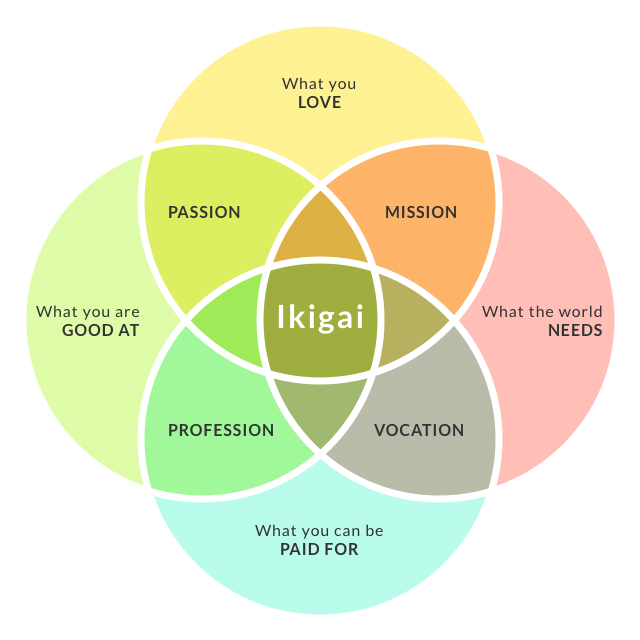
A DAO begins with two things: a mission and a community (culture). Everything else can come later. A DAO can exist and even be successful in the future without a product, funding, strict voting mechanisms, dispute-resolution policies, or treasury management right now.
A mission is the reason for the organisation’s existence. Successful DAOs are always larger than their founders. They outlive their founders and early participants if the mission is shared by many others. A DAO’s mission may be commercial (“to generate profits for token holders”), but in the real world it is almost always something more, because token price alone is a poor motivator for long-term, intrinsically motivated contributors.
An example of such a mission might be to build a community around a topic, to solve a specific problem with a product or product line, to achieve changes in the world (climate, education, science, etc.), or to realise a grand vision (for example, building a metaverse).
DAOs are a way of operating an organisation, not its legal form. A DAO may have a legal identity in one or multiple jurisdictions. A DAO may (and often should) pay taxes. But the form of organisation is not as important as the reason for its creation, the community of participants, and its internal processes.
The DAO Community
The community is the backbone of a DAO; it drives the organisation forward. If you want to hire people directly, have clear job descriptions, and conduct all work within a closed loop of full-time staff under NDA, a DAO is unlikely to be for you.
A DAO is a globally open organisation that will grow and evolve independently of you, yet inside it ideas will emerge and teams will form organically.
A community does not form by itself. It requires leaders and pioneers, such as Satoshi, Vitalik Buterin, CoopahTroopa, Andre Cronje, and others. In any successful community there is a core team that spends 100% of its time developing it and shaping its internal culture. But over time the founders and the team cease to influence and steer the project’s development.
For example, in Yearn the treasury holds tens of millions of dollars, but Andre Cronje has no control over these funds. Any community member can propose allocating some of the money to a specific project. In Yearn such proposals have included token buy-backs, the creation of CoordinApe (a highly successful spin-off product), the development of a new interface, and the launch of a new model for organising teams within the DAO, and other initiatives.
Drafting, lobbying, and executing proposals is arguably the most important and challenging process in a DAO. It combines:
- policy (the ability to broker compromises and social consensus around challenging issues);
- entrepreneurship (the ability to persuade the organisation to allocate funds and deliver tangible results);
- communications (the ability to articulate the purpose of the task to DAO participants, token holders, journalists, and users).
Undoubtedly, the first DAO is Bitcoin. Its mission is to create a decentralised public monetary system. Its community comprises miners, developers, users, node operators, and others. Satoshi did monumental work, but today has effectively little influence over the project’s future. The community has built around Bitcoin tens of thousands of businesses, products, applications, and organisations. It develops new protocol versions, conducts research, engages in lobbying in parliaments of dozens of countries, and much more.
DAO Culture
Culture is the “glue” that holds the community, mission, and organisation together.
If corporations are about abstract results, DAOs are always about people. If a person is tired, content, and happy, what benefit can they bring to the organisation? And why should they care?
In no other form of organisation will you find as much focus on personal health, mental well-being, and shared cultural values as in a DAO. The traditional organisation (government, business, or school) is oriented toward achieving some result. The metrics that matter are typically those of founders, investors and managers.
Without a sense of joy, belonging, and satisfaction in the work, achieving outstanding results becomes hard — and who benefits if the price is one’s health?
In almost every DAO you will find a dedicated channel, Twitter feed, or chat where people greet one another with “gm”, meaning “good morning”. It doesn’t matter what time it is, since somewhere on Earth it is morning right now, and most DAO participants live in different countries or are entirely anonymous at times.


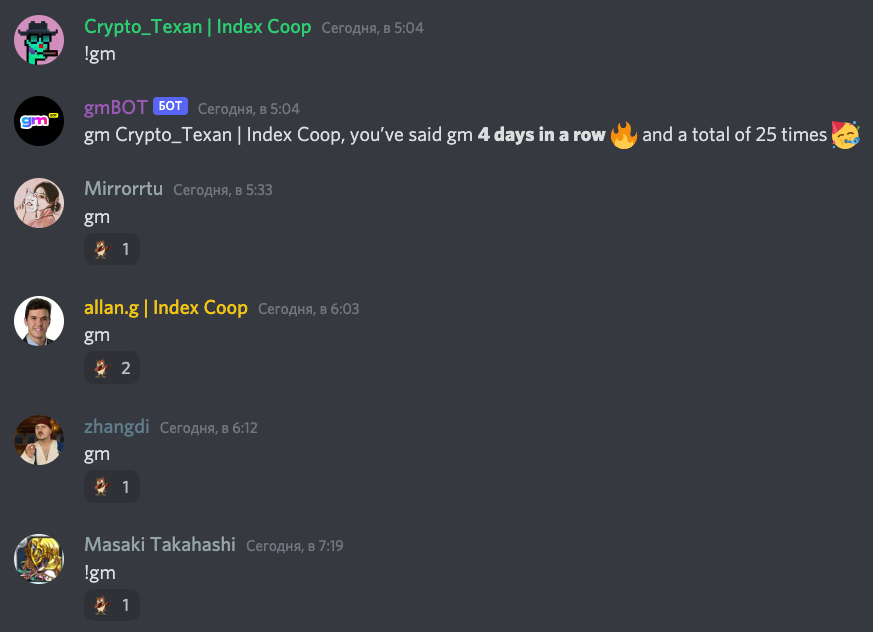
“gm” is a ritual that binds strangers. It’s a reminder of why we are all here and what we are trying to build together.
Mental and physical health is a particularly important part of the culture of many DAOs. We are not trying to build a world in which everyone must push themselves to the limit. On the contrary, we build decentralised systems that are convenient, pleasant, and productive for people.
New post 👇
2022 is the year DAOs adopt Mental Fitness as a core design principle.
🧵⬇️https://t.co/xKpnPvgxy0 pic.twitter.com/SG4qB17jzi
— Twoplus (@twoplusDAO) January 4, 2022
For example, in the Deep Skills channel we use a bot that asks every morning how everyone is feeling. This is important for the individual — acknowledging and recognising their own emotions — and for others — the ability to support and adjust communication depending on others’ state. Below is an example of how this works for us. I recommend reading this article on practices for improving mental health in DAOs.


DAO compensation models
DAOs often employ decentralised tools to coordinate and compensate. Here we discuss the most interesting models for fair and transparent distributions of equity, tokens, and remuneration among DAO participants.
SourceCred
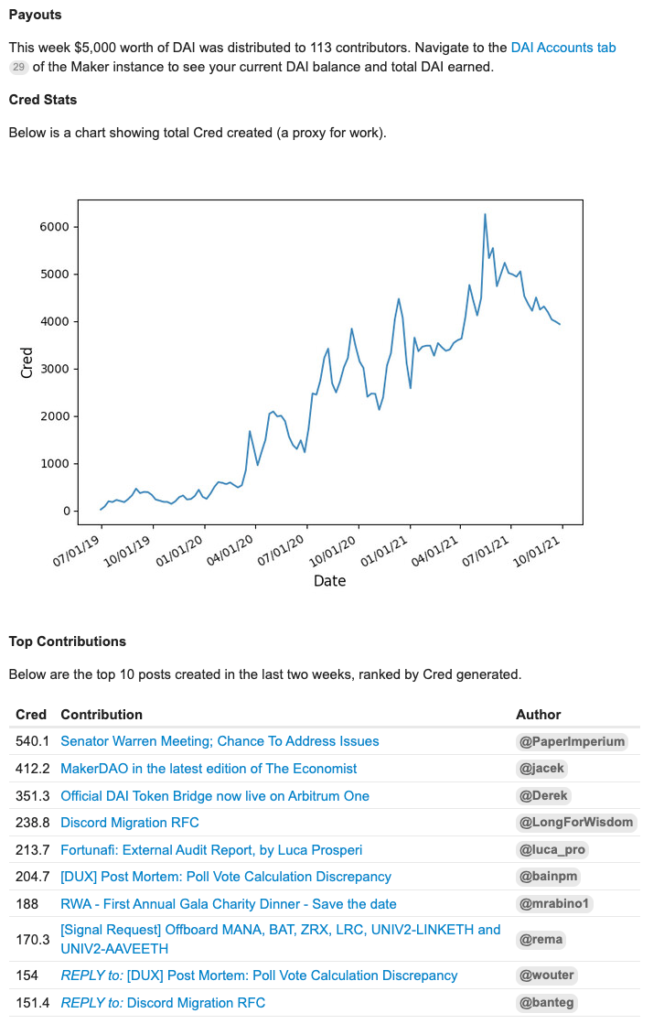
SourceCred is one of the first decentralised reputation systems used by many DAOs, including Maker, TEC and MetaGame.
This system automates tracking of contributions and compensation for DAO participants. It automatically monitors participants’ activity on various platforms where work occurs: Discord, Discourse, GitHub, and others. Evaluation depends on objective factors such as the number of commits or review of proposals, and on subjective metrics such as assessments from other participants.
For more on how live SourceCred implementations work, read on the MakerDAO forum.


Did-a-thing
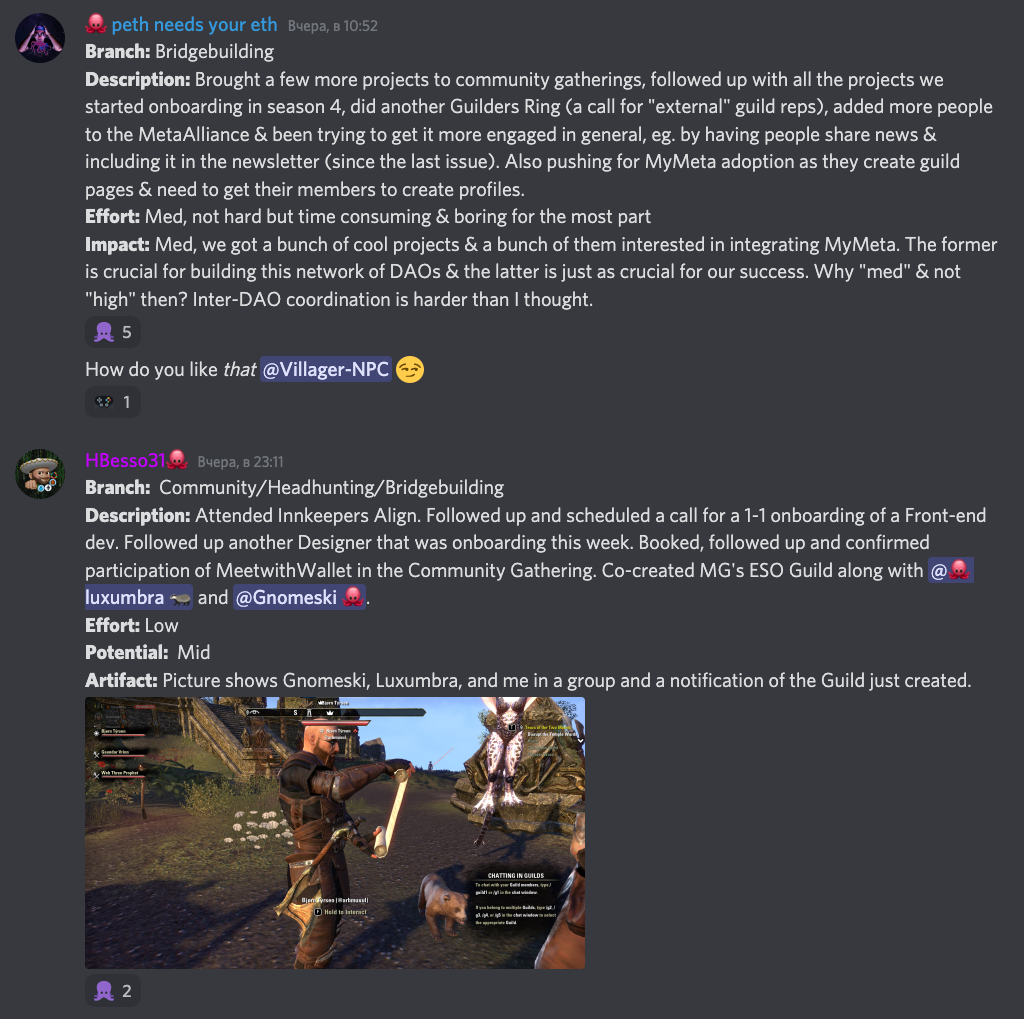
An even simpler and fairly popular method for assessing contributions is to create a dedicated Discord channel where each participant writes a report on what work they have done, how challenging it was, and what impact is expected for the community. Unlike most corporations, it is not at all necessary (and often rare) for someone else to assign you a task.
Do you see a flood of interesting messages in the chat? Publish a monthly digest of the most interesting posts for the other participants. If it proves useful and engaging, your initiative will be in demand and you will receive more tokens or USD.


CoordinApe
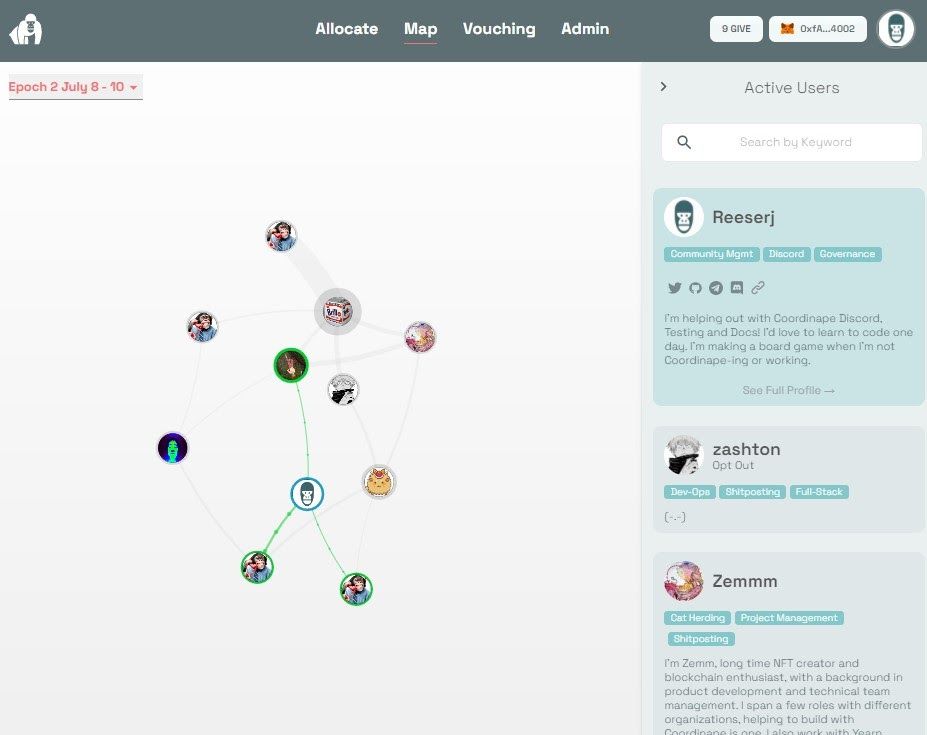
CoordinApe originated as an internal Yearn DAO tool, but quickly gained popularity and is now used by more than a hundred organisations. In CoordinApe, coordination is built around “circles”— groups of DAO participants who work together and wish to distribute funds in a decentralised manner.
Time is divided into epochs (usually a week or a month). At the start of each epoch each circle participant receives 100 GIVE tokens, which they may freely give to other team members. Typically, circle participants are expected to give GIVE to others proportionally to their contributions.
This effectively measures others’ contributions toward the common goal. At the end of the epoch, the GIVE received by each participant is converted into GET tokens, which can then be exchanged for a proportional share of the allocated funds.


Reputation-weighted
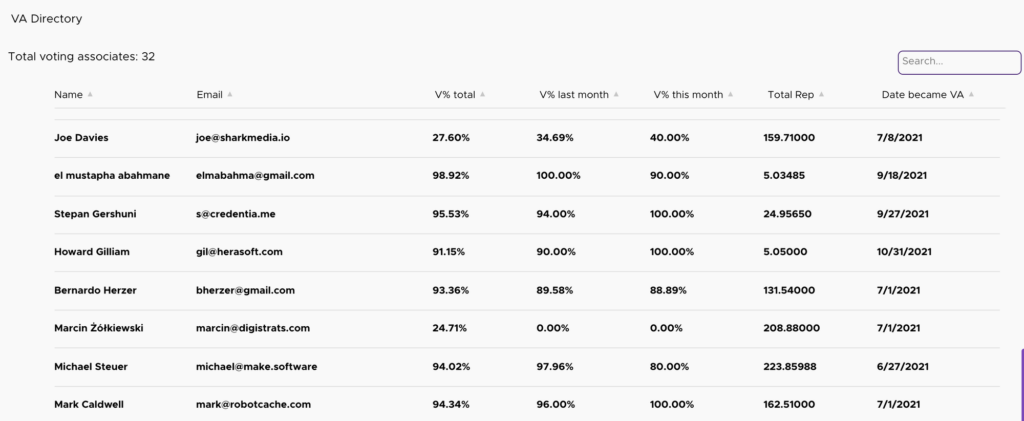
Another popular model is a decentralised reputation system. One implementation we use in DEVxDAO.
The system comprises three elements:
- Clear rules for awarding and revoking reputation for DAO actions. In our case: mentoring, voting, project evaluation, DAO development, legal work;
- A robust reputation-weighted voting system where the amount of reputation determines the weight of a participant’s vote. A design that penalises attempts to game the system by risking loss of the existing reputation stake.
- Payments to participants. In our case this is around $100–$150 thousand per month, distributed among 32 participants proportionally to accrued reputation.
Read more about the MVPR system here, and the formal mathematical model of reputation is published in Wolf’s book.


Deep Skills
Deep Skills (my project) is not directly a compensation tool, but the core function of our product — tracking skills, competencies, and work performed by DAO participants — can be used directly in other compensation-management systems.
The Best DAOs
I am frequently asked to name the best DAOs. It is a difficult question, since my criteria and preferences may differ from yours. Moreover, I cannot keep track of every new DAO, let alone review their landings and teams.
That said, I have attempted a curated selection of DAOs, loosely categorised into three types — legendary, epic, rare:


Reasons (not) to create a DAO
Create a DAO
- You see benefits from decentralising work. You want to organise work in small or large groups within the community rather than hiring people as staff.
- You already have a community and you want to create new tools for development and monetisation.
- You are interested in a global talent pool. DAOs operate 24/7 and from day one function globally, giving access to the best talent.
- You believe in a mission or idea that many will support.
- You want to create an organisation owned by the community.
- You are building an open-source tool or protocol that will be governed and developed by the community.
Not create a DAO
- You build a DAO because of regulation, in spite of regulation, or thanks to regulation. Innovation comes first, and then regulation. This is akin to creating an internet corporation simply because there appeared a law on the taxation of marketplaces.
- You have a token and you do not understand why anyone would use it. You decide to attach a token to the DAO so that users vote with it. This looks like a scam, it is a scam, and it will rightly be regarded as a scam.
Subscribe to ForkLog news on Telegram: ForkLog Feed — the full news stream, ForkLog — the most important news, infographics and opinions.