




While traders fixate on charts and the market’s muted reaction to the recent upgrade, important shifts are under way on Ethereum. Call it a “quiet evolution”: despite underwhelming price action, on-chain activity is rising.
On-chain metrics show lower fees and a record number of new addresses. Big players are increasing staking positions and ignoring gloom, while the network is running more efficiently.
Next up are the Glamsterdam and Hegota hard forks, meant to make Ethereum more performant and resilient and to lay a firm foundation for future innovation.
This article reviews developers’ plans and weighs the asset’s prospects in light of the forthcoming upgrades.
A post-Fusaka boost
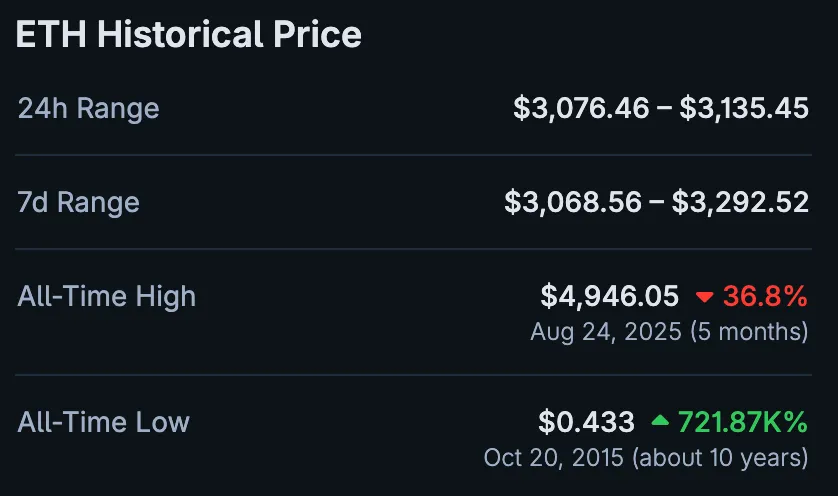
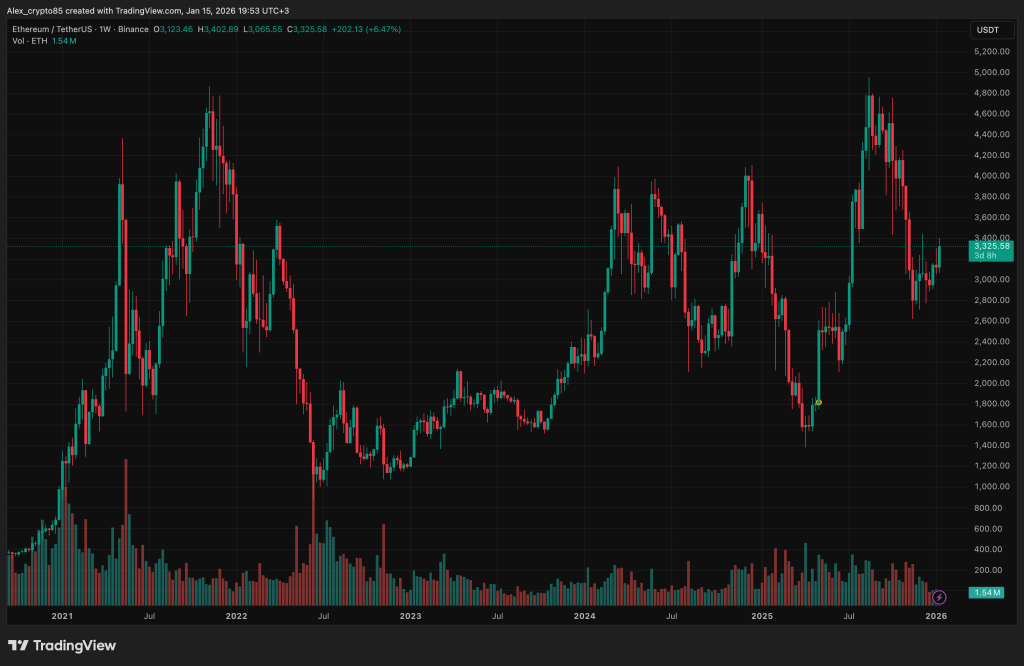
More than a month has passed since the major Fusaka upgrade, but Ethereum still trades far below its August ATH.


Despite the tepid price action, the hard fork delivered foundational improvements to the scalability, efficiency and security of the second-largest crypto network.
In particular, EIP-7594 prepared the ground for PeerDAS. It will let validators check small fragments instead of entire BLOB objects, reducing node load and improving data availability.
In the wake of the upgrade, ETH briefly moved above $3200 (+3%), but over the following month prices changed little.
Even so, deep changes to the system have boosted on-chain activity, laying a solid base for future updates and prospects for the second-largest cryptocurrency.
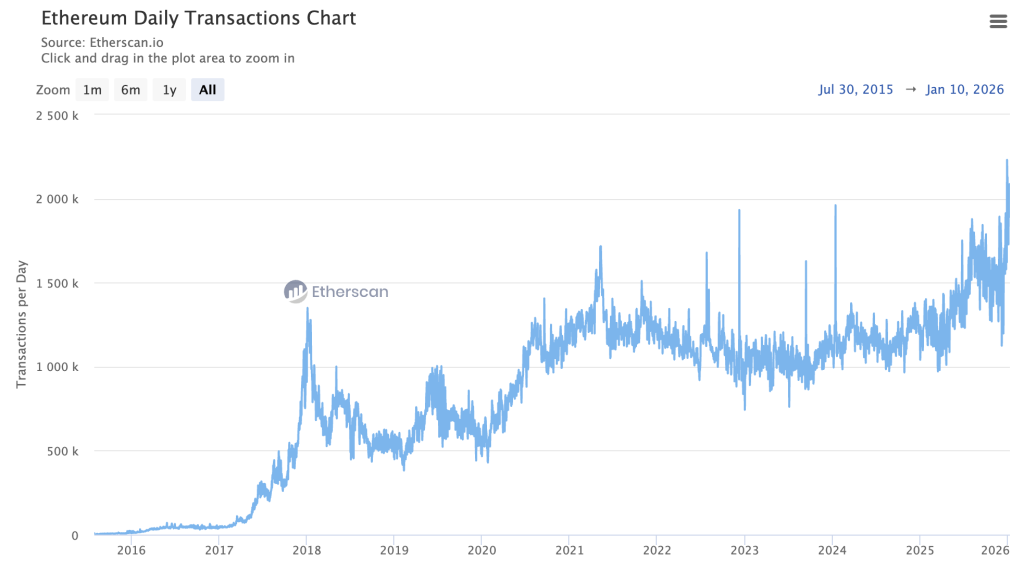
At year-end the Ethereum network set a new record: more than 2.2m transfers processed in a single day.


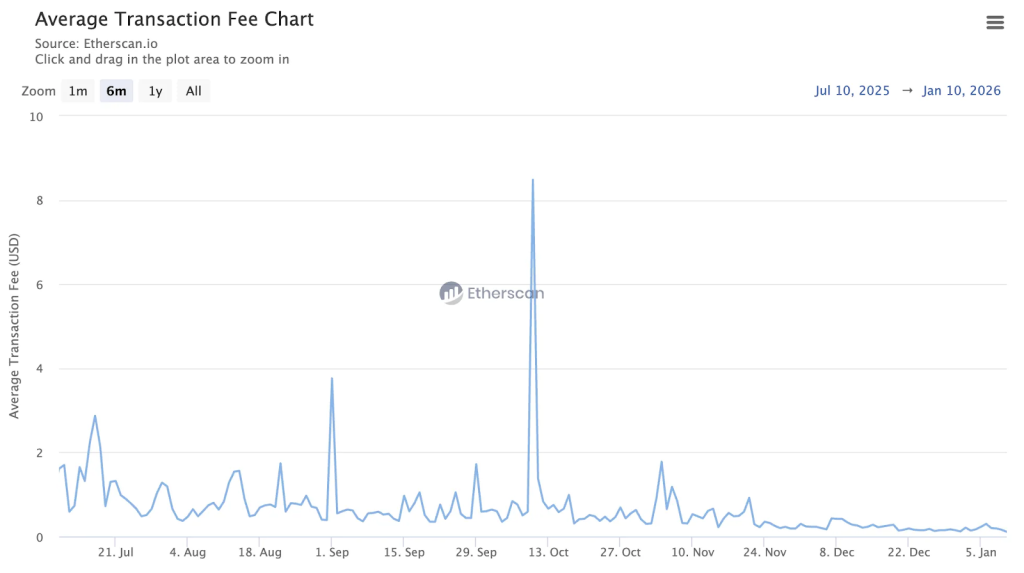
Despite the heavier load, the average fee is about $0.11.


The Fusaka upgrade increased the network’s base throughput by 33%, lifting the gas limit from 45m to 60m per block. The earlier Pectra update optimised validator infrastructure and increased staking flexibility.
Glassnode researchers recorded a doubling in Ethereum’s activity-retention metric.


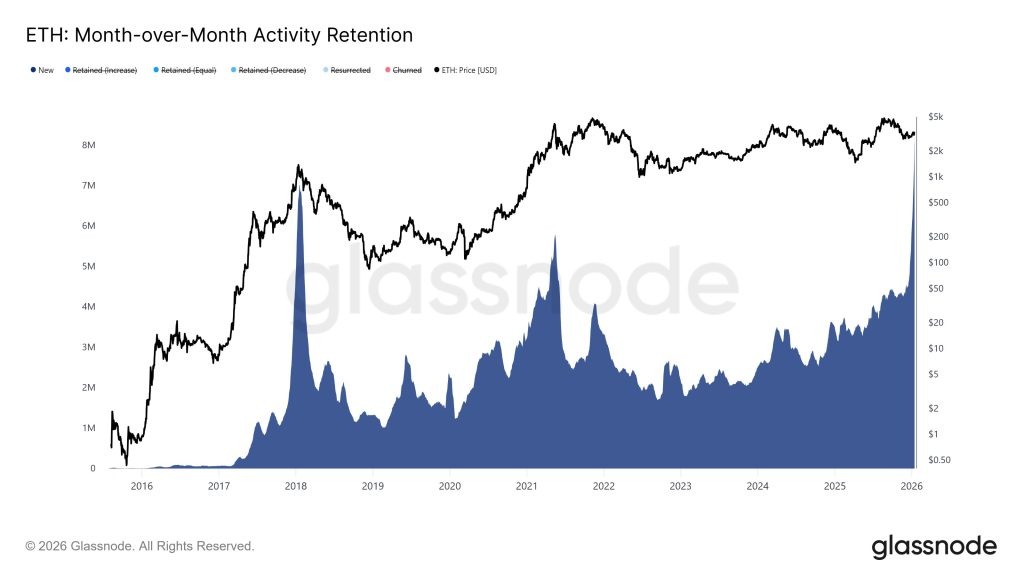
The number of addresses that were active for the first time during a month jumped from 4m to 8m. Analysts link this to an influx of newcomers who keep using the blockchain after their first transaction.
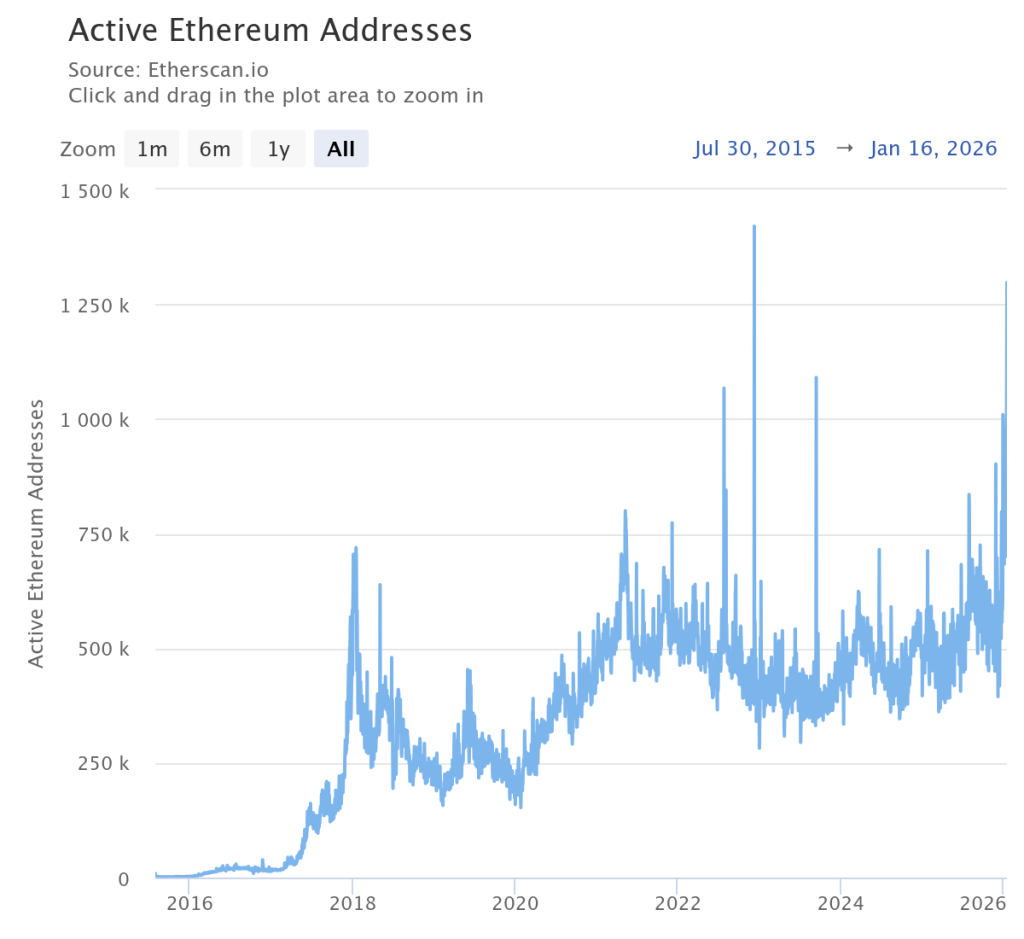
On January 15 active address counter exceeded 1m — twice the level of a previous year (410,000).


Technical efficiency is attracting capital: according to Artemis, Ethereum led 2025 by net inflows ($4.2bn).
Ethereum added $4.2B to lead 2025 net flows pic.twitter.com/vIVaaYCPwG
— Artemis (@artemis) December 29, 2025
At the end of December, the queue to stake Ethereum was longer than the queue to withdraw.


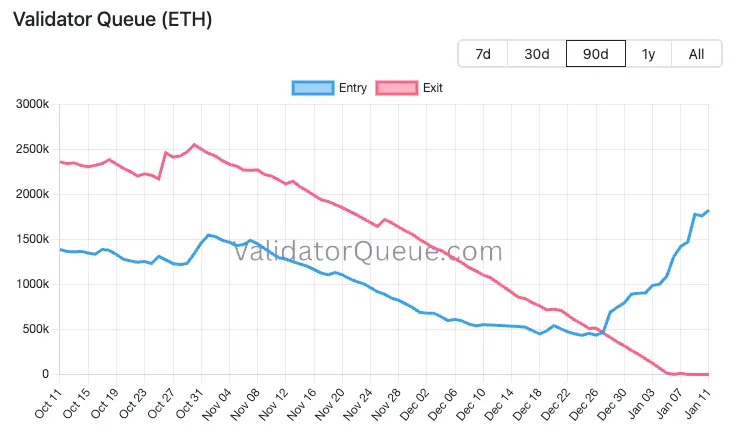
Abdul, head of DeFi at L1 network Monad, noted that a similar flip in queues occurred in June. ETH then doubled, reaching an all-time high of $4946 by August.
Smart Economy podcast host Dylan Grabowski linked the queue shift to aggressive buying by large corporate treasuries such as BitMine, followed by staking. By late December, the firm run by the well-known Tom Lee had staked around $1bn worth of Ethereum. Two weeks later that figure reached $3.33bn.
Tom Lee(@fundstrat)'s #Bitmine staked another 86,400 $ETH($266.3M) 5 hours ago.
— Lookonchain (@lookonchain) January 11, 2026
In total, #Bitmine has now staked 1,080,512 $ETH($3.33B).https://t.co/P684j5YQaG pic.twitter.com/TpEf32m6AF
Developer popularity and an RWA boom
In the fourth quarter, new smart contracts on Ethereum hit a record 8.7m.
The analyst known as BMNR Bullz linked the growth to three organic drivers: RWA, activity in stablecoins and improvements to base infrastructure.
“Ethereum is quietly becoming a global settlement layer,” the expert stressed.
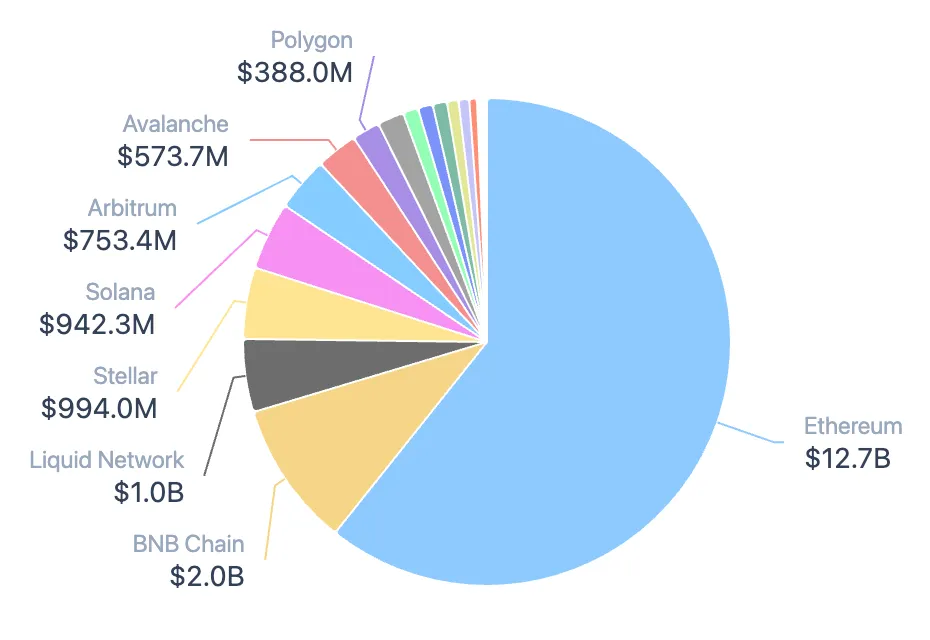
The network of the second-largest cryptocurrency retains leadership in tokenisation. It accounts for $12.7bn of the sector’s $20.69bn total value as of January 11.


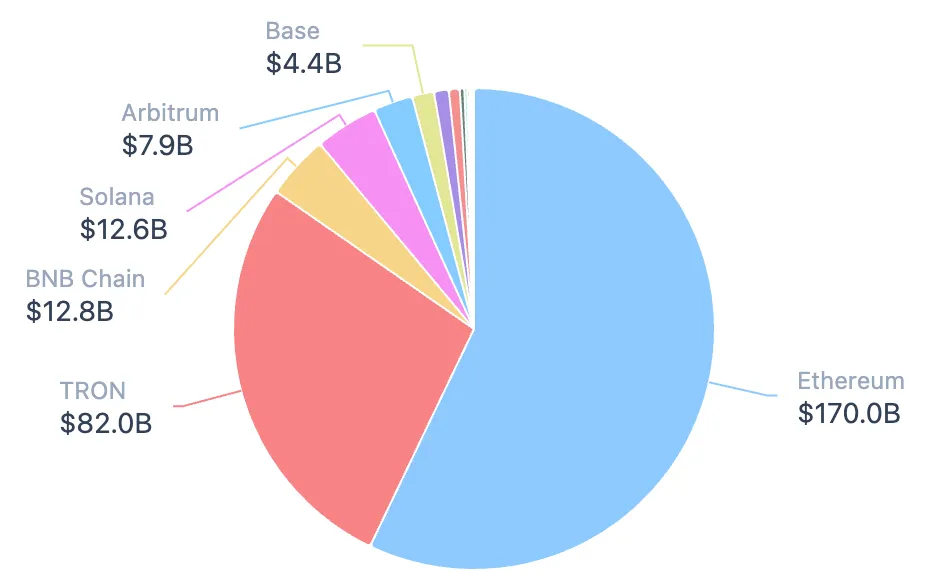
Ethereum also ranks first in the stablecoin sector. The ecosystem’s share of the total capitalization of stablecoins in circulation is $170bn.


On January 7 Ethereum developers carried out another BPO fork, raising the per-block BLOB limit to 21. The target also rose — from 10 to 14.
The update increased the maximum block size to 2,688KB, which should help throughput. It is the second scaling of this kind since Fusaka; the previous parameter change took place in December 2025.
The team now turns to the next hard fork — Glamsterdam. It also sits within The Surge phase of the Ethereum technical roadmap.
What is Glamsterdam?
The Glamsterdam upgrade combines two changes: Amsterdam for the execution layer and Gloas for the consensus layer. Activation is tentatively planned for the first half of 2026.
Developers’ goals are to minimise trust in block formation, prepare for parallel transaction execution and optimise gas economics. These steps will let Ethereum scale effectively via rollups without overburdening nodes or sacrificing decentralisation.
Key technical changes:
- Built-in role separation (EIP-7732). The core of the upgrade is enshrining ePBS at the protocol level. Today, separation of the proposer and builder roles works via external add-ons, creating centralisation risks. The new algorithm will require builders to keep block contents hidden until approval. That deprives validators of the ability to censor transactions or profit from reordering (MEV).
- Access lists (EIP-7928). Block-level Access Lists will allow predeclaring the data needed to process a block. This should speed up execution and make fees more predictable.
- A new gas model (EIP-7904). Operation costs become proportional to real CPU and memory usage. This removes the ability to perform “heavy” computation cheaply and protects the network against DoS attacks. Servicing bulky smart contracts will get pricier, reducing load on validators’ hardware.
Advantages of the updated architecture:
- decentralisation. Enshrined ePBS reduces reliance on centralised relays, making the network resistant to censorship;
- stability of EVM. Optimising gas and data storage costs ensures more predictable smart-contract execution;
- efficiency. Block-level Access Lists allow parallel verification, speeding state access under heavy load;
- containing blockchain bloat. A more accurate gas-pricing model reflects real resource costs, preventing excessive long-term state growth (state bloat);
- L2 support. Optimised block processing helps the base chain handle rising data from rollups, simplifying L2 publication of transaction batches and proofs;
- validator reliability. Less reliance on external MEV infrastructure cuts operational risk for participants.
Pitfalls
Glamsterdam revisits block-handling models, introducing several specific risks:
- ePBS and MEV risks. Role separation could mean builder failures hit validator revenues. There are also concerns that block building could be monopolised by large players, threatening decentralisation;
- technical complexity. New consensus rules and BALs require tight client synchronisation. Mistakes at this layer could cause chain splits or DoS vulnerabilities;
- compatibility issues. A new gas model could “break” dapp economics. Developers will need to adapt to new storage prices and opcodes;
- operational challenges. Validators may find infrastructure management tougher as intermediaries are removed, and the breadth of simultaneous changes raises systemwide risks.
How might Glamsterdam affect ETH’s price?
Hard forks are typically volatile. Historically, in the 60 days before an upgrade ETH often outperforms bitcoin, making a “buy the rumour” strategy effective.
For example, ahead of The Merge in 2022, Ethereum doubled from its local bottom, then fell 15% after the upgrade. The Shapella update in 2023 saw ETH rise 10%, defying fears of mass staking withdrawals.
Analysts reckon Glamsterdam could echo Dencun, when ETH gained 60% into the hard fork. That points to a possible accumulation phase in early 2026.
Foundational improvements, such as stronger censorship resistance, could also support sustained institutional inflows over the medium to long term.


What do we know about Hegota?
Ethereum developers have moved to a twice-yearly upgrade cadence. This lets them ship changes incrementally, avoiding the risks of rare, sweeping protocol overhauls.
If Glamsterdam arrives in the first half of the year, Hegota is due in the second. The name blends Bogotá (the Devcon host city) and the star Heze.
The final set of improvement proposals (EIPs) will not be approved before February. The leading candidate is the introduction of Verkle trees, a new data structure meant to replace today’s Merkle trees.
History-pruning mechanisms and execution-layer optimisations are also under discussion. If some Glamsterdam features prove too complex for the timeline, they will shift into Hegota.
The state-bloat problem
As user numbers grow and the gas limit rises, Ethereum’s data footprint is swelling fast. This phenomenon is called “state bloat”.
The protocol’s state is the full set of information about accounts and smart contracts that node operators must store to verify blocks and transactions. The Ethereum Foundation (EF) warns that the more data there is, the costlier and harder it becomes to run a full node. That pushes the network towards centralisation, squeezing out ordinary users in favour of large providers.


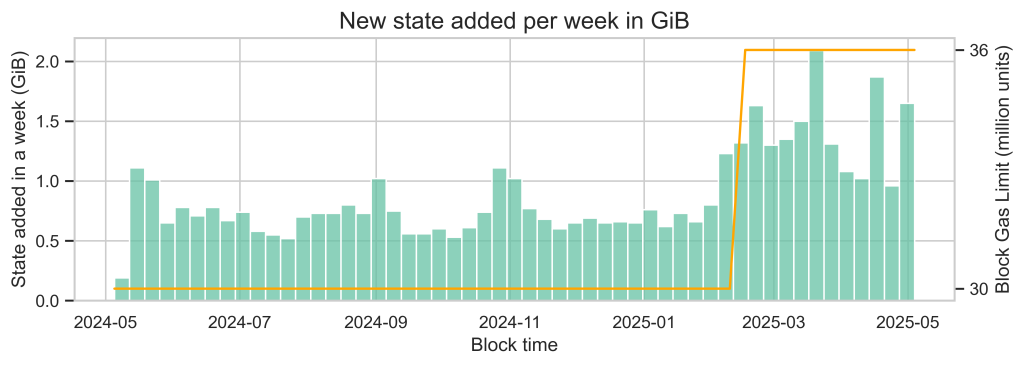
Main consequences of state growth:
- validator load — they must continually add disk space for storage;
- RPC-provider costs. Services must maintain access to full historical archives, raising operating expenses;
- sync problems. As the dataset grows, state download on new devices slows and becomes less reliable.
Possible fixes
Ethereum’s long-term strategy includes achieving statelessness. Validators would verify blocks without storing the chain’s full history. That would raise throughput but shift storage duties to a smaller set of specialised providers.
To strike a balance, the EF team is considering three approaches:
- State Expiry. Remove inactive data. Research suggests about 80% of state is unused for over a year, yet nodes keep it. Developers propose a “best-before date”: old data would be archived and recoverable with cryptographic proofs.
- State Archive. Split data into “hot” (current and fast-access) and “cold” (historical, stored separately).
- Partial statelessness. Nodes would store only fragments of state, while wallets and light clients take on caching. That lowers hardware requirements and reduces dependence on large RPC services.
From scaling to simplification
In December, Ethereum co-founder Vitalik Buterin acknowledged that ecosystem complexity is hindering mass adoption.
Though the blockchain is technically decentralised, its architecture remains insufficiently intuitive for the average user. That creates a paradox: in practice, people end up trusting a small circle of developers rather than open code. Weighing functionality against simplicity, Buterin pointed to the need to “consciously give up some capabilities”.
A shift towards simplicity
According to the roadmap, Ethereum’s end-goal is to make using the network as intuitive as a standard web app. The approach is multi-pronged:
- smart wallets. Implementing smart-contract-based accounts will hide technical details such as key management and gas payment;
- light nodes. In future, a node could run on a smartphone or inside a browser extension, lowering barriers to participation.
Priorities for development
Buterin compared Ethereum to a hybrid of BitTorrent’s scalability and Linux’s openness. He argues the priority now is not faster confirmations but higher throughput.
He says this is achievable thanks to PeerDAS and ZK-proofs. Together they could boost throughput by orders of magnitude while preserving decentralisation.
Has the scaling trilemma been solved?
Early in 2026, Buterin expressed confidence that Ethereum is overcoming the blockchain trilemma thanks to zkEVM and the rollout of PeerDAS.
He expects new kinds of nodes and higher gas limits soon. Between 2027 and 2030, zkEVM should become the standard for validation. The long-term aim remains distributed block production, reducing centralisation risks and levelling access across regions.
Researcher Xiao-Wei Wang of the Ethereum Foundation agrees with this direction. She emphasised that integrating ZK-proofs into L1 is not merely theoretical but part of an approved medium-term roadmap, backed by recent technical breakthroughs.
Bleak forecasts and reasons for optimism
Claudia Biancotti, an economist at the Bank of Italy, outlined a hypothetical scenario in which Ethereum’s market value collapses. In her view, that would crash the settlement mechanism and freeze more than $800bn of assets.
She sees the chief vulnerability of decentralised networks as their infrastructure’s direct dependence on the price of the native token.
Mechanics of a collapse
Blockchains function thanks to validators paid in cryptocurrency. If ETH loses value, incentives to secure the network vanish. That triggers a chain reaction turning market risk into infrastructure risk:
- validators shut down equipment to avoid losses;
- transaction confirmations slow down and the network then halts entirely;
- a falling token price erodes the “security budget”, making a 51% attack cheap and feasible.
The biggest hit would fall on tokens issued atop the base chain. Even fully collateralised stablecoins (USDT, USDC) or tokenised securities would become effectively useless. Assets would remain at addresses but could not be moved because the base infrastructure would stop responding.
Counterarguments: institutions and staking
Despite such theoretical risks, current market dynamics suggest the opposite. Wintermute researchers note liquidity concentrating in blue chips, including Ethereum. Institutional activity has reshaped capital flows, moving the market away from old cyclical patterns.
Confidence in the asset is also evident in the record volume of coins in staking — about 30% of supply is locked. Growth has been driven by large players and ETF issuers:
- BitMine: the firm holds 4.07m ETH (3.36% of supply), earning passive income on nearly half of it;
- ETF: Grayscale has begun distributing staking rewards to clients. Morgan Stanley has filed for a spot Ethereum fund with a staking option.
Many analysts see improving sentiment and constructive signals in both technicals and fundamentals.
“Strong on-chain metrics, steady ETF inflows and optimism among ecosystem participants create the conditions to break through current resistance levels,” believes LVRG Research director Nick Rak.
In his view, the asset’s position is strengthened by a liquidity shortfall driven by large buyers. Further support comes from upgrades that boost scale and lower fees.
***
Ethereum is at an interesting juncture. Prices have yet to fully reflect technological progress, but fundamentally the network has outgrown the speculative stage. Lower fees and heavy developer activity are turning it into a global settlement layer.
The shift from retail hype to institutional pragmatism shows up in the numbers: record staking and interest from giants such as Morgan Stanley create resilience that is hard to ignore. Capital is betting on the protocol’s long-term security, treating it as foundational infrastructure.
Next come Glamsterdam and Hegota — milestones where the race for speed gives way to optimisation and simplification. Vitalik Buterin’s push to “lighten” the protocol suggests a maturing technology: invisible to users, with decentralisation under the hood.
The groundwork for the next cycle is in place; the question is when markets will recognise the evolution.