



Aave Experiences Over $16 Billion in Deposit Outflows in Days
Aave deposits fell by 35% after Kelp hack, dropping from $45.8 billion to $29.6 billion.
Following the Kelp hack, deposits in the leading lending protocol Aave dropped by 35% — from $45.8 billion to $29.6 billion. This was noted by on-chain analyst EmberCN.
Aave 上的总存款量已经跌破 $300 亿。从 rsETH 事件前的 $458 亿到现在的 $296 亿,流出 $162 亿。 https://t.co/kxalj1cZ4y pic.twitter.com/8QoI2tl8S8
— 余烬 (@EmberCN) April 23, 2026
The platform’s TVL continues to decline. At the time of writing, it stands at $15.1 billion, although it exceeded $26 billion on April 18.
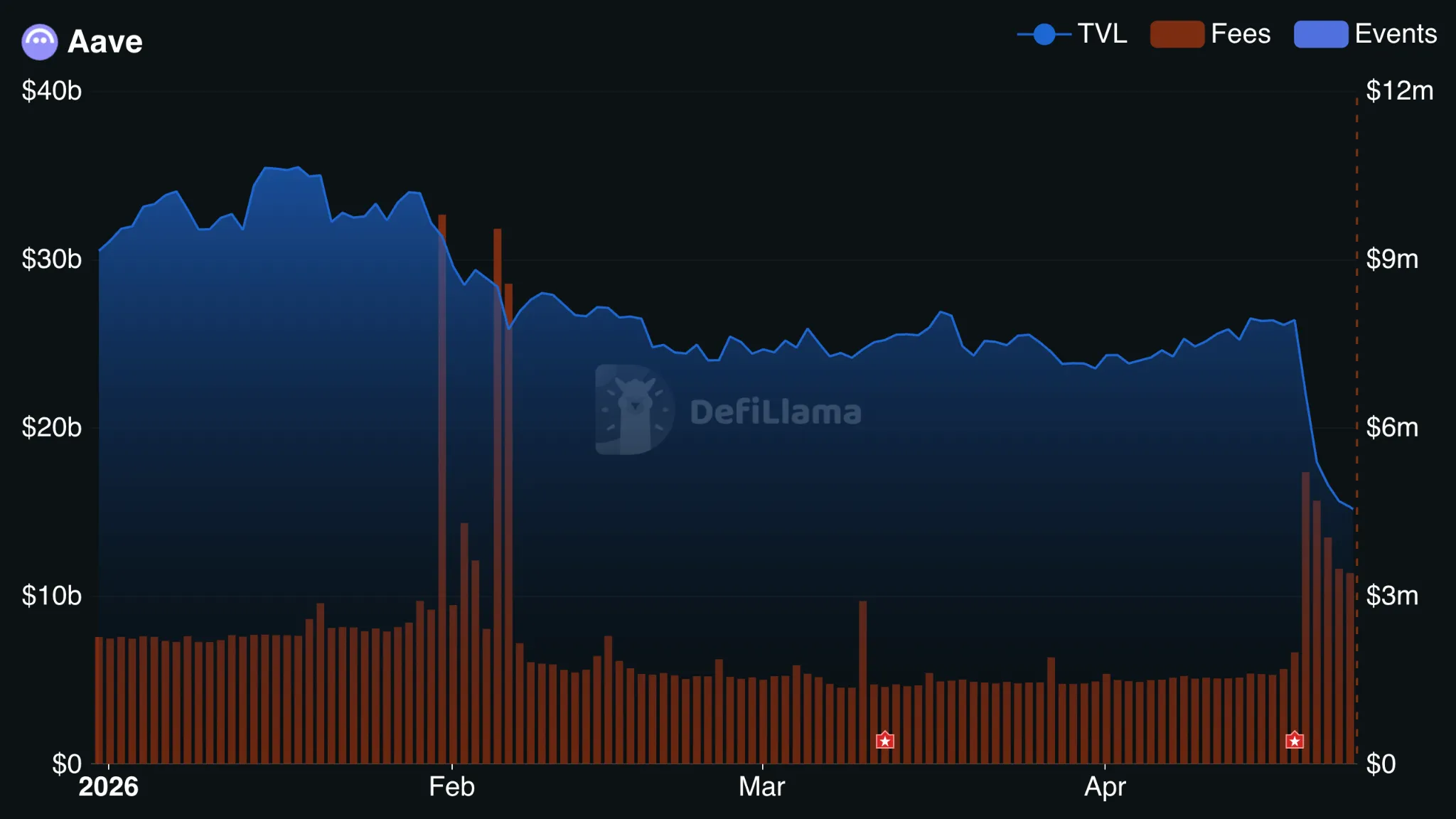
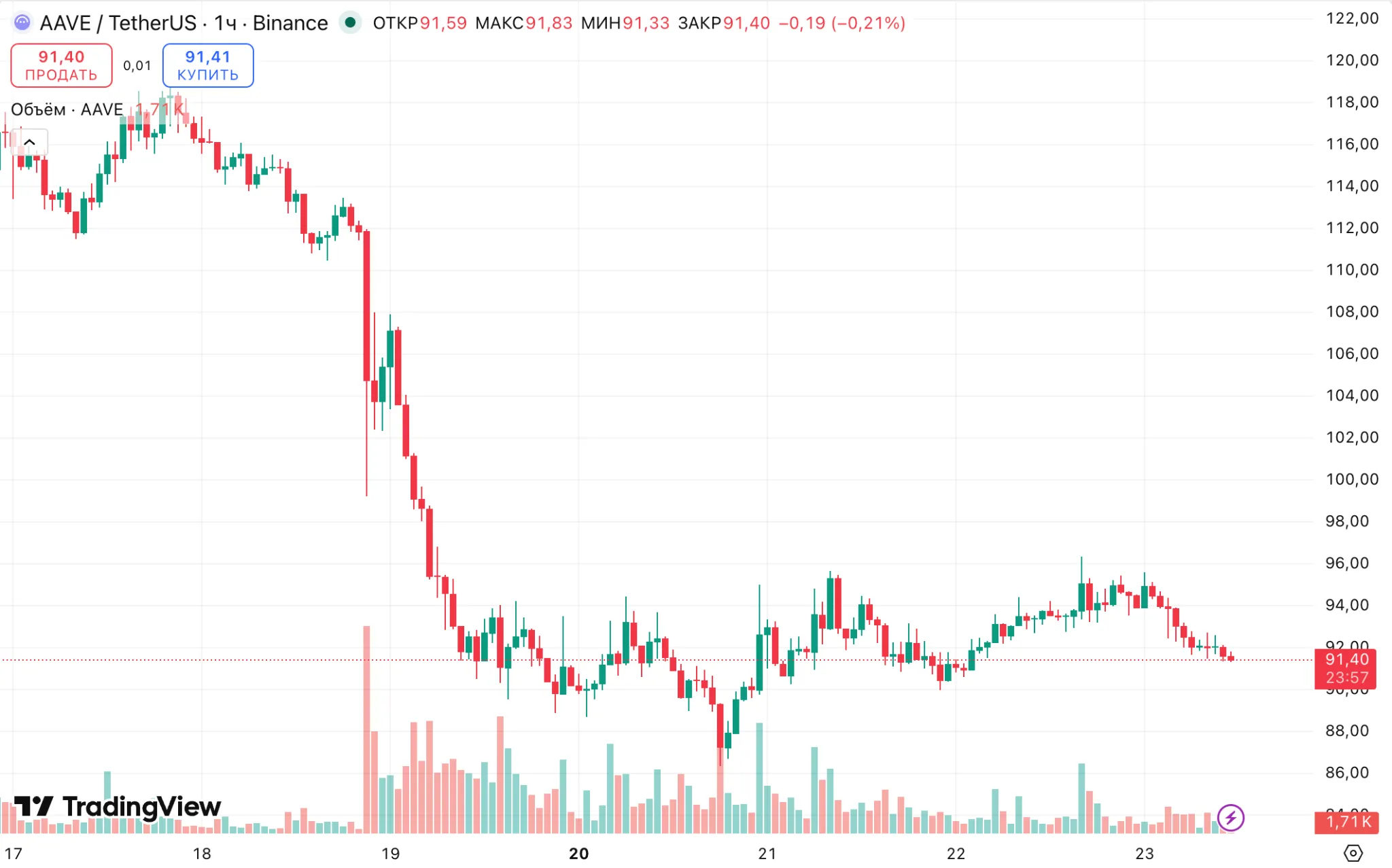
The native token Aave remains in a downward trend. Over the past week, AAVE quotes have fallen by 13.8%. At the time of writing, the asset is trading around $91.4.
The Kelp hacker continues to launder funds. According to EmberCN, in a day and a half, the hacker almost completely converted the stolen 75,700 ETH ($175 million) into Bitcoin via THORChain.
用时一天半,KelpDAO 黑客的 75,700 枚 ETH ($1.75 亿) 现在已经基本上都换成 BTC 了。
黑客把 ETH 跨链兑换成 BTC 主要走的协议是 THORChain,黑客的使用也为 THORChain 带去了 $8 亿的交易量以及 $91 万的平台手续费收入。
—————————————————-#Bitget VIP… https://t.co/YHNjV4jTGy pic.twitter.com/QMsFhsjWFx
— 余烬 (@EmberCN) April 23, 2026
Thanks to this activity, the platform’s trading volume exceeded $800 million, and commission income reached $910,000, the expert noted.
Addressing the Issue
To stabilize liquidity and halt the outflow of funds from Aave, the Fluid project launched an aWETH redemption mechanism.
The aWETH Redemption Protocol is now live on @Arbitrum and @Base.
After processing $400M+ in redemptions on Aave Ethereum, we’re expanding to L2s.
This time, we’ll be opening up for all loopers to unwind while ETH lenders exit to LSTs.
How it works 🧵 https://t.co/lMhmsl8vAL pic.twitter.com/JmxdxUZnHP
— Fluid 🌊 (@0xfluid) April 22, 2026
In 48 hours, 166,772 aETH (about $400 million) passed through it: users converted frozen assets into wstETH or weETH.
The tool is based on the Lite Vault Fluid repository, which holds wstETH and weETH as collateral for ETH debt on Aave. This allows for direct closure of counter positions.
Redemption occurred at a discount of about 2.2%. For comparison, aWETH traded at a discount of up to 23% on the secondary market, according to Castle Labs.
Meanwhile, Circle’s Chief Economist Gordon Liao proposed raising the rate on USDC on Aave v3.
A proposal on AAVE USDC market and liquidity parameters from Circle’s Chief Economist @gordonliao https://t.co/7wX3TWIHop
— Jeremy Allaire — jerallaire.arc (@jerallaire) April 22, 2026
The stablecoin pool on the platform has been fully loaded for four consecutive days: available liquidity fell below $3 million, decreasing by $60 million in a day. The variable loan rate is fixed at a “ceiling” of about 14% and does not “clear” the market.
Following the Kelp hack, about $300 million in new borrowings appeared in Aave. Some borrowers barely react to the rate: 14% per annum is a small price to exit a position. But liquidity providers, seeing the pool empty, demand a higher premium.
Liao proposed making the rate progressive: the more funds are borrowed, the higher it is. At 95% load — 37%, at 100% — 53%. This would force borrowers to repay debts and attract new liquidity.
Community members criticized the idea. Avant protocol founder Rhett Shipp stated that raising rates will not stop the outflow of funds from Aave.
You need to fire your chief economist. This will accelerate capital flight from both aave and usdc.
If you want Morpho and usdt to win, this is a great idea.
— Rhett Shipp (@RhettShipp) April 22, 2026
On April 21, the Arbitrum security council took “emergency measures” and blocked 30,766 ETH (~$71.2 million) stolen from Kelp.
Рассылки ForkLog: держите руку на пульсе биткоин-индустрии!