




BTCFi project Babylon will launch bitcoin‑collateralised lending on Aave V4.
What happens when the world’s largest DeFi lending protocol meets trustless native Bitcoin collateral?
A new era of BTC lending and borrowing, without wrappers, bridges, or custodians.
Babylon and @aave are partnering to build the first native Bitcoin-backed Spoke on Aave V4. pic.twitter.com/NdU35gVMNS
— Babylon (@babylonlabs_io) December 3, 2025
Users will be able to borrow in stablecoins and other tokens against native bitcoin collateral, without bridges or wrapped assets.
The core of the integration is the Babylon Bitcoin Vault. It allows digital gold to be locked on the main chain, while DeFi protocols create a cryptographically verifiable “twin” to use as collateral.
“Our Bitcoin vaults operate without the need to trust intermediaries. This allows the use of Bitcoin itself in DeFi, not its substitutes, while fully preserving the main advantage — the absolute security of the network. Integration with Aave V4 is exactly the meaningful application that immediately shows the strength of our technology,” commented Babylon co-founder David Tse.
The release notes that collateralised lending was in high demand in 2025. Loans secured by the first cryptocurrency exceeded $1bn. The Babylon team expects the figure to keep rising as institutional interest grows.
For now the options are limited: most activity runs through centralised platforms or uses wrapped versions of the asset. That entails counterparty risk and the loss of key bitcoin properties, the developers noted.
The state of BTCFi
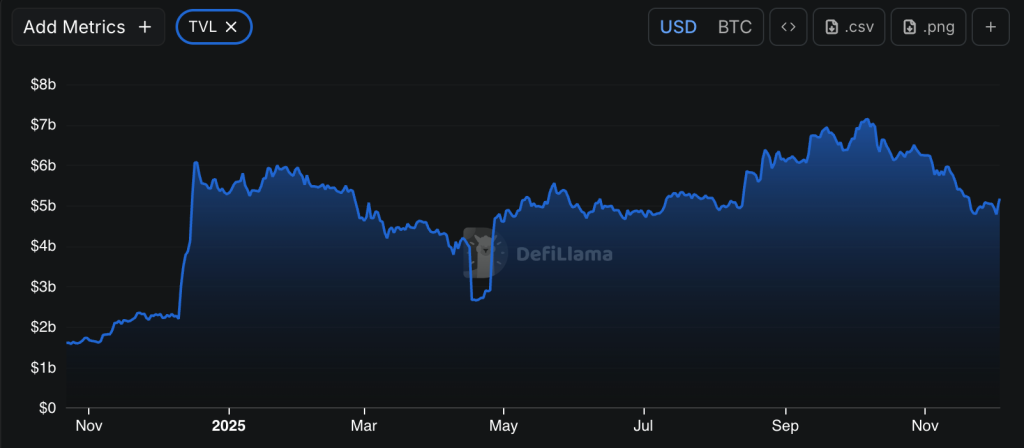
Babylon is the leading BTCFi project by total value locked at $5.1bn. At its peak it reached $9bn.


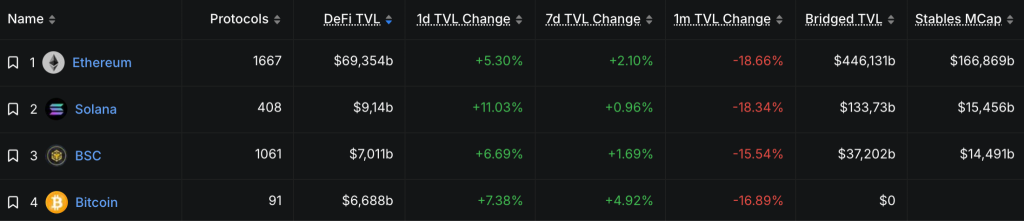
The entire decentralised‑finance segment on bitcoin stands at $6.6bn. The ecosystem lags far behind rivals such as Binance Smart Chain, Solana and especially Ethereum:


Some consider the field the next stage in the evolution of the first cryptocurrency. BTCFi surged initially, but the momentum faded in early 2025. TVL growth has since stagnated.
A new Aave initiative
The Aave DAO is debating abandoning its multichain strategy. The protocol could exit ZKsync, Metis and Soneium.
“Each separate Aave V3 deployment across multiple blockchains is an operational expense and a new attack vector for the protocol. Analysis shows that some of our instances do not pay for themselves: their revenues do not cover either the costs or the risks taken,” the authors of the Aave Chan Initiative (ACI) noted.
According to them, the Metis project, whose co‑founder is Vitalik Buterin’s mother, Elena Sinelnikova, generates just over $3,000 a year. Soneium brings in about $50,000. By contrast, Aave’s main deployment on Ethereum yields more than $142m.
Beyond low revenues, these networks also add operational overhead.
“Listing new assets on some of them requires disproportionate engineering effort. Given the team’s current workload and the extremely low payoff, maintaining this work now is not advisable,” ACI explained.
To address this, the developers proposed two measures:
- set a $2m minimum annual revenue threshold for any new protocol deployment;
- introduce a “Reserve Factor” for stablecoins in existing but low‑revenue networks. This means a portion of funds in “stablecoins” will be retained as reserves, boosting the pool’s overall yield.
A preliminary vote has 100% support; it closes on 5 December, after which a public discussion will begin.
In October, the Aave community proposed launching a buyback programme for AAVE tokens.