



Upgrades to the bitcoin network are infrequent—the last soft fork, Taproot, was activated in November 2021. By comparison, since then Ethereum has shipped Shapella, Dencun and The Merge, with the Pectra upgrade already slated for the first quarter of 2025.
Meanwhile, the community is only debating the possible implementation of an improvement proposal dubbed OP_CAT (BIP-347). Here is why it matters, and why developers’ ideas move so slowly from concept to code.
Remove, don’t add
Shortly before disappearing in 2010, bitcoin’s creator Satoshi Nakamoto made several significant changes to the protocol of the first cryptocurrency:
- introduced a 1 MB block-size limit to deter spam attacks and improve the network’s decentralisation;
- fixed bugs related to integer overflow, which could have led to invalid or malicious transactions;
- removed centralized nodes, adding a DNS seed mechanism that lets clients dynamically discover peers to connect to the network;
- disabled 16 opcodes, including OP_CAT. The latter pushes a one-byte value onto the stack, then repeats OP_DUP and OP_CAT 40 times, inflating it to more than 1 TB.
These changes enabled the development of digital gold while preserving decentralisation. Even so, the peculiarities of Script have long hampered bitcoin’s programmability:
- stack-based language. Operations are processed in a stack following a last-in, first-out (LIFO) principle;
- not Turing-complete. It does not support loops and other constructs that could cause unbounded computation. This constrains building dapps with complex smart contracts, but makes the language safer;
- small instruction set. A limited number of opcodes allows only simple tasks such as adding, comparing and hashing data on the stack.
In late 2021 the Taproot soft fork introduced support for Schnorr signatures (BIP-340) and the TapScript scripting environment (BIP-342). The latter capped the maximum size of a stack element at 520 bytes, thereby removing OP_CAT’s potential vulnerability.
Don’t remove, add
The BIP-347 draft was published in 2023 by developers Ethan Heilman and Armin Sabouri. They proposed reviving OP_CAT via a soft fork by assigning its semantics to the existing OP_SUCCESS126.
Smart contracts enable funds to move automatically without intermediaries. In bitcoin, however, their functionality is largely limited to locking and unlocking.
Covenants—conditions or restrictions that enforce certain rules when interacting with assets or functions in a contract—could broaden bitcoin’s smart-contract capabilities.
OP_CAT’s core function is conCATenation: joining two or more strings or other sequences into one. The BIP-347 authors propose using reverse concatenation to create recursive covenants and to split stack elements into multiple parts.
If a smart contract receives a user’s signature and public key, it could verify them independently, ensuring both pertain to the same transaction.
Introducing OP_CAT would help minimise the threat from quantum computers and enable on bitcoin:
- vaults—covenants to block attackers who have obtained a user’s secret key;
- multisignature with more than 20 public keys by using Merkle trees in script verification;
- secure cross-chain bridges with L2 networks;
- support for sophisticated financial instruments such as escrow accounts;
- enhanced atomic swaps;
- penalties for double-spending in payment channels.
Taproot Wizards co-founders Eric Wall and Udi Wertheimer have fronted a PR campaign to bring OP_CAT back under the slogan BIP-420 and launched the Quantum Cats inscriptions collection to highlight the boost to bitcoin’s quantum resilience after the upgrade.


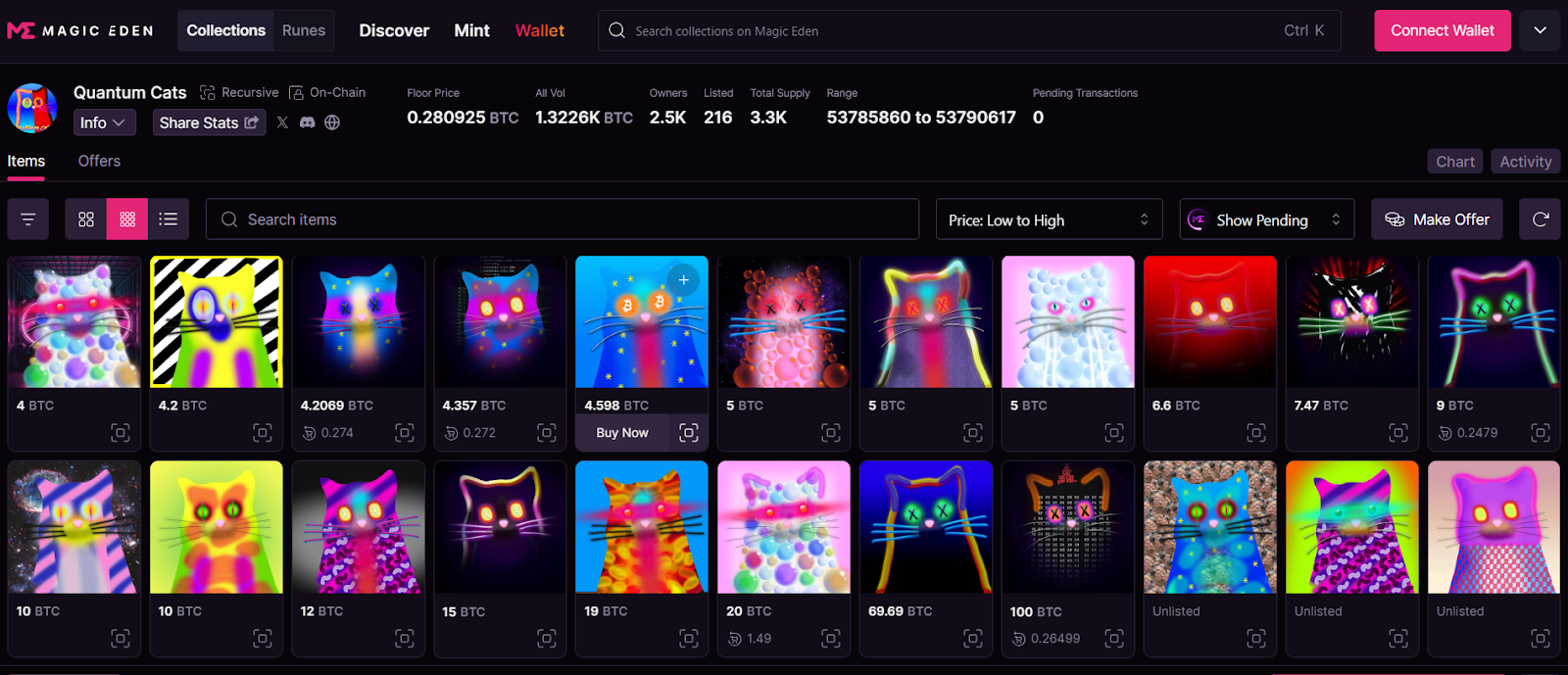
According to CoinGecko, in April 2024 the floor price of a “quantum cat” reached 0.47 BTC. At the time of writing the NFTs trade around 0.28 BTC.
OP_CAT is not the only proposal to support covenants. Developers have put forward several other approaches:
- Check Template Verify (CTV)—an opcode from Jeremy Rubin that guarantees only transactions matching a predefined template can spend coins. Potential use cases include vaults and more complex multisig schemes;
- OP_CHECKSIGFROMSTACK (CSFS) makes multisig easier—allowing signatures to be verified when pulled from the stack rather than standard transaction fields. It is considered a more flexible and powerful route to a wider range of applications;
- LNHANCE. Offers flexible scripting, including loops and conditional execution based on external data. A conceptual, less formalised proposal.
The community is also discussing cross-chain bridges and L2 networks if OP_CAT is adopted. For example, Taproot Wizards has begun work on a bitcoin-scaling protocol, CatVM, as an alternative to the existing BitVM, where users have to rely on operators to move funds.
StarkWare, the company behind StarkNet, has announced plans to make its L2 network a single scaling layer for the first cryptocurrency. According to co-founder Eli Ben-Sasson, this could be achieved six months after OP_CAT is implemented:
“Once OP_CAT is accepted, implementing a STARK verifier into Bitcoin script becomes real. This will open the path for secure and self-custodial movement between the first cryptocurrency’s blockchain and StarkNet, creating a single scaling layer for both Ethereum and BTC.”
Why it takes so long
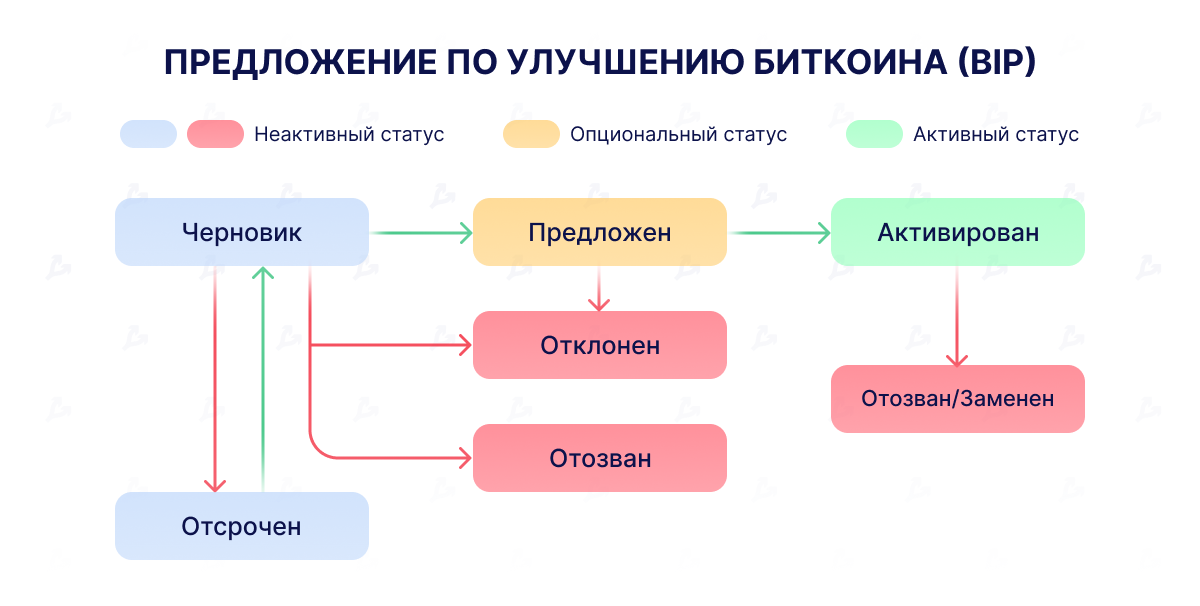
Bitcoin is an open protocol that lets anyone with the requisite skills publish a BIP. After that, however, the proposal must be accepted by a group of editors and then approved by 95% of miners.

For a long time the only BIP editor was Luke Dashjr, who has voiced controversial views on bitcoin’s future. For instance, early this year he proposed blocking Ordinals at the code level, but failed to gain sufficient support.
In April 2024 Bitcoin Core developer Ava Chow proposed forming a group of editors to speed up decision-making and relieve Luke Dashjr of excessive responsibility.
The team includes bitcoin developers Brian Bishop (Kanzure) and John Atack, bitdevs.org contributors Mark Erhardt (Murch) and Ruben Somsen, and Lightning Labs CTO Olaoluwa Osuntokun (Roasbeef).

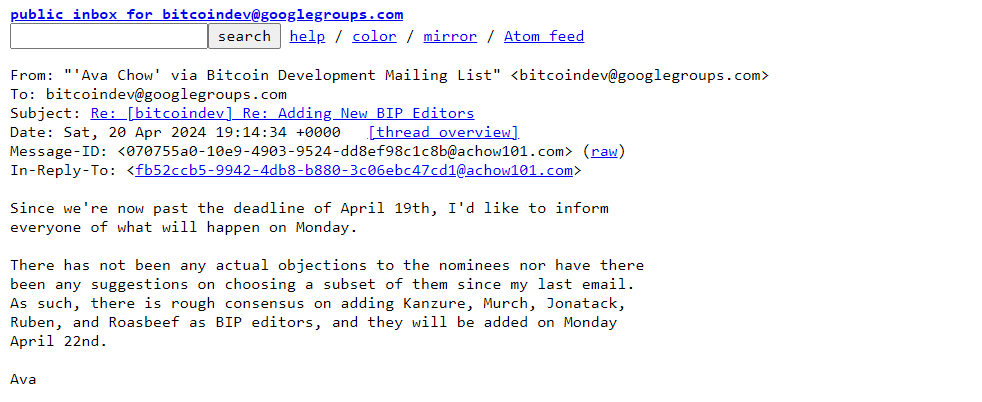
The change helped accelerate the next potential upgrade: on 24 April 2024 the editors assigned OP_CAT the number BIP-347.
“Assigning a number does not signal community consensus, but it makes it easier to discuss and write software for the proposal, because it now has a unique identifier everyone agrees on,” noted Ethan Heilman in an interview with CoinDesk.
Conclusions
OP_CAT would expand bitcoin’s functionality and allow advanced smart contracts on the network of the first cryptocurrency.
For SegWit and Taproot, the path from first mention to implementation took about two years, and activation came roughly a year after community approval. On that precedent, BIP-347 could be implemented in 2026.