




On February 3rd, OpenAI unveiled its new Deep Research agent feature for in-depth investigations, available to Pro subscribers at $200 per month. Decrypt has compiled a list of similar, yet more affordable or free solutions on the market.
Access to this functionality is limited to users of the most expensive ChatGPT subscription due to its high computational demands. Although OpenAI’s CEO, Sam Altman, has promised to make the tool available to everyone in the future, similar solutions from other companies have been available for several months.
it is very compute-intensive and slow, but it’s the first ai system that can do such a wide variety of complex, valuable tasks.
going live in our pro tier now, with 100 queries per month.
plus, team, and enterprise will come soon, and then free tier.
— Sam Altman (@sama) February 3, 2025
Gemini Deep Research — Ten Times Cheaper
In December 2024, Google launched its Gemini 2.0 AI model and the Deep Research feature, which uses “advanced reasoning” and “long context capabilities” to create a brief summary after conducting research. Briefs can be exported to Google Docs for further editing.
The service can analyze information related to a query using the internet, acting as a sort of research assistant. The results are presented as a concise summary with links to sources. The procedure is as follows:
- The user writes a query.
- Deep Research creates a “multi-step research plan.”
- The user confirms the start of the analysis.
- Deep Research conducts the research within minutes and generates a response.
Unlike OpenAI, Google imposes no restrictions on the number of queries. According to Decrypt’s tests, the research process mirrors Altman’s startup’s approach. Users input a topic and receive the results.


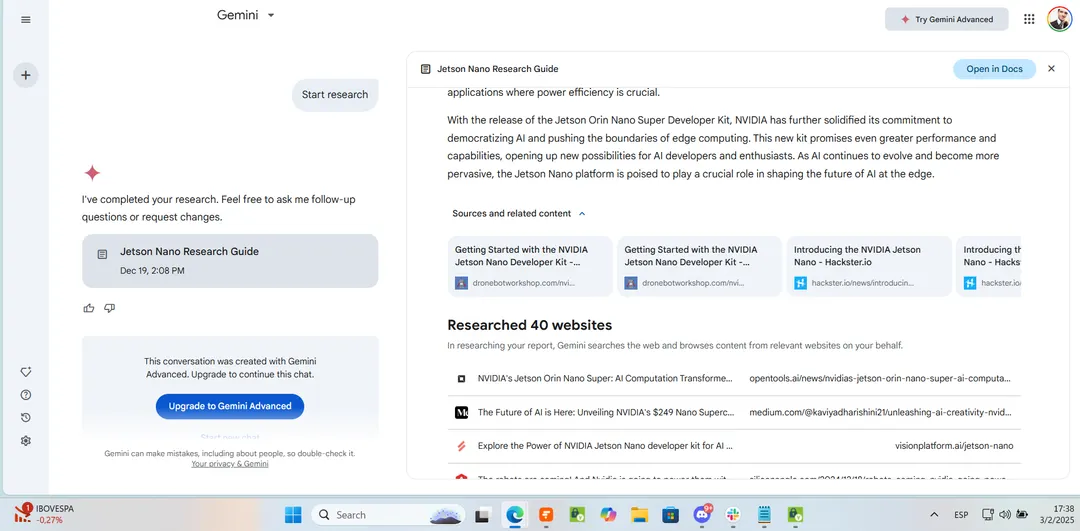
Regarding sources, Gemini acts cautiously, favouring reputable scientific journals and respected news outlets over smaller sites and blogs. The process takes only a few minutes.
Research on Nvidia Jetson Nano took three minutes. The model analyzed 40 sites and provided a six-page report on the technology, its operation, potential, key competitors, and other useful information.
The service is available to owners of the paid Gemini Advanced version, which costs $20 per month.
You.com — For Speed
The AI startup You.com is known as a competitor to Perplexity in the search engine field. In November 2024, it introduced an AI agent for conducting research.
The tool can analyze up to 200 sources for a single query and employs research methodologies at a PhD level. It operates faster than OpenAI’s Deep Research. In some cases, queries are processed in seconds and almost never take longer than a few minutes.
However, speed comes with trade-offs — You.com reports typically span two to three pages.
The platform offers three free researches per day; for more, a different model is required.
DeepSeek R1 — Completely Free
The much-discussed Chinese model DeepSeek features built-in internet access, setting it apart from competitors.
To properly configure the neural network for complex reasoning, one must select Deep Reasoning. This activates the R1 model. By default, V3 operates, which is geared towards creative tasks.
After activating web search and reasoning, the model needs detailed instructions regarding the task, ideally structured as a plan or set of recommendations.
R1 demonstrates its work and thought process in real-time. Users can ask clarifying questions to obtain more detailed information. The initial analysis for Decrypt comprised three pages, but later expanded to 25 pages of relevant content within the given topic.
Other Players
Among other tools, the publication highlighted the work of Beago AI, Perplexity Pro, and AI Scientist.
Earlier in January, the startup OpenAI introduced its own AI agent “Operator,” capable of performing tasks on the internet on behalf of the user.