



After Gotbit: A large scam syndicate surfaces
Zeus gave Pandora a mysterious box (in fact, a pithos — a large jar) and forbade her to open it. Curiosity prevailed. When Pandora lifted the lid, all the world’s ills flew out: disease, war, suffering. Only hope remained at the bottom.
On 15–16 February the LIBRA token launched, briefly championed in person by Argentina’s president, Javier Gerardo Milei. A lightning ascent to a $4.5bn FDV, followed by a headlong plunge and a string of scandals, opened Pandora’s box: out spilled the crypto market’s classic vices — manipulation, scandal, deceit, insider dealing and sniper bots. The web filled with theories about a covert group in the industry perpetrating the dirtiest rug-pulls on credulous punters chasing a few quick multiples on a new memecoin.
Does such a group exist? Who is influential enough to pull presidents’ strings? Where does Gotbit fit in? And the crucial question: is there any hope for a normal altseason when scammers are siphoning off hundreds of millions of dollars from crypto investors?
We sift the rumours, conjectures and verified facts in this ForkLog report.
In Gotbit’s footsteps
Until recently, one of the louder names in memecoins was the notorious market-maker Gotbit, which rose to prominence with the BONK trade. Alexey Andryunin’s firm provided marketing and advisory services to the team behind the token from July 2023. Toward year-end the coin began a strong run that cycled up and down into November 2024.
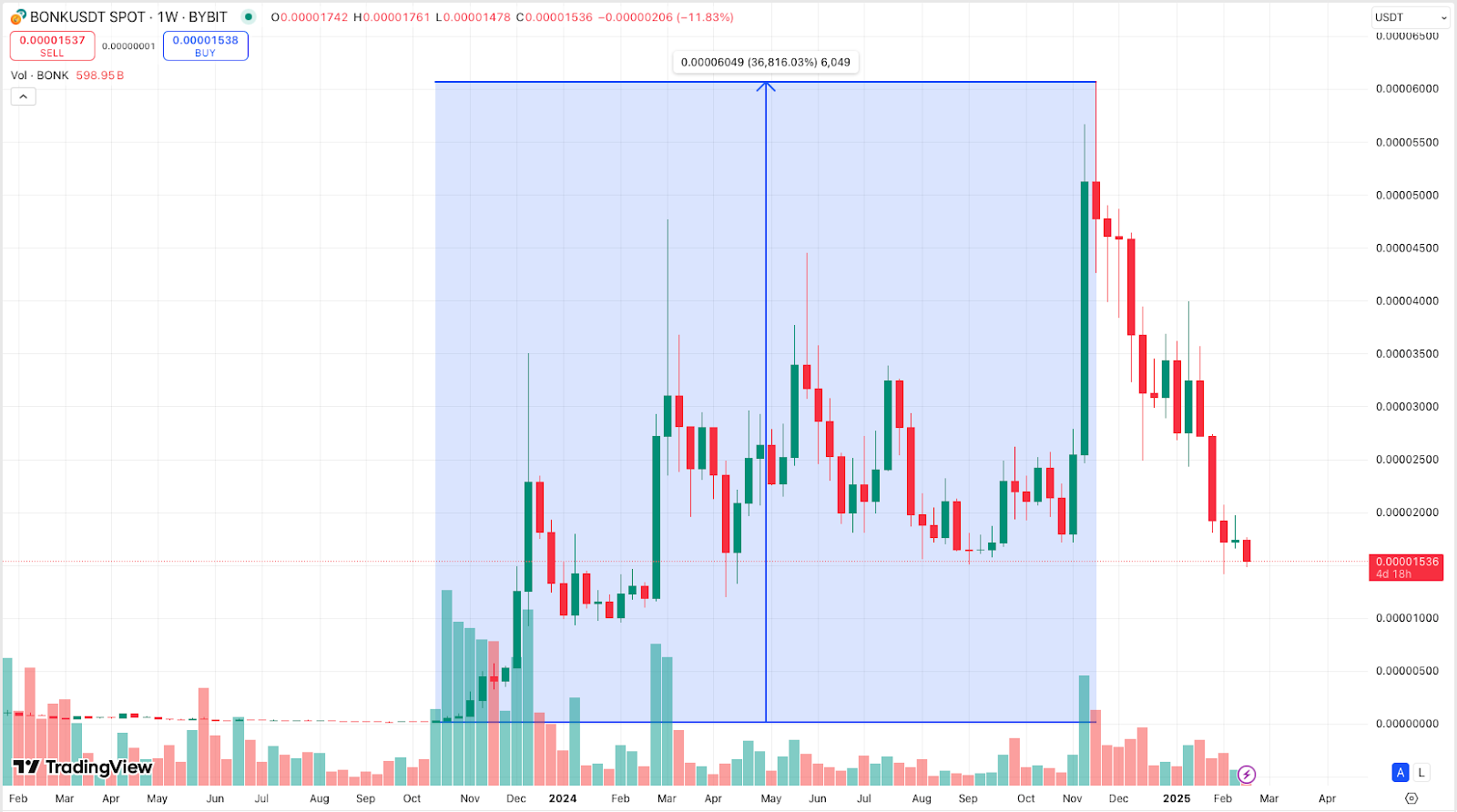
Gotbit cemented its status as a big crypto player — and earned the label of manipulator. With a portfolio of 500+ tokens and an in-house team of 200+, it did more than “paint” charts: it ran social media, timed announcements to price action on exchanges, and supplied infrastructure. The package helped memecoins rocket — and then, inevitably, crash.
In October 2024 the quasi-legal playbook met its denouement: federal prosecutors in Boston charged “the first-ever criminal charges against financial firms for manipulating the crypto markets and wash trading.”
Andryunin’s line that memecoins are unregulated and thus fair game for manipulation did not save him.
His arrest created a hole in the manipulation racket — apparently filled by another, even more influential group.
“Presidential” scams as a meta
Donald Trump was first among presidents to stride onto the memecoin stage. On January 18th, two days before inauguration, he announced on X and Truth Social the launch of TRUMP.
The token shot to a $75bn FDV before entering a long slide.
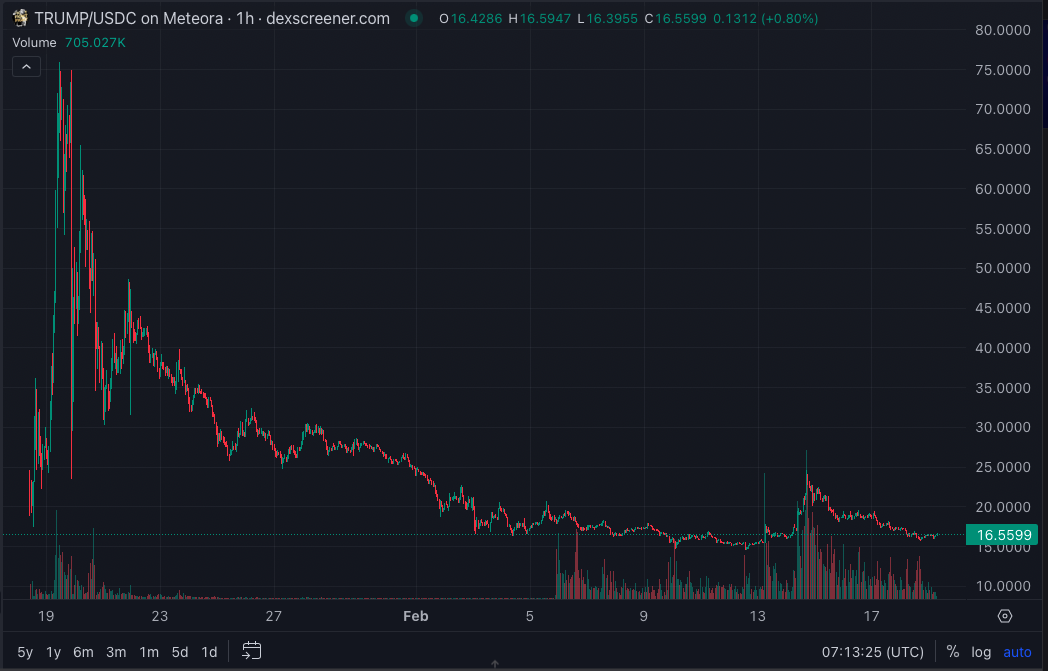
Mr Trump swiftly distanced himself, while confirming the token was indeed his, though he was not paying it much heed. Plainly the politician did not run the launch or the market-making. A team appears to have offloaded into the rally post-launch. There were also bouts of buying — unlike the Argentine coin.
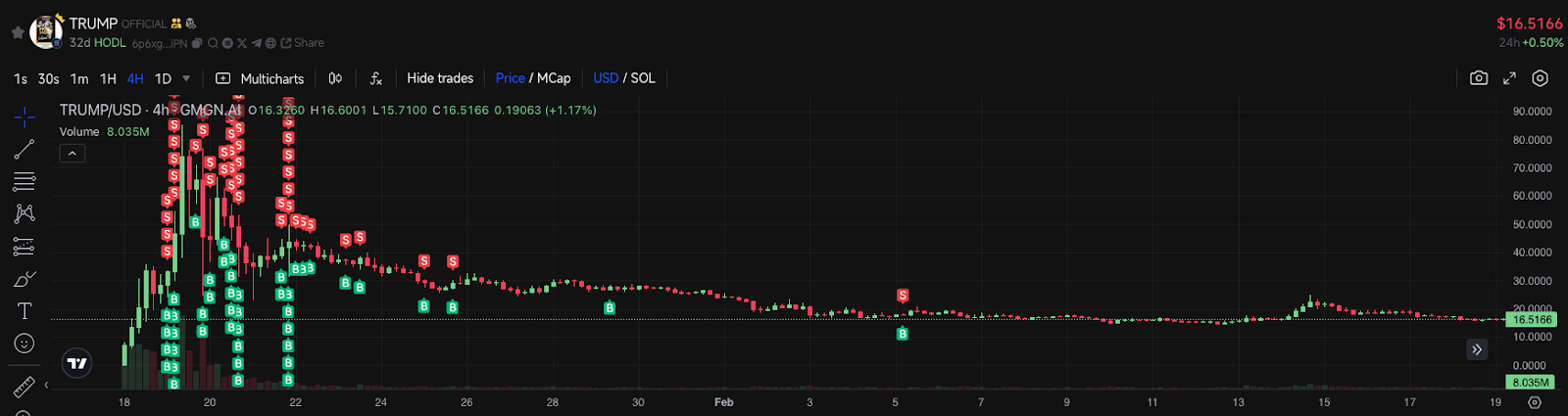
Estimates of the developers’ take varied widely, from $100m to $800m.
On January 19th a token from Mr Trump’s wife, Melania, appeared. It fared worse, and fell faster. The developers sold into the earliest green candles.
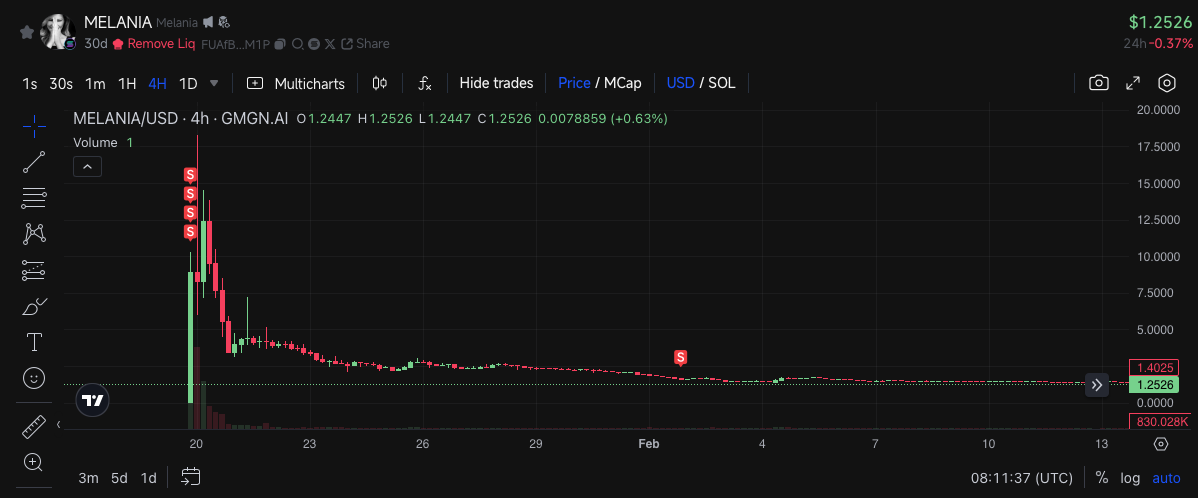
And the unlocks have yet to start. On 19th and 20th February, 3% of supply will be released, then another 3% a month later and 2.25% every 30 days for a year.
川普老婆币 $MELANIA 团队的代币后天或大后天 (2/19~20) 就要开始解锁了:会解锁总量 3% (3000 万枚) 的 $MELANIA,价值 $3900 万。
根据 $MELANIA 的解锁规则,团队的代币只有 30 天的锁定期,满 30 天的时候解锁 3%、然后接下来 12 个月里每个月解锁 2.25%。
一共 30% 总量的代币,在 13… pic.twitter.com/EZh0pT1RGG— 余烬 (@EmberCN) February 17, 2025
LIBRA hammered the last nail into mem-speculators’ coffin. Insider and sniper selling was the most aggressive here; the rout that followed was sharper still.
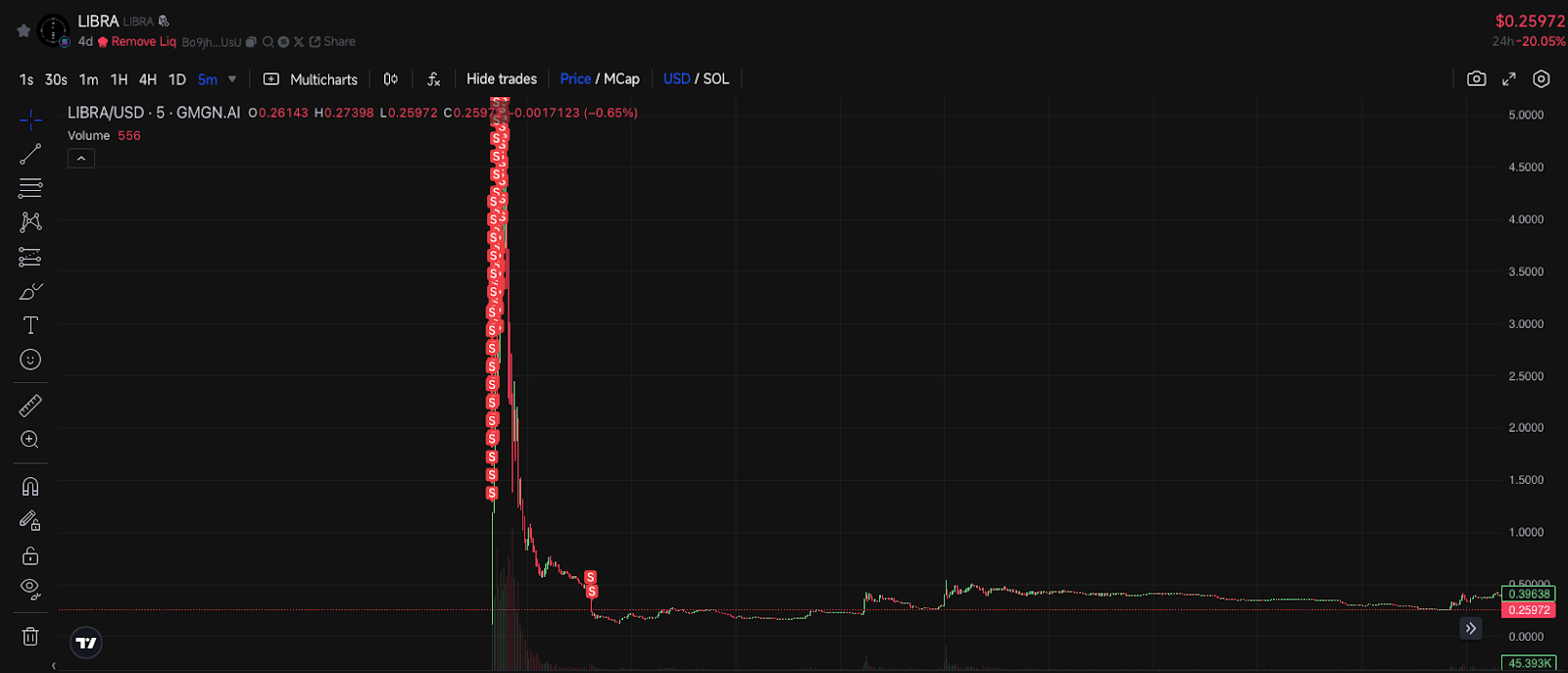
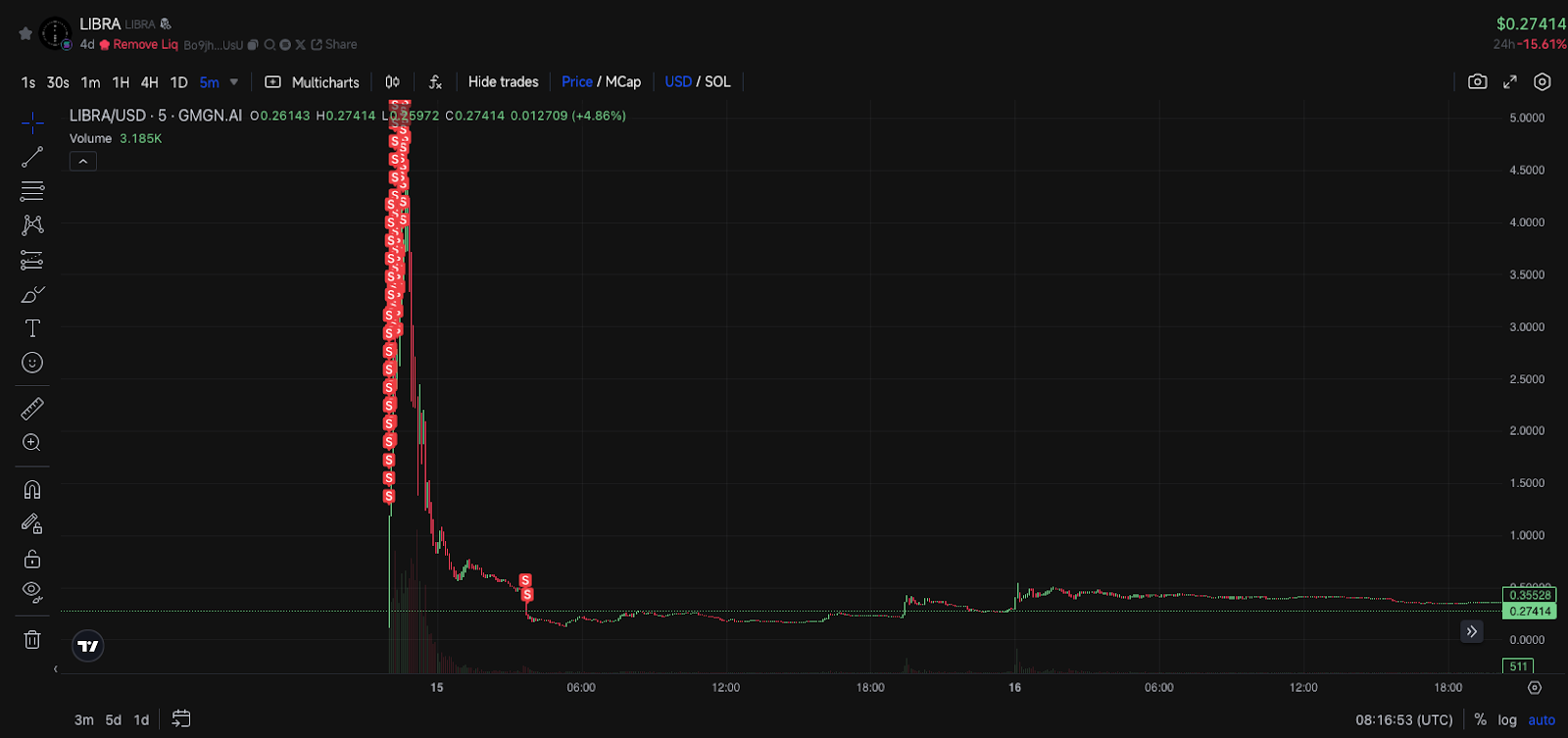
On February 14th, hours after the token’s debut, Argentina’s president deleted his announcement post, later saying he had “shared information about the token, not promoted it.” He also confirmed he had met the people who proposed and ultimately launched LIBRA.
Twenty-four traders lost more than $1m; 61 lost over $500,000. The largest loss was $5.17m.
24 traders lose $1M+ on $LIBRA! 61 traders lose $500K+ based on transaction history.
The biggest loser realized $5.17M loss! He spent $5.6M to buy 2.1M token in total, and ended up sold these token for $430K!
More on ? https://t.co/2Jkc0aK7J4 https://t.co/CwFwhyq5Ov pic.twitter.com/2tx4se0G5o
— lmk.fun ? (Prev. Scopescan) (@lmkfun) February 15, 2025
Meanwhile Hayden Davis, the man behind the launch, moved $100m — purportedly to shield funds from snipers.
Addressing Libra: pic.twitter.com/lUlAADWnkq
— Kelsier (@KelsierVentures) February 16, 2025
Patience snapped when the “protection of users” fig leaf was used to excuse what many openly called a scam.
Links among LIBRA, TRUMP, MELANIA, CAR
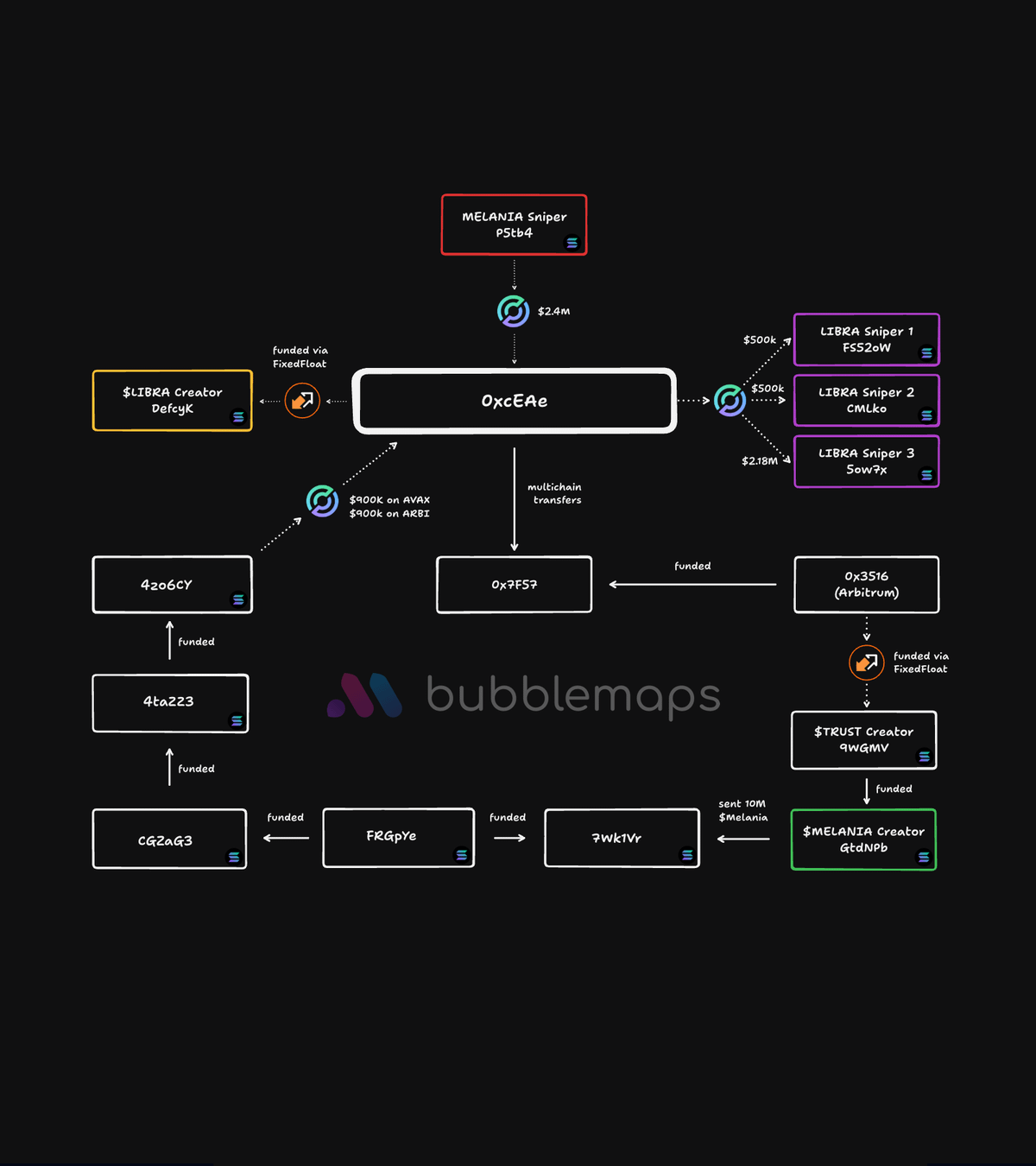
Researchers have flagged ties between the teams behind LIBRA and MELANIA. Bubblemaps says both coins were created by the same developers or their close circle.
According to the firm, suspicious activity began on January 19th, at MELANIA’s launch. A main wallet, labelled 0xcEA, made $2.4m on the First Lady’s coin. The funds were promptly moved to another address on Avalanche.
After LIBRA appeared, the wallet used the same playbook, netting another $6m. Bubblemaps argues this points to a single team behind both projects.
The analysts add that 0xcEA and the wallets used to fund LIBRA are linked by a chain of transactions spanning several blockchains, including Solana and Arbitrum.
They also associate 0xcEA with other pump-and-dump schemes, including a fake Robinhood token (HOOD) whose market cap rose to $120m before collapsing to $12m.
Hayden Davis — CEO of Kelsier Ventures, which effectively acted as LIBRA’s custodian and liquidity provider — said in a video that the coin crashed because of actions by President Javier Milei. On-chain data, however, points to insider selling as the main driver.
Mr Davis also said he was ready to return $100m and insisted on the innocence of the “company sponsoring LIBRA” — KIP Protocol. KIP, for its part, called LIBRA a Kelsier project.
In a separate interview he blamed sniper bots that buy immediately after listing.
He said that virtually every memecoin launch involves insider trading — now standard procedure. He also admitted a role in launching Melania Trump’s token and noted a sniper team operated there too.
If the same people stand behind MELANIA and LIBRA, they may well be behind TRUMP. Launches of this scale do not happen in hours. They require lengthy prep and access to principals — in this case to the Trumps and Mr Milei — as well as pre-approval of social posts. It strains belief that one team ran TRUMP and, the very next day, a different team ran MELANIA.
Launching a memecoin is a complex, preparation-heavy process. A rough outline:
How the group operates
According to rapper YE, who refused a $2m fee to promote a memecoin, the group follows this script:
- Approach a celebrity with cash for promotion.
- Launch the token; have the public figure post the contract on social media.
- Dump tokens on retail and book profits.
Reaching a head of state is hard; the inner circle helps, including relatives. Mr Davis boasted he could “control” Argentina’s president thanks to payments to his sister, Karina Milei — in mid-December, two months before LIBRA’s launch.
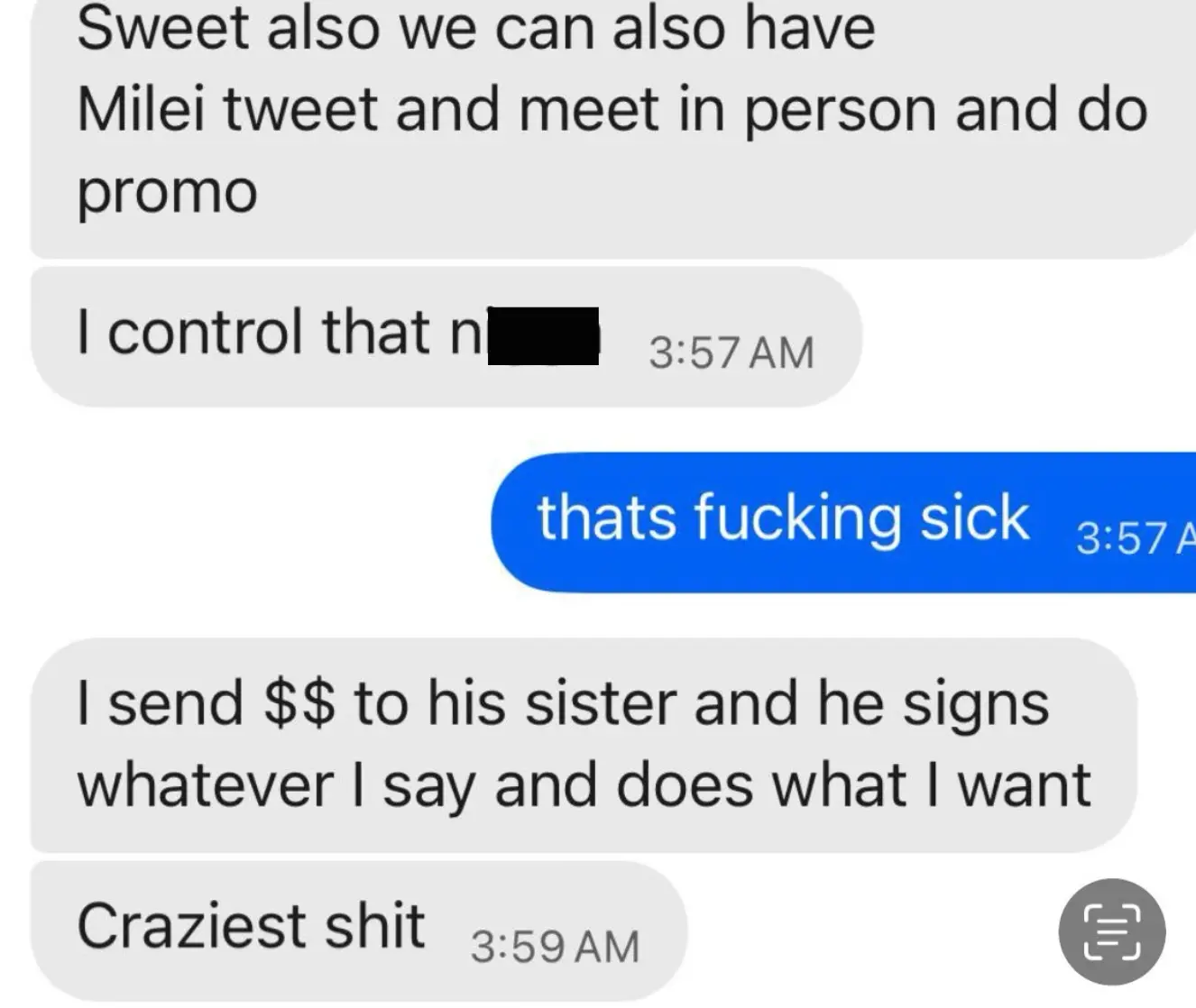
“I send $$$ to his sister, and he signs whatever I say and does what I want,” he said.
Mr Davis’s representative, Michael Padovano, denied the authenticity of the messages, calling the leak a political attack on Mr Milei.
Diogenes Casares, co-founder of Stream Finance, said at least one person near the president took a $5m bribe to arrange an introduction.
“To be clear: this does not mean Milei received money to promote the token; rather, it’s someone close to him,” he explained.
Mr Casares stressed that his source’s seniority and reliability made the claims hard to dismiss.
Dave Portnoy, founder of sports-media firm Barstool Sports, said he knew of LIBRA’s launch in advance. He was offered payment to promote it.
For the record I could care less that people know Hayden paid me back. I was fully planning on saying it on the live stream but he caught me off guard by texting me in the middle of it and asking me not to mention it. You can actually see my eyes read the text in real time… pic.twitter.com/DR4pqpDKhS
— Dave Portnoy (@stoolpresidente) February 17, 2025
He said he was ready to join as an adviser and bought the token after launch, but returned a gift of roughly 6m LIBRA after the memecoin’s creator told him not to disclose the bonus.
Mr Portnoy said he trusted Mr Davis because of his prior crypto experience and hoped the project would help him reach the president. The token’s creator floated an interview between Portnoy and Mr Milei to “introduce the world” to Argentina’s leader.
Later Mr Portnoy mistakenly bought the wrong LIBRA and lost $170,000. He tried to recoup losses by launching the GREED memecoin. After its market cap rose to $37m, he dumped 35% of the supply on his own audience, pocketing about $258,000.
The token fell 90%. He then had the gall to launch Greed 2 under the pretext “don’t invest more than you can afford to lose,” while buying 26% of the supply himself.
Mr Portnoy has also long pushed the JAILSTOOL memecoin, while denying involvement in its creation. Aggrieved users urge a boycott of his projects over what they call widespread fraud.
Also worth noting is the “official memecoin” of the Central African Republic — CAR. It has not been tied to scandal, so it is unknown whether the same people behind LIBRA/MELANIA/TRUMP launched it. What is clear is another presidential wreck.
The team behind LIBRA worked on a similar project with Nigeria’s authorities. Other countries have asked for comparable initiatives.
Among other influencers who knew of LIBRA’s launch ahead of time is Threadguy.
Jupiter and Meteora
Users also suspect two major Solana-based decentralised platforms — Jupiter and Meteora — of ties to the LIBRA debacle.
One theory holds that the scam ring has an insider within both teams.
A compilation of $LIBRA Insiders
Main theory now is that the cabal has an insider in the Meteora team (which is also Jupiter team) pic.twitter.com/NnKFp9WfpD
— Smol News (@NewsInSmol) February 15, 2025
Several Jupiter employees knew about the coin touted by Argentina’s president two weeks in advance, via Kelsier Ventures. The exchange denies involvement in internal processes or dealings with market-makers.
On $LIBRA
Since the start, Jupiter has always placed a massive premium on transparency. The memecoin launch game is a dirty game with plenty of ugly behavior. We, however, have nothing to hide.
So here are the facts as clearly as we can say them.
A few members of the…
— Jupiter (?, ?) (@JupiterExchange) February 16, 2025
In memecoin circles the “Argentine coin” was no secret, but, the team says, no one at Jupiter received tokens or launch-related compensation.
On $LIBRA
Since the start, Jupiter has always placed a massive premium on transparency. The memecoin launch game is a dirty game with plenty of ugly behavior. We, however, have nothing to hide.
So here are the facts as clearly as we can say them.
A few members of the…
— Jupiter (?, ?) (@JupiterExchange) February 16, 2025
“We take accusations of insider trading extremely seriously. We ran our own investigation and found no evidence of sniping by team members,” Jupiter said.
Meow, a co-founder of both Jupiter and Meteora, issued a separate statement.
Hi, I’m meow from Jupiter, and I also cofounded Meteora.
Firstly, I’d like to reiterate my confidence that no one at Jupiter or Meteora committed any insider trading or financial wrongdoing, or received any tokens inappropriately.
Secondly, we are hiring an independent 3rd…
— meow (?, ?) (@weremeow) February 18, 2025
His points:
- no one at Jupiter or Meteora engaged in insider trading or financial wrongdoing;
- the company hired independent firm Fenwick & West — among the most authoritative law outfits globally — to investigate and publish a report;
- Meteora has operated separately from Jupiter for over a year; its head, Ben Chow, resigned because “he demonstrated a lack of judgment and care about some core aspects of the project.”
Mr Chow, in his own statement, said neither he nor the team ever received tokens or insider information about LIBRA.
There have been questions regarding Meteora and my involvement in $LIBRA, so I want to explain our role and share why we work with 3rd parties.
Meteora and I personally, have never received or managed any tokens on the side, do not receive knowledge or get involved with any…
— benchow.sol (@hellochow) February 17, 2025
He acknowledged recommending Mr Davis and Kelsier Ventures to several projects as token developers, including MELANIA.
Meanwhile, news outlet SolanaFloor published a video of an apparent conversation between DefiTuna founder Dhirk and Mr Chow.
? BREAKING: SolanaFloor has obtained exclusive video evidence exposing a $200M+ memecoin extraction scheme tied to @KelsierVentures , @MeteoraAG and @WEAREM3M3_ .
The footage, featuring DeFi Tuna Founder @CavemanDhirk and Ben Chow, lends further credibility to allegations of… pic.twitter.com/rjPLBgKCjG
— SolanaFloor (@SolanaFloor) February 17, 2025
Dhirk appears to describe abuses by Mr Davis and Kelsier during memecoin launches, citing personal knowledge. Mr Chow denied wrongdoing by himself and Meteora, but seemed clearly shaken by the account. He conceded he had “messed up” and would “have to leave.”
Who is behind these scams?
We now veer into theories not backed by hard proof.
Leaked messages surfaced of Mr Davis chatting with his market-maker, one Vlad Poznyakov. Their authenticity is unproven.
In the exchange Mr Davis urges “maximum extraction” from the token — implying no intent to build long-term, only to sell as much as possible at peak prices.
Who Mr Poznyakov is and his role in the launches remains unknown.
Another theory is that access to the president came via Donald Trump’s son, Barron.
Looks like Barron Trump now has a Twitter account…
And of course he’s in the crypto X Space with his dad right now.
Soooo…
All those rumors about Barron creating and rugging a $400 million crypto sh*,tc,o,i.n seem like they have teeth after all. pic.twitter.com/xfTJYCcjWe
— Art Candee ?? (@ArtCandee) September 17, 2024
His links to Donald and Melania, and the ability to solicit their support, are obvious. He is known to be crypto-curious; he is behind World Liberty Financial.
Mr Trump Jr has four crypto wallets and knows DeFi well, judging by his father’s remarks. Barron was also tied to the DJT token — in June 2024 the controversial businessman Martin Shkreli said he created it with the younger Trump.
Another unresolved piece is the mysterious “LeBron” wallet, created in December and profitably trading all the tokens covered here — TRUMP, MELANIA, LIBRA. This further supports the presence of an insider — or a network of them — buying in the first seconds on privileged information.
The ties may be broader and murkier. In 2022 Steve Espinosa, a former senior tech adviser at the White House, joined the team behind the Kanpai Pandas NFT collection. In August 2024, rumours swirled that this organisation was behind Mr Trump’s future memecoin.
Takeaways
Pandora’s box is overrun with bad actors willing to wreck crypto for profit.
Their antics corrode trust in the industry. Many now call Solana toxic because of memecoins, and losses by TRUMP buyers at the top are being debated well beyond crypto circles.
Solana has lately lagged peers on price action; DEX volumes fell 25% week on week. Santiment analysts note sentiment at a one-month low.
Some even suggest the bull cycle is over as a result, though some traders expect an Ethereum “revival.”
For those who came for freedom and decentralisation, the rational course is to ignore the noise, keep building and accumulate hard assets — and shun the urge to get rich quick on the next scamcoin.
Рассылки ForkLog: держите руку на пульсе биткоин-индустрии!