



AI Leads to Energy Grid Issues in Developed Countries
AI and EVs are straining power grids as demand outpaces supply.
The spread of electric vehicles and artificial intelligence has pushed up electricity demand. Supply is falling short and grids are struggling with the mounting load, creating economic strain, Bloomberg reports.
Dutch chipmaking-equipment giant ASML Holding NV is so large that changes in its finances could sway the national economy and the global development of artificial intelligence.
At present, one of the company’s biggest expansion plans—a new campus that would employ up to 20,000 people in the Eindhoven region—depends on whether it can connect to the power grid.
The firm is queued alongside 12,000 other businesses in the Netherlands. According to Netbeheer Nederland, congestion will persist for ten years, even with annual investment of €8bn in grid operators.
One reason is surging consumption.
“The Netherlands is already using as much as was originally forecast for 2030. The physical network cannot keep pace with society’s ambitions and development unless we change the fundamental approach to how we design and use it,” said Debbie Drege of Netbeheer Nederland.
A rich-world problem
Research shows that such problems are typically seen in developing countries, and that stable power supply supports economic growth.
Developed economies had not faced the same issue, as deindustrialisation kept electricity demand flat or falling over recent decades despite economic growth.
Now AI, the rise of EVs and mass electrification are causing jitters even in wealthy states.
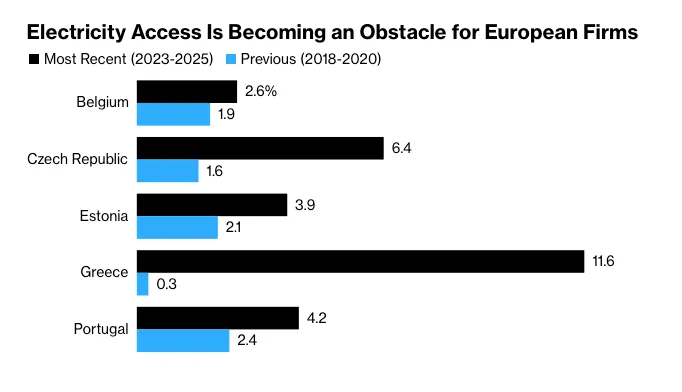
Analysis by Bloomberg Economics shows that almost all G20 countries in recent years have faced mounting strain on their power systems. Supply has been unable to meet demand, price volatility is high, climate impacts are causing damage and transmission losses persist.
Such strains reduce capital spending in the sector. Governments and businesses are less willing to buy or maintain long-term assets.
“Lower investment means lower long-term economic growth,” said Bloomberg Economics’ chief trade and climate economist, Maeva Cousin.
The economic benefits of electrification have been seen across regions—from India and China to most of Africa—since the late 19th century. The richer a country, the more energy it consumes.
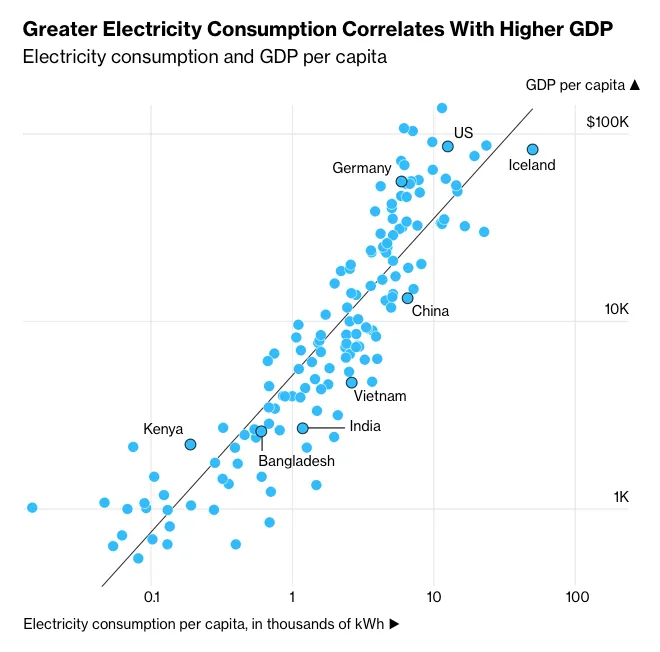
No such correlation is observed for other forms of energy. Coal consumption rises with income and then falls as countries move from middle- to high-income status.
Electrification brings radical change. For example, after a small grid was installed in the village of Rukubi, Nigeria, local fishermen could store fish in refrigerators; otherwise the heat quickly spoiled it.
Researchers at the University of Nigeria found that with each 1 percentage-point increase in the share of clean energy, a country’s GDP rises over time by 2.74%.
Bloomberg Economics has developed an index that shows power-system strain in each G20 country. It considers five factors: adequacy, demand, cost, losses and climate impact.
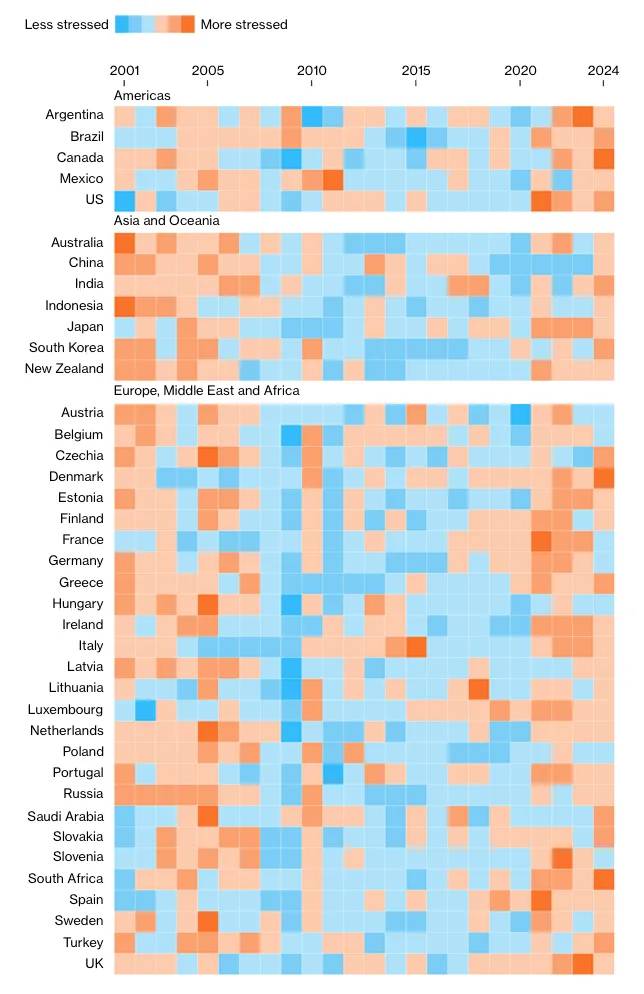
In the early 2000s most countries saw rapid growth in electricity demand and only moderate increases in supply, which created strain. In the 2010s effective grid management and lower consumption allowed stable operation.
“This calm is fading. Now in most rich countries the last few years have seen rising strain on the power system,” said Paris-based economist Eleonora Mavroedi.
In Europe and the United States, electricity demand was largely flat or falling over the past two decades, but it is forecast to grow by more than 40% over the next two.
The economics
Research suggests that unless the Dutch grid is reinforced quickly, the country will forgo €8bn–€30bn in economic gains—up to €1,800 per person a year.
In Germany, business groups have warned that the lack of reliable, rapid power supply threatens the country’s industry.
In the United Kingdom, grid operators paid £1.4bn to run more expensive gas plants and curtailed cheaper wind turbines in the north that were not connected to demand centres with sufficient system capacity.
In the regions mentioned, demand will be driven mainly by data centres powering AI and by EVs. Big technology firms have warned that if a country’s grid is not ready, they will redirect investment elsewhere.
Google has already cancelled plans to build a data centre near Berlin. A facility in Frankfurt cannot expand because of insufficient electricity. Power shortages pushed Microsoft to shift investment from Ireland and the United Kingdom to the Nordics.
The same problem exists in the heart of Silicon Valley. Utilities in Santa Clara are struggling to keep up with rising demand.
“The inability to expand electricity supply quickly could make it impossible to realize the full potential of advanced technologies,” said Mavroedi.
In November, analysts predicted a decline in the cost of AI computing in space.
That same month, Google announced a plan to create a system of satellites in low-Earth orbit to harvest solar energy and power data centres.
Рассылки ForkLog: держите руку на пульсе биткоин-индустрии!