



In the first quarter, traffic to US retailers’ websites via AI tools surged by 393% year-on-year. Such visitors spend more, stay longer, and are more active buyers compared to others, noted Adobe Analytics.


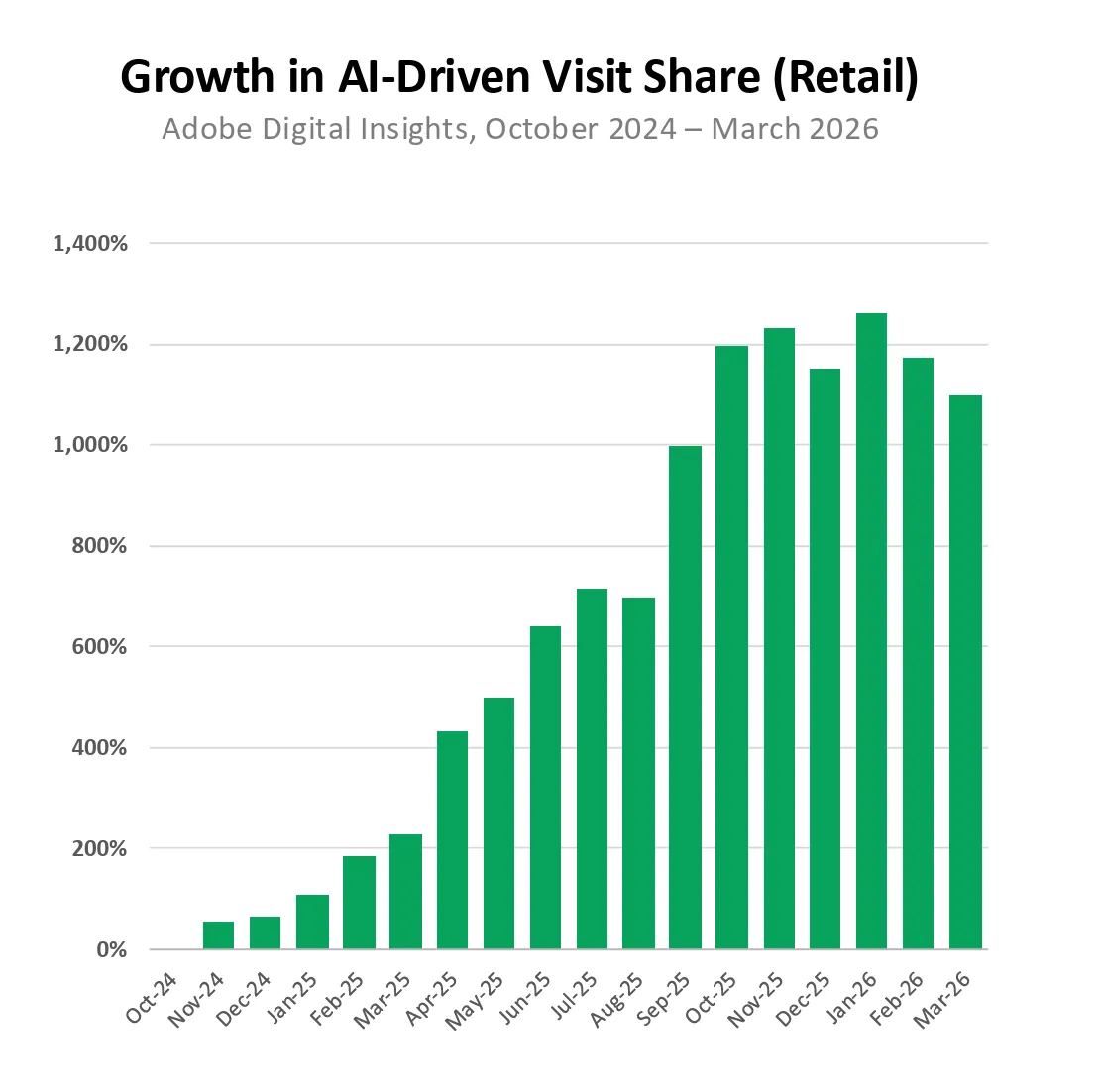
“The growth continues the trend from the last holiday season (November-December 2025), when AI-driven traffic jumped by 693% over 12 months,” experts noted.
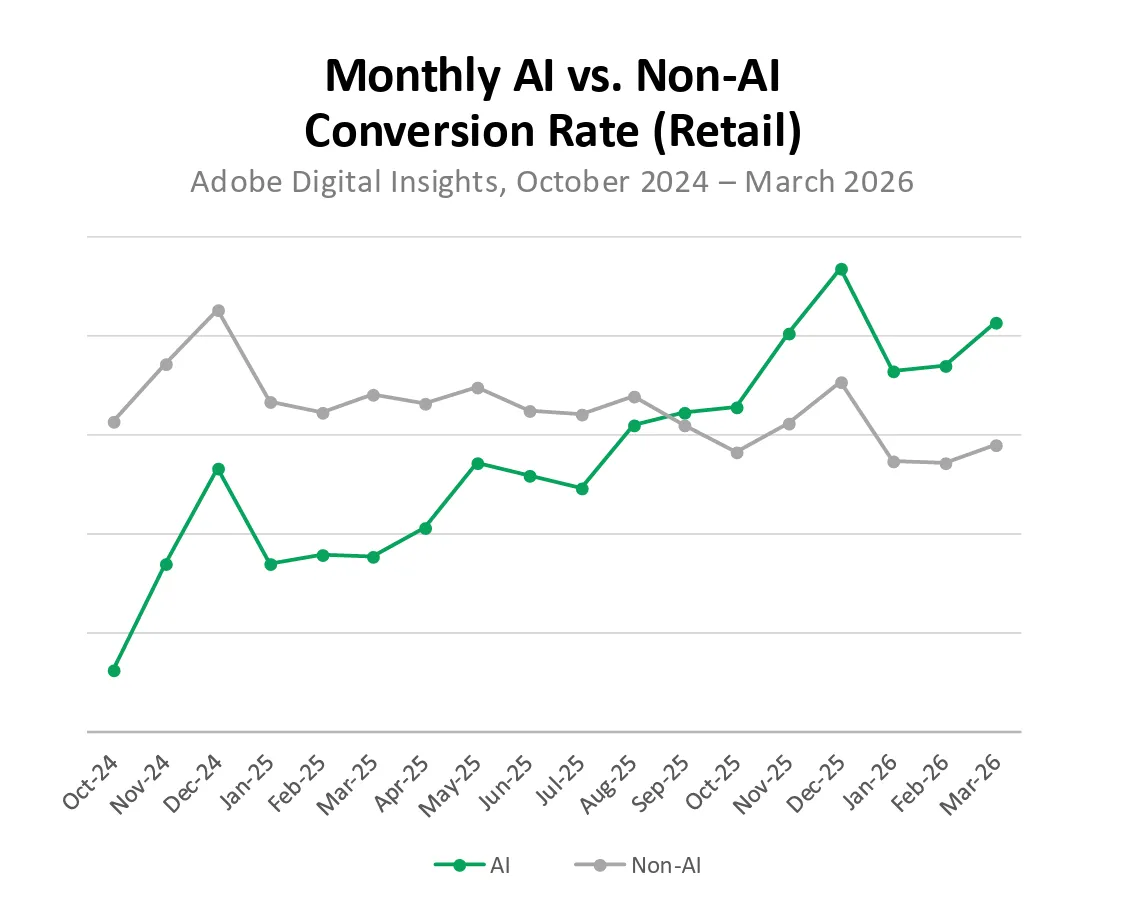
A year ago, AI traffic conversion lagged behind paid search and email by 38%. Now the situation is reversed: conversion has reached a record level—42% higher than that of regular visitors.
Revenue per user arriving via chatbot was 37% higher than average. A year ago, human traffic was 128% more valuable.

These users also stay longer on sites: they spend 48% more time, view 13% more pages per visit, and show 12% higher engagement.
“Artificial intelligence is rapidly becoming the main channel of communication between shoppers and brands,” noted Vivek Pandya of Adobe Digital Insights.
According to an Adobe survey of 5,000 Americans, 39% have already used AI for online shopping, with 85% of them saying it improved their experience.
Trust in artificial intelligence is growing: 66% are confident in the accuracy of the results obtained. Analysts noted that this explains the steady increase in conversion—without signs of plateauing.
Serious Business
For e-commerce market participants, AI traffic is becoming critically important—they need to understand who exactly is generating views and clicks.
Earlier, a dispute erupted in federal court between Amazon and Perplexity: can digital assistants make purchases on third-party platforms without explicit permission.
In March, a San Francisco judge issued a preliminary injunction, blocking the Comet browser from the AI startup from purchasing on the tech giant’s site.
Amazon stated that the tool disguised automated sessions as human traffic. Perplexity called it “intimidation,” noting that agent purchases would only bring more transactions to the company.
With the advent of OpenClaw, AI agents gained even more ways to make purchases: via API, MCP servers, skills, integrations, or by controlling the user’s browser.
Expansion
Digital assistants are gradually covering new areas. Coinbase CEO Brian Armstrong revealed that the company has begun testing AI agents in Slack and email.
Coinbase is testing AI agents that show up in slack/email at work, just like any human teammate. To start we’re shipping two which are modeled after legendary former Coinbase employees, @FEhrsam and @balajis. (Who brutally frame mogged who in this matchup?)
Soon, it will be easy… pic.twitter.com/1bxfh8Dg9q
— Brian Armstrong (@brian_armstrong) April 18, 2026
The assistants are named Fred and Balaji. Fred is named after the exchange’s co-founder Fred Ehrsam. He will act as a “strategic executive agent”: helping employees understand strategic priorities and providing feedback at the executive level.
Balaji is the “agent of chaos and creativity,” inspired by former Coinbase CTO Balaji Srinivasan. His task is to challenge assumptions, help think outside the box, and “ignite innovation.”
For now, the agents are only meant to assist employees with work tasks. However, Armstrong wrote that in the future, there may be more of them than live workers:
“Soon any employee will be able to easily launch a new agent for themselves or their team. I think soon we will have more agents than people.”
Back in March, a16z Crypto analysts predicted the decline of the internet advertising era due to digital assistants