



America tightens curbs on chip imports
President Joe Biden’s administration has introduced new restrictions on imports of US-designed computer chips in a bid to prevent other countries from accessing cutting-edge technology, CNN Business reported.
US Commerce Secretary Gina Raimondo said the rules are intended to safeguard advanced AI systems and ensure their distribution only among allied nations.
The curbs introduce mandatory licences for certain chips. The regime divides countries into three tiers for exports of advanced processors and AI solutions:
- The new rules do not apply to allied states such as Australia, Japan, South Korea and Taiwan—18 countries in total.
- Another 120 countries, including Singapore, Israel, Saudi Arabia and the UAE, will face restrictions with caps on computing-power purchases. They will be able to apply for additional quotas.
- Russia, China and Iran face a complete ban on receiving the technologies.
Suppliers headquartered in the United States are allowed to deploy up to 50% of their computing capacity outside the country.
A 120-day window has been set for public comments.
“We hope that the next administration will fully use this period to listen to experts, industry representatives, participants from the sector and partner countries. I fully acknowledge that future authorities may make changes as a result of these efforts,” Raimondo said.
Since October 2022 the Biden administration has announced several China-focused rounds of semiconductor export controls.
How will the restrictions work?
The new rules govern the flow of American AI chips and technologies abroad. They limit exports of graphics processors at 790 million TPP through 2027. The cap is equivalent to nearly 50,000 Nvidia H100 chips.
“50,000 H100s is an enormous amount of power, enough to conduct cutting-edge research, launch entire companies operating in artificial intelligence, or support the most demanding AI applications on the planet,” commented Divyansha Kaushika of consulting firm Beacon Global Strategies.
For comparison, in September the team at AI startup xAI launched the Colossus artificial-intelligence training cluster using 100,000 Nvidia H100 GPUs. According to Elon Musk, it is the most powerful AI training system in the world.
Some firms such as Amazon Web Services and Microsoft are exempt from the restrictions because they meet the criteria for special licences.
Those with “verified end user” status have a limit of roughly 320,000 advanced GPUs over the next two years.
The measure is intended to prevent China from obtaining AI chips via third countries. The United States wants visibility into, and control over, who uses its technologies.
Australia, Belgium, the United Kingdom, Canada, Denmark, Finland, France, Germany, Ireland, Italy, Japan, the Netherlands, New Zealand, Norway, South Korea, Spain, Sweden and Taiwan are exempt from the curbs.
Criticism from tech giants
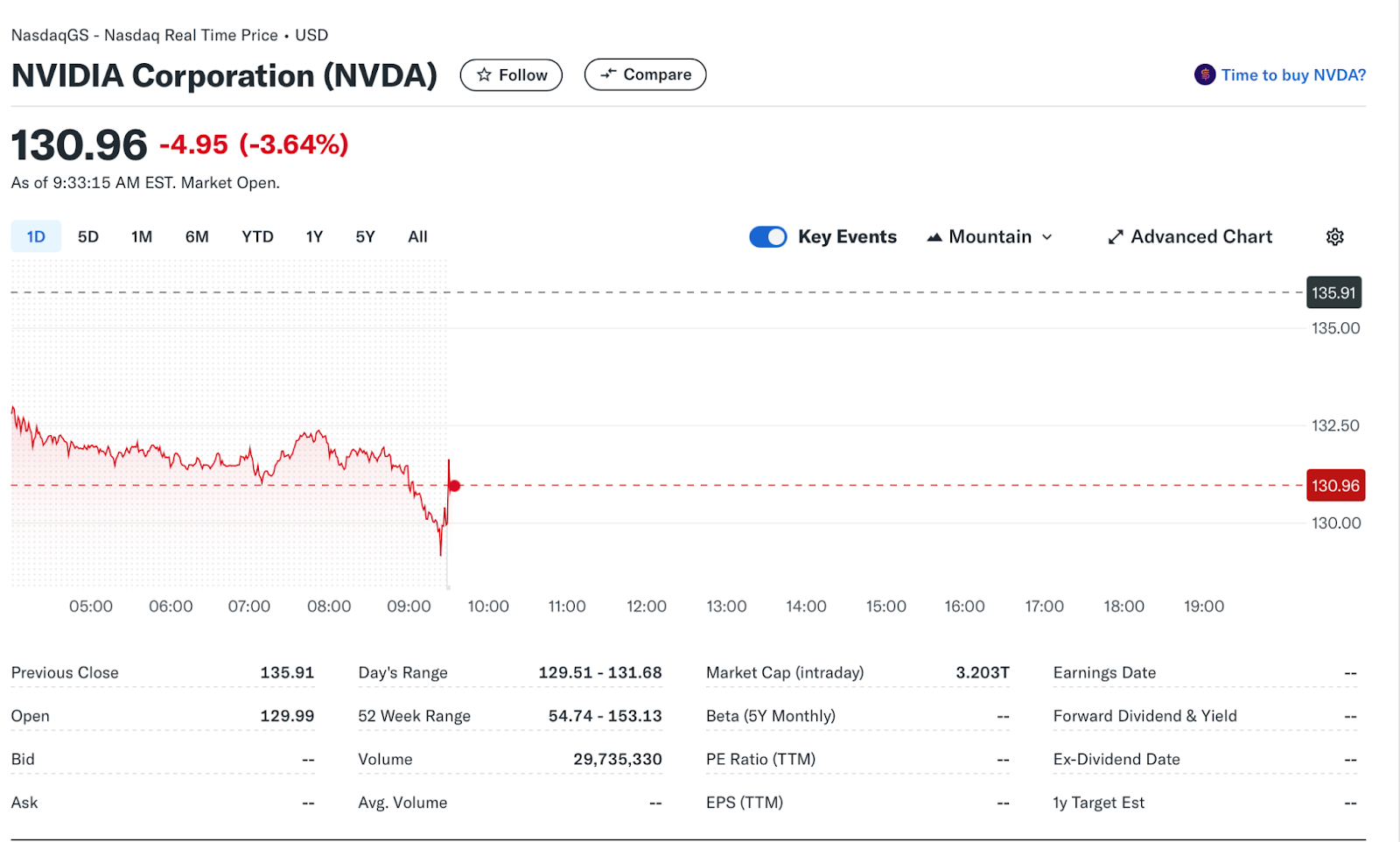
Technology giants Nvidia and Oracle criticised the new restrictions.
Nvidia’s vice president for government affairs Ned Finkle said the rules “threaten to derail innovation and economic growth worldwide” and “will undermine America’s leadership.”
In the view of Oracle executive vice president Ken Glueck, the measures amount more to overregulation than to protecting the interests of the United States, partners and allies.
In December, China launched an investigation into Nvidia on suspicion of antitrust violations.
Earlier, institutes linked to China’s People’s Liberation Army used a publicly available neural network from Meta to develop a tool potentially suitable for military purposes.
Рассылки ForkLog: держите руку на пульсе биткоин-индустрии!