



If you regularly receive cryptocurrency into your wallet from other users, you should beware dirty coins. They compromise all assets at the address, and legitimate exchanges and brokers won’t accept them. To avoid this, crypto businesses and private investors check the cleanliness of incoming transactions.
AML checks are a means of combating fraudsters, preventing them from using illegally obtained coins. Together with the AML service GetBlock we explain how to reduce the risks of acquiring dirty cryptocurrency, as well as how to assess counterparty risk and the cost of transaction checks. We also provide a promo code for free transaction and address checks in GetBlock.
GetBlock in brief
The GetBlock service evaluates the risk level of transactions and wallets in the blockchains of Bitcoin, Ethereum, Bitcoin Cash, Zcash, Dash, and Monero. It stores the verification results accessible via a link.
GetBlock also operates as a standard blockchain explorer: displays blocks, transactions, hashrate, transfer volumes and other on-chain data.
Upon registration, users receive one free AML check. After registering, enter promo code FORKLOG22 in the account settings to receive five more checks.
How exchanges recognise dirty cryptocurrency
Transactions in the Bitcoin blockchain and its forks resemble bank checks. The ledger stores records of balances for users as UTXO — unspent transaction outputs. When a user sends tokens to someone, the blockchain “spends” the used UTXO and instead creates two new ones: a transfer to the recipient and change for the sender.
Example: Alice has 1 BTC in her wallet. She sent Bob 0.3 BTC. The blockchain records her transaction as “Alice used a UTXO of 1 BTC, Bob received a UTXO of 0.3 BTC, Alice received a UTXO of 0.7 BTC.”
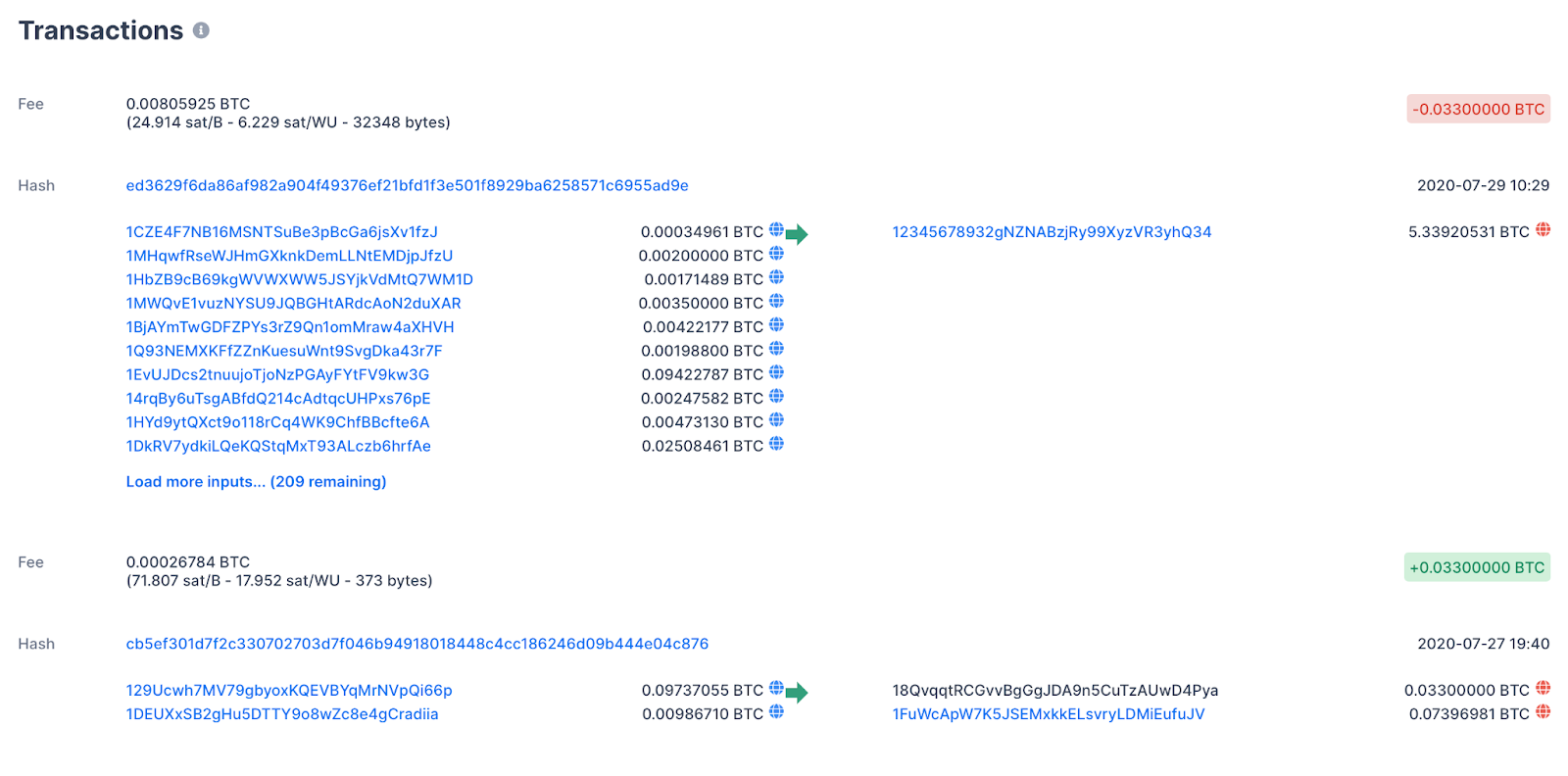
Blockchains do not delete UTXO and keep the history of each unspent output up to the moment the coins are mined. Using these records, blockchain-analytics services can trace through which addresses specific coins passed.
Under current international anti-money laundering rules ( AMLD5 ), wallets and transfers from high-risk sources include:
- illegal casinos;
- darknet marketplaces;
- mixers;
- fraudsters;
- scam projects;
- recipients of stolen cryptocurrency.
AML services compile information about such addresses and add them to their databases. When checking a wallet, they calculate the share of funds that came from dangerous UTXO. This is how they form the risk level.
Exchanges and brokerages check users’ addresses against AML-service databases. If a wallet contains high-risk UTXO, the AML-enabled service may freeze the user’s deposit.
What the risk level means
When checking addresses, services calculate their risk level — the proportion of coins from different sources. If there are few suspicious UTXO, the address gets a low risk level. The exchange will not block a deposit from such a wallet.


However, if the address received most of its cryptocurrency from a suspect source, it also becomes suspect. If the address risk level exceeds 70%, exchanges may block the user’s deposit and require proof of provenance. Regular wallet checks help avoid asset confiscation in cases where a user inadvertently bought compromised crypto.


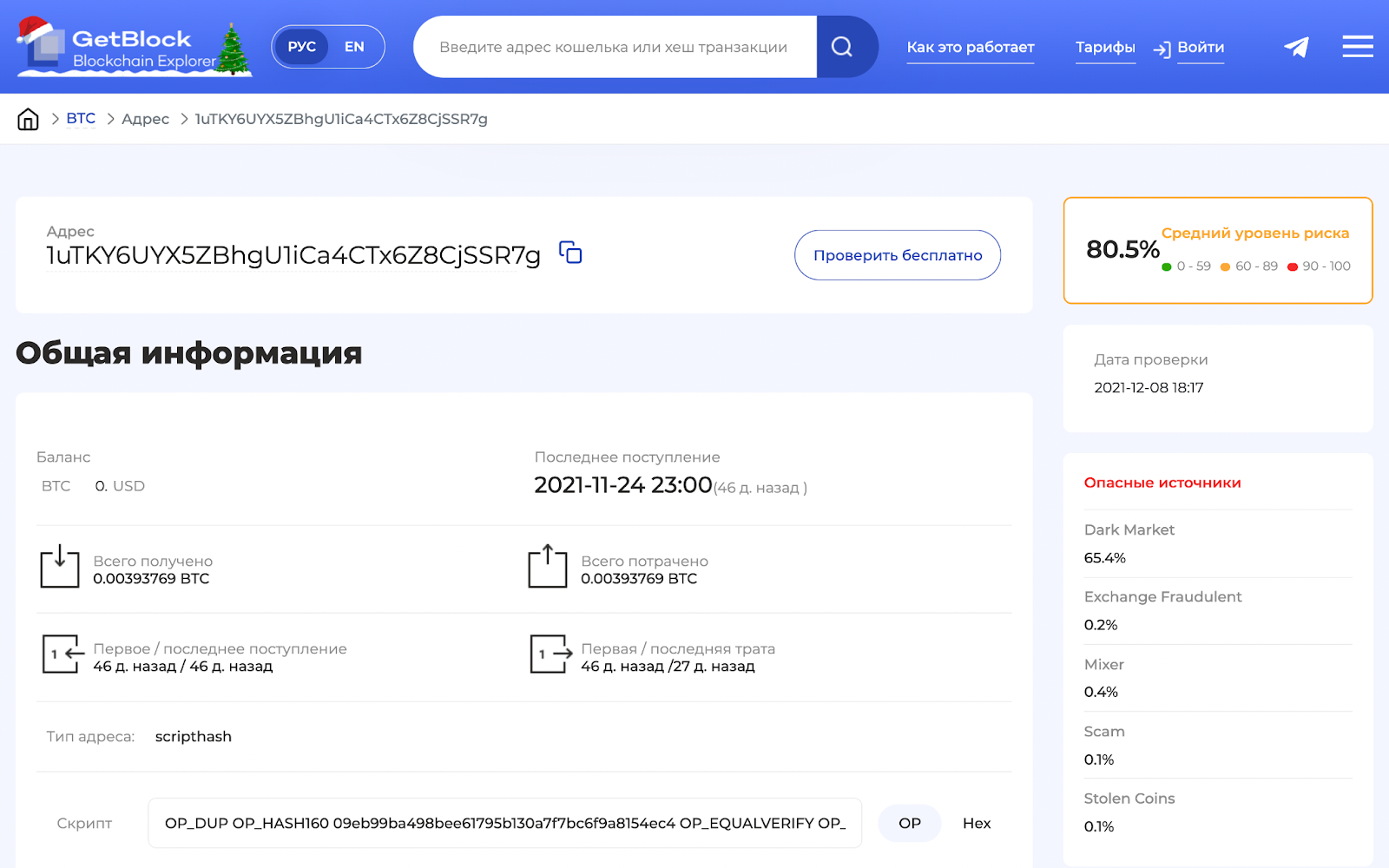
Exchanges and other AML-enabled services immediately freeze transactions with a risk level above 90%. Blocking high-risk assets is one of the FATF recommendations.
How to protect a wallet from dirty coins
Private investors, small and medium-sized businesses risk accepting suspicious cryptocurrency into their main wallet and lowering the purity of the rest of the coins. You can protect yourself from dirty cryptocurrency as follows:
- Accept every new transfer to a separate address.
- Perform AML checks on transfers.
- After that, decide — keep the cryptocurrency and close the deal, or not.
We checked operations from several exchanges and brokers and found that they indeed accept cryptocurrency under this scheme.

Large blockchain-analytics services operate on a subscription model. This is convenient for large business: for a fixed fee the company gets unlimited checks, plus extra options such as embedding checks into an app or visualising transactions of suspicious addresses. Pricing starts from a few thousand dollars, and most services provide checks only after direct inquiry.
Private investors, as well as small and medium crypto businesses with 50–100 transactions per day, can buy fixed-volume service packages. For example, GetBlock offers three tariffs:
- Flexible — from 5 to 100 checks. Cost of one AML check — $1;
- PRO — 250 checks with API integration. Cost of the plan — $125; cost per check — $0.50;
- Maximum — 1000 checks with API integration. Cost of the plan — $300; cost per check — $0.30.
When purchasing the maximum plan, the user also gets access to the GetBlock partner system.
GetBlock accepts payment in Bitcoin, Litecoin, Tether (USDT TRC20) and Payeer.
Conclusions
In any blockchain there is dirty cryptocurrency: either stolen or used in illicit operations. Transactions with such coins compromise the rest of the user’s assets and increase the risk of account blocks on exchanges that rely on AML services.
Crypto businesses and private investors can protect their cryptocurrency from blocks. To do this, you should receive transactions at one-time addresses, check their risk level in AML service like GetBlock, and transfer only clean cryptocurrency to the main account.
Subscribe to ForkLog news on Facebook!