



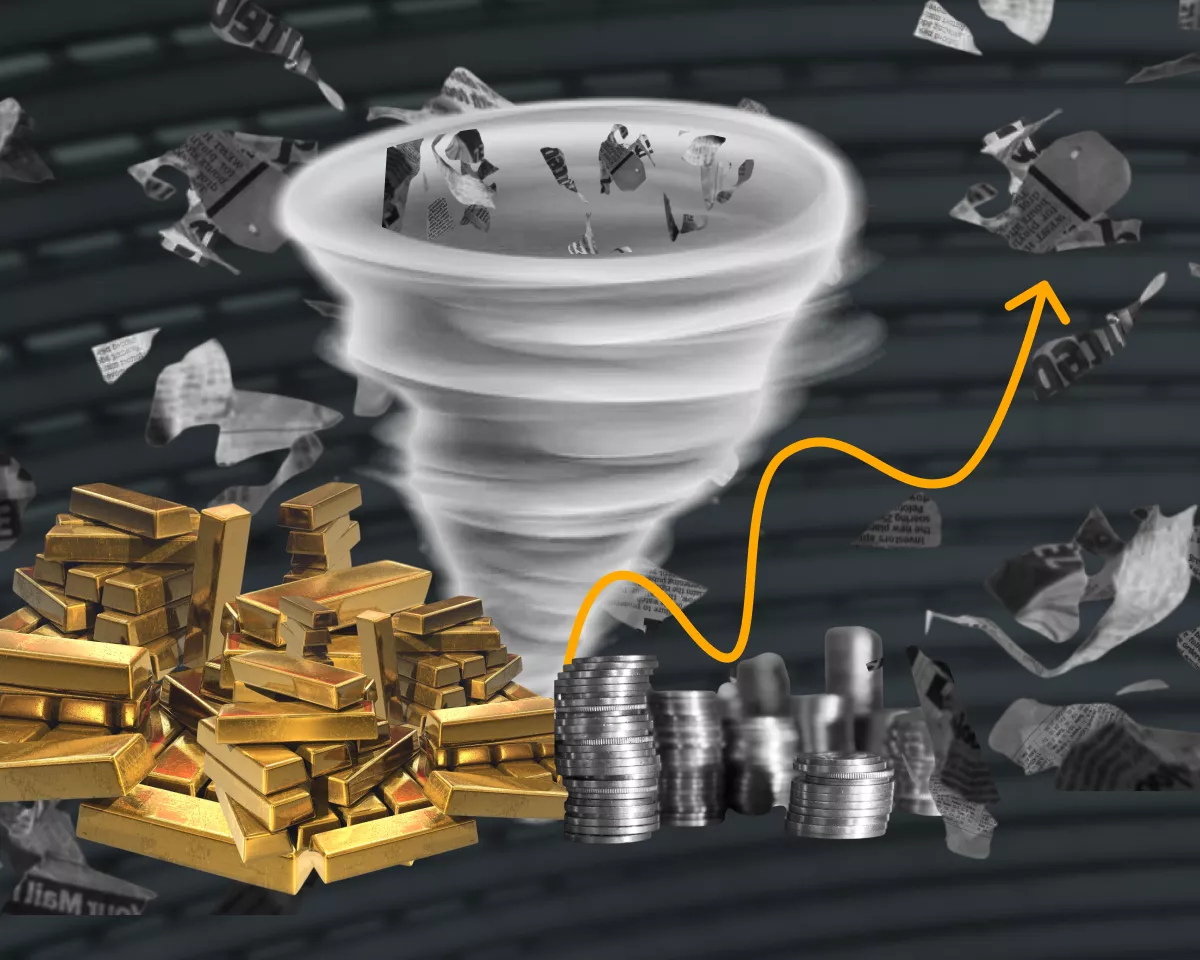
As bitcoin storms a new ATH, Americans are asking how to amass even more digital gold. In pursuit, many are willing to part with a portion of their precious-metal reserves.
In this ForkLog piece, we examine how the wealthiest holders of gold and bitcoin are preparing for change—and where in the world it is easiest to buy physical bullion.
An irreversible process
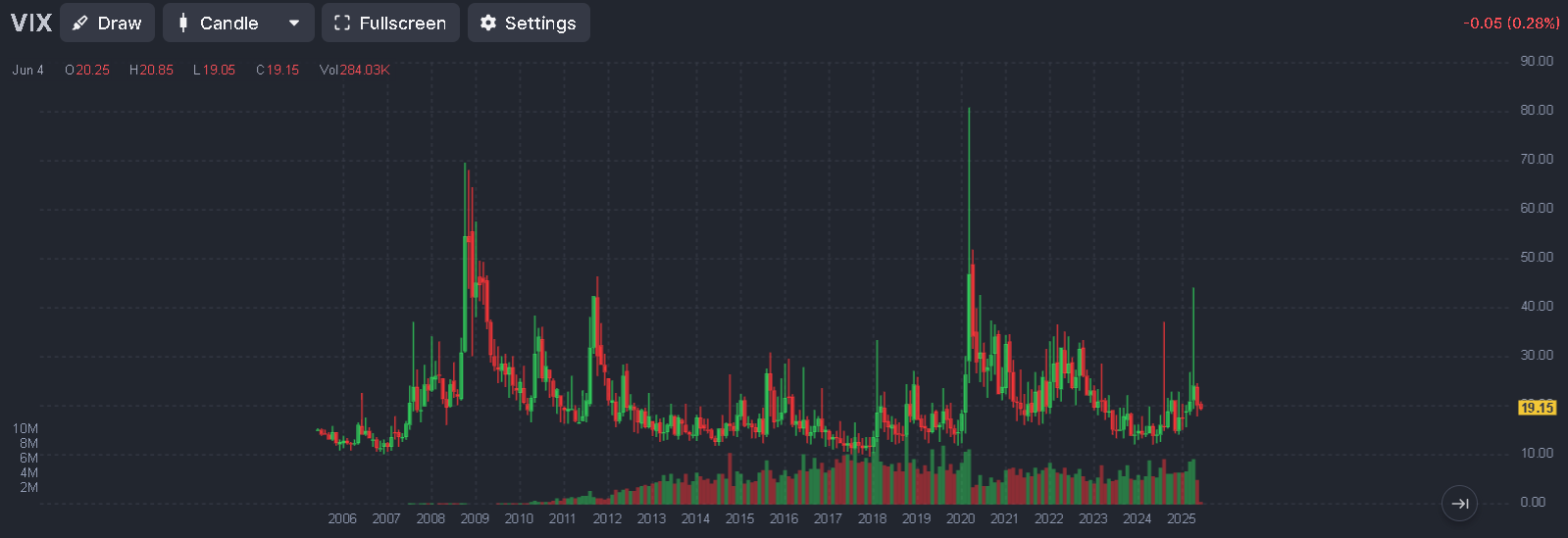
Over the past ten years the Volatility Index (VIX) has entered panic territory eight times. The Covid-era peak at 80 surpassed the record set during the 2008 crisis.
Dubbed the “fear index”, the VIX infers future volatility in S&P 500 equities from pricing on the options market of CBOE. It helps gauge how sharply the market capitalisation of the 500 largest international companies could soar or sink.


The U.S. dollar is flashing warnings too. Since late 2022 the USD Index has increasingly resembled the onset of its historic slide—from the 2002 peak to the turmoil of 2008.

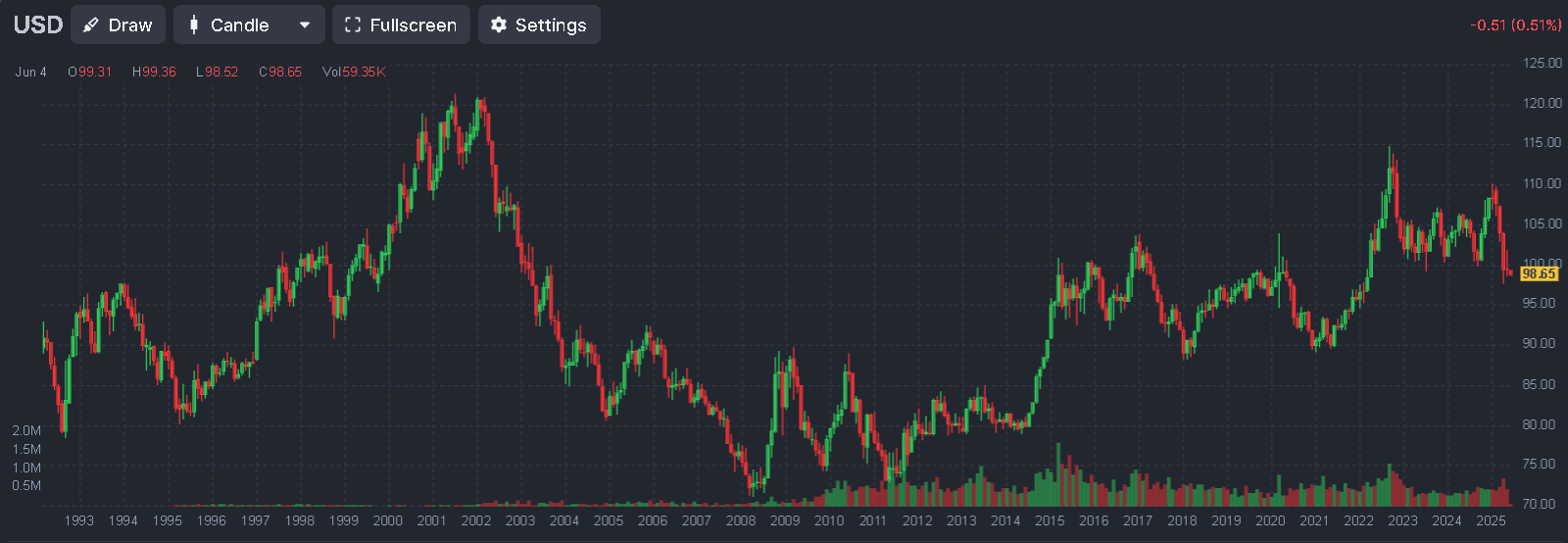
Such signals do little to bolster investor confidence. They also underscore an imminent changing of the guard in global reserves.
Government bonds, long seen as a haven when equities tumble, are having a rough spell—yet remain embedded in top-tier portfolios and partly back some stablecoins such as USDT. Since 2021 these instruments have failed to break a bearish trend.


Combined with geopolitical and macroeconomic upheaval, these alerts spur experts to write entire books about alternative stores of value and to keep drumming home the case for precious metals and digital assets.
Ray Dalio, founder of the giant hedge fund Bridgewater, has used a line more than once at conferences:
“If you don’t own gold, you don’t know history or economics.”
Similar views are shared by Peter Schiff, the Euro Pacific Capital president and bitcoin critic, and by Michael Burry, the investor who foresaw the 2008 crisis.
Gold into bitcoin
Exemplary moves by some countries to add bitcoin to national reserve funds have signalled to billions the direction of travel for the global financial system. The big question: will the dollar still have a place, and what will money look like in five years?
The fashion for adding bitcoin to the investment portfolios of not‑so‑rich firms is gathering pace. News sustaining the trend now lands more than once a week.
The first cryptocurrency, dragging altcoins in its wake, has become a tool of political and economic speculation. Its correlation with traditional finance is high; recall the crypto market’s reactions to Donald Trump’s recent speeches or to a report by the Fed.
Until a mass “Nakamoto” future arrives—where 1 BTC equals 1 BTC—people must choose where to hold capital. With swings between a putative $50,000 and $250,000, an alternative and a calming ballast for the next five to ten years is needed. That leaves gold.
Demand to convert between bitcoin and gold is already evident. As big banks open up access to buying the first cryptocurrency, U.S. citizens are ready to swap bullion for BTC.
A recent poll found that four in five Americans would convert part of the country’s gold reserves into bitcoin. The Nakamoto Project surveyed 3,345 respondents: most favoured converting up to 30% of the metal. On average, respondents agreed on 10%, while the young (under 35) are keener than others to hold the first cryptocurrency.
4 in 5 Americans want some US gold reserves converted to bitcoin. pic.twitter.com/ibxXfe04g5
— The Nakamoto Project (@NakamotoProjct) May 19, 2025
Consider which countries and companies are accumulating these two assets the fastest.
Concentration of “digital” and “paper” gold
In recent years crypto firms have been avid buyers of bitcoin. Yet others remain far behind the leader, Strategy. Michael Saylor’s firm holds more than 580,250 BTC. Second among the top ten holders is miner MARA with about 49,230 BTC. Metaplanet rounds out the list with 8,888 BTC.


For the third year running central banks worldwide have bought more than 1,000 tonnes of gold for their reserves: 1,045 tonnes in 2024, 1,037 in 2023, and a record 1,082 in 2022.
Central banks remain the leaders in net purchases, with Uzbekistan, China and Kazakhstan among the top buyers. Poland and India continue to add to reserves, too—both central banks added 3 tonnes in January 2025.


The pace suggests countries are hastening preparations for a global economic transition.
Jim Rickards, a former adviser to the CIA and the Pentagon and author of “The New Case for Gold”, calls yellow metal not held in your possession “paper gold”. He states plainly that, in a crisis, governments could freeze or confiscate it.
Several countries have repeatedly asked for their gold back—and found the process anything but easy.
In the 1960s French president Charles de Gaulle demanded that the United States return France’s gold reserves. He feared that America’s balance-of-payments deficit would rupture the Bretton Woods system and devalue the dollar.
France then launched the secret operation Vide‑Gousset and repatriated 3,313 tonnes of gold from vaults in New York and from the Bank of England in London between 1963 and 1966. In February 1965 de Gaulle publicly announced his intention to exchange France’s dollar reserves for gold at the official rate and sent a fleet across the Atlantic to collect the country’s hoard.
France’s actions put significant pressure on U.S. reserves and contributed to President Richard Nixon’s 1971 decision to end the dollar’s gold convertibility, marking the demise of Bretton Woods.
States that hold their gold abroad:
- India. In 1991 the country endured a severe crisis that forced the government to use its gold reserves to avoid default. About 8 tonnes were shipped to the Bank of England as collateral for loans. In 2024 the Reserve Bank of India moved roughly 100 tonnes from the United Kingdom back to its own vaults for the first time since 1991;
- The Netherlands. Some 31% of the kingdom’s reserves sit in the vaults of the Federal Reserve Bank of New York. Another 38% is with the Bank of England and the Bank of Canada;
- Italy. The republic keeps gold at the Federal Reserve Bank of New York (43.3%), at a vault in Bern, Switzerland (6.1%), and at the Bank of England (5.8%);
- Germany. As of end‑2023 the country left 36.6% of its gold at the New York Fed and 12.8% at the Bank of England.
For most Westerners, convenient access to investing in physical gold is limited. Buyers either face hefty taxes or red tape.
Asia is different. In India the purchase tax is a modest 3%, and in 2024 the import duty was cut from 15% to 6%. In China, standard gold sold through the Shanghai Gold Exchange is exempt from VAT.
Thailand supports free circulation, but from July 5th 2024 imposed a 7% VAT on all imported goods, including gold, regardless of value. Domestically, bullion can be bought in numerous jewellery shops and from licensed dealers. The standard fineness is 96.5% (23 karats), often sold as jewellery, bars or coins.
Dubai levies zero import duty on gold and 5% VAT on sales. In Saudi Arabia, investment‑grade gold with 99% purity or higher is zero‑rated. In Qatar all gold transactions are tax‑free.
Some countries impose relatively high VAT on bar purchases. In Japan it is 10%.
Conclusion
While the crypto community awaits fresh bitcoin highs, the Fed is plotting its next move. No one knows what it will be, but the sharp policy of U.S. president Donald Trump leaves greater scope for VIX records—and for accelerating change.
Crypto’s volatility can erase around 40% of accumulated value in a day. Big capital playing the long game cares little about price over a five‑year horizon. On every dip whales add to positions as small investors panic‑sell. “Big money” sells in pieces into rallies—and buys back cheaper.