




This material is for informational purposes only and does not constitute investment advice. ForkLog is not responsible for readers’ decisions.
The recent market drop was not a panic sell-off but a controlled reduction of leverage — deleveraging. CryptoQuant analyst Axel Adler Jr. sees it as a sign of market maturity.
During Friday’s crash, spot volume hit $44B (near cycle highs), futures $128B, while OI dropped $14B with only $1B in BTC long liquidations. 93% of OI decline wasn’t forced — this was a controlled deleveraging, not a cascade.
👉 A very mature moment for Bitcoin. pic.twitter.com/sTrziRUXXo
— Axel 💎🙌 Adler Jr (@AxelAdlerJr) October 14, 2025
According to him, during the 11 October correction spot trading volume reached $44bn, near cycle highs. Futures volume was $128bn.
Open interest (OI) fell by $14bn, while forced liquidations of bitcoin long positions were just $1bn.
Ninety-three percent of the OI decline was not driven by liquidations — traders closed positions voluntarily and cut risk.
A necessary reset
Glassnode added detail. By its count, more than $19bn of open interest was washed out. Funding rates on the futures market plunged to levels last seen in the 2022 bear phase.
#Bitcoin endured its largest leverage wipeout in history, with $19B in open interest erased and funding collapsing. The market is now recalibrating amid slower momentum, cooling profit-taking, and steady ETF demand.
Read more in this week’s Market Pulse👇https://t.co/56joxJ5xtb pic.twitter.com/Po5a8jEo1B
— glassnode (@glassnode) October 13, 2025
Technical indicators confirm the shift in sentiment: buying pressure eased and aggressive selling dominated short-term flows. The drop in futures open interest signals a broad de-risking.
Despite the scale, the market’s structure held up. Spot volumes remain elevated, ETF inflows continue, and on-chain activity remains high.
Experts say this suggests that highly leveraged participants were flushed out, while the capital structure and institutional demand remained intact.
In options, open interest rose as traders rebalanced positions for the new volatility regime. A modest increase in skew points to renewed demand for downside protection.
Glassnode calls it a significant but necessary reset. The market is now entering a consolidation phase defined by caution and a more measured approach to risk across spot and derivatives.
Time for altcoins?
Another CryptoQuant analyst, known as Darkfost, argues that amid “extreme fear” it is time to accumulate altcoins.
📊Extreme fear in Altcoins : Time to accumulate ?
The best time to gain exposure to altcoins is often when no one wants them anymore.
It’s precisely during these periods of disinterest that the market tends to offer the best medium-term opportunities.
The chart below shows the… pic.twitter.com/5alY70qLn3— Darkfost (@Darkfost_Coc) October 13, 2025
In his view, the best entries come when “no one wants them.” He pointed to the share of altcoins on Binance trading above their 200-day moving average.
“Today, only 10% of altcoins on Binance remain above this key metric. In other words, 90% of the market is below its long-term trend, which is a clear sign of pervasive lack of interest,” the expert explained.
He noted that each time in the current cycle the metric fell to similar levels, the market soon posted a notable short-term rebound.
According to Darkfost, there is still time to enter altcoins, but one should choose strong projects that have retained liquidity and on-chain activity. He advised not to wait too long — the market returns to normal quickly.
DeFi’s reaction
The sharp move also hit DeFi. According to DeFi Llama, open interest on Perp-DEX collapsed from $26bn to under $14bn.
What Friday’s flash crash looked like in onchain metrics: pic.twitter.com/aNZF7mKvVk
— DefiLlama.com (@DefiLlama) October 14, 2025
Lending protocols accrued over $20m in fees, a new all-time high. Weekly trading volume on DEX topped $177bn, also a record.
Total borrowing in cross-chain-lending protocols fell below $50bn for the first time since August. Amid the turmoil, stETH yields briefly topped 7%.
Stablecoin inflows ahead of CPI
CryptoQuant analyst Maartunn flagged an influx of “stablecoins” to exchanges after the drop.


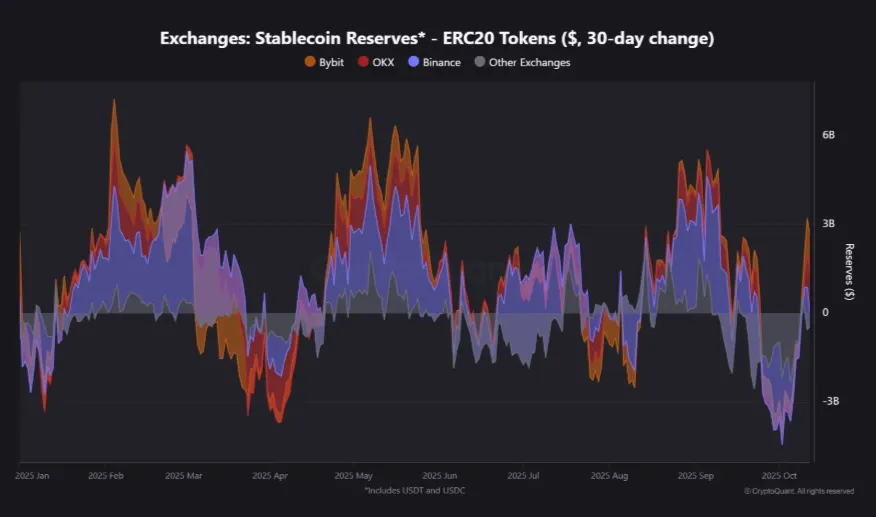
The $3.2bn inflow was among the largest in the past month. He sees it as traders preparing for potential swings ahead of the US inflation print (CPI).
Change in stablecoin (USDT + USDC, ERC-20) reserves over 30 days:
- Binance: +$1.423bn;
- Bybit: +$1.228bn;
- OKX: +$1.114bn;
- other exchanges: -$549.6m.
If CPI undershoots forecasts, that could spur a rally — traders may deploy dry powder into bitcoin and altcoins.
Conversely, if inflation beats expectations, the same funds may stay sidelined, signalling caution and the potential for further declines, Maartunn concluded.
Earlier, Santiment analyst Brian Q said that fear and uncertainty among retail investors remain one of the most accurate signals for accumulating the first cryptocurrency.