


Analyst outlines advantages and drawbacks of EIP-3074
In June EIP-3074 — one of the candidates for activation as part of the Shanghai hard fork — passed a security audit. The Block Research analyst Mika Honkasalo explained how the proposal would affect user experience for network participants and what issues could arise.
Two main objectives drive EIP-3074:
- Further development of the concept of sponsored transactions;
- Improvement of user experience when using a standard Ethereum account (the address from a public/private key pair).
Sponsored transactions allow separating the gas payer account from the account that actually performs operations with ERC-20 tokens. For example, DEX can include gas costs in the trading fee, paying on behalf of the user. This would give the latter the option to avoid owning ETH if they do not use it.
Earlier, similar proposals were offered by the Centre consortium behind USD Coin (USDC), the POA Network project and other participants. However, in their case the capability was implemented via a meta-transaction mechanism, which executes off-chain and is not implemented at the Ethereum protocol level.
In Honkasalo’s view, the approach has two key drawbacks. First, there is an element of centralisation — if desired, the relayer could censor the transaction.
Second, a specific smart contract must initially be designed with this capability in mind, creating additional overhead. If the contract does not support meta-transactions, users will not be able to use them.
EIP-3074 defines two new opcodes for Ethereum:
- AUTH — specifies the address that can send a transaction on behalf of the user;
- AUTHCALL — performs a call to smart contracts at the specified address on behalf of the user.
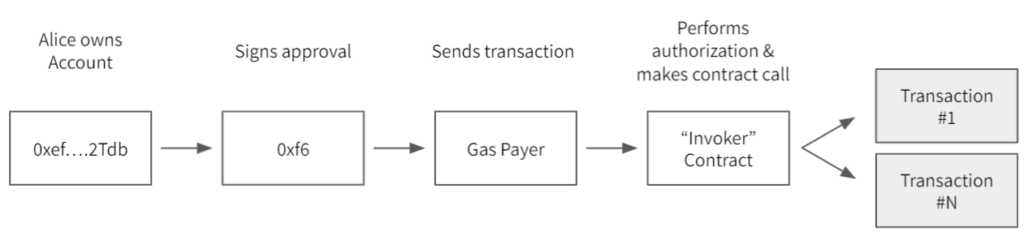
These operations are implemented within special invoking contracts (invoker contracts), which handle functions typically performed by the Ethereum protocol. They also allow bundling several transactions into a single package, which saves gas.
According to Honkasalo, the drawback of EIP-3074 is that the invoking contract has full access to user funds and cannot be disabled. He noted that to solve this problem, a “white list” of the most frequently used contracts will probably be formed.
The analyst also believes that EIP-3074 could weigh on the price of the second-largest cryptocurrency by market capitalization. In his view, from the perspective of validators and users, the asset’s price is directly tied to its usage, and the integration of invoking contracts would dampen that metric.
According to The Block Research, activation of the Shanghai hard fork is planned for October 2021. The second candidate for inclusion in the upgrade is EIP-3540, aimed at modernising the Ethereum Virtual Machine (EVM).
Back in July, the developer Tim Beiko initiated a proposal to activate the London hard fork on the Ethereum mainnet at block #12965000, expected August 4.
Subscribe to ForkLog news on VK.
Рассылки ForkLog: держите руку на пульсе биткоин-индустрии!