




Bitcoin slipped below $86,000. Bloomberg Intelligence senior commodity strategist Mike McGlone warned the price could plunge to $10,000 in 2026.


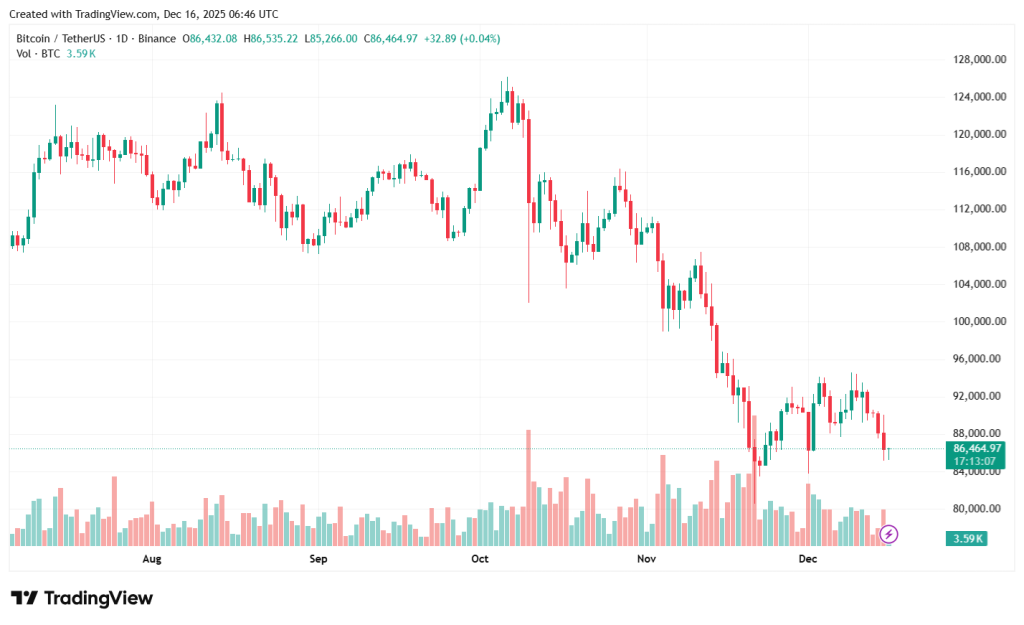
At the time of writing, bitcoin trades at $86,464, down 3.7% over the past 24 hours.
Other majors followed. Ethereum fell 6.3% to $2,941, BNB 2.8% ($863), XRP 5.3% ($1.89) and Solana 4% ($127).



McGlone cautioned about the risk of a deep crypto-market correction. He suggested the next economic recession could be triggered by a crash in highly speculative digital assets with unlimited supply.
Most of them, he said, lack fundamental value and “track nothing”.
Even so, the strategist noted bitcoin’s relative resilience: as of December 14 the decline in its price was only about 5%.
Bitcoin correction to $25,240
Veteran trader and technical analyst Peter Brandt warned of a risk of a deep drop in bitcoin’s price, citing a break in the asset’s parabolic advance.
Bitcoin investors, do you know:
1. Bull cycles have experienced exponential decay
2. BTC’s bull cycles have undergone parabolic advances
3. The violation of previous parabolas have all declined <80%
4. The current parabolic advance has been violated20% of ATH = $25,240 pic.twitter.com/0hWAaEd6Dy
— Peter Brandt (@PeterLBrandt) December 14, 2025
Historically, he argued, bull markets exhibit exponential decay, and bitcoin’s rallies are parabolic. Breaking such a trajectory has previously led to drawdowns of more than 80%.
By Brandt’s calculations, if that pattern repeats and prices drop 80% from the peak, the “digital gold” could fall to $25,240.
By contrast, Presto Research analyst Rick Maeda told The Block he sees little reason for a capitulation. The sell-off coincided with the US stock market open, he noted, as the S&P 500 and Nasdaq started lower and dragged risk assets with them.
Maeda added that thin year-end liquidity is magnifying moves, especially during US trading hours.
Flight from risk
Kronos Research CIO Vincent Liu said a sharp risk-off shift amid macroeconomic uncertainty sparked the slump.
Low liquidity, he noted, turned local dips into a broad slide. Traders rotated into perceived safe assets.
In Liu’s view, the Fed’s rate cut has barely altered cautious market expectations. Two factors made matters worse: widespread closing of leveraged positions and the seasonal year-end liquidity squeeze. That led to cascading sell-offs.
Mining in China
Trader NoLimit suggested the crypto sell-off was driven by shutdowns of bitcoin mining equipment in China’s Xinjiang region.
🚨 BITCOIN IS CRASHING AND THIS IS THE REASON WHY!!!
Bitcoin is down today for a very simple reason, and almost nobody is explaining it properly.
It’s coming straight from China, and the timing matters.
That’s right, china’s crashing bitcoin, AGAIN.
Here’s what’s happening:… pic.twitter.com/RV3k9JzA0T
— NoLimit (@NoLimitGains) December 15, 2025
Nano Labs founder Jack Kong, said that between December 14 and 15 the network hashrate of the first cryptocurrency fell by 8% — roughly 100 EH/s. He estimates at least 400,000 devices were switched off.
In late November the People’s Bank of China pledged to “strictly crack down on illegal activity” in the crypto sector.
Presto research fellow Min Zhong explained that in recent months China’s share of mining quietly recovered to 15% thanks to cheap electricity and spare data-centre capacity. The regulator’s swift response exposed the fragility of that rebound.
Zhong also stressed there is no direct evidence of mass bitcoin selling by miners in Xinjiang.
Liu allowed for short-term price pressure from a drop in computing power. He added that fundamentals are unchanged and the impact of shutdowns should be temporary.
Earlier, macro analyst Lukas Gromen suggested that bitcoin could fall to $40,000 in 2026.