




By 2030, AI computing in orbit is expected to be cheaper than on Earth, according to a forecast by experts from the research group 33FG.
Analysts calculated the cost of sending equipment into space to harness solar energy and compared it with the price of similar resources on the planet.
With current costs of delivering cargo to high orbit around $2000 per kilogram, satellites provide electricity at a price of approximately $18-26 per watt. This is about twice as expensive as in terrestrial data centres ($12/W).
If the cost of delivery is halved, the price of “space” energy will match that of terrestrial energy. At $500 per kilogram, “space” energy will be about 30% cheaper, and at $100/kg — 50% cheaper.
Reusable Starship vehicles with orbital refuelling could make these figures achievable by the end of the current decade.
Calculations
The authors modelled four types of architectures:
- Starlink-class (LEO) — low-orbit systems based on modern satellites;
- Starlink-class (HEO) — the same technologies transferred to high orbit with almost constant sunlight exposure;
- Compute-Optimized Starlink (HEO) — a version of Starlink adapted for computing: previous photovoltaic panels and radiators, but with lighter structures and a higher active area-to-mass ratio;
- Thin-PV Frontier (HEO) — a promising ultra-light architecture for future systems.


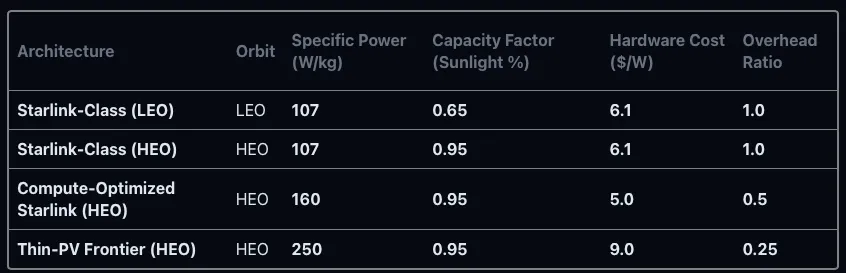
For deploying equipment to HEO, refuelling in low Earth orbit is required, making delivery about one and a half times more expensive compared to LEO.
The first class costs about $2000 per kilogram. Such orbital systems cost $18-26/W compared to terrestrial systems at $12/W.
Starlink-class systems in HEO reach terrestrial levels at a launch cost of about $500 per kilogram. Compute-optimized Starlink (HEO) achieves parity at $1000/kg and begins to surpass terrestrial infrastructure if launch costs fall below $500/kg.
At $100/kg in HEO, orbital architectures provide $6-9/W, which is 25-50% cheaper than terrestrial data centres.
Further reductions in launch costs have little impact on the economics. The main contribution to system efficiency begins to be determined by the cost of equipment, not rockets.

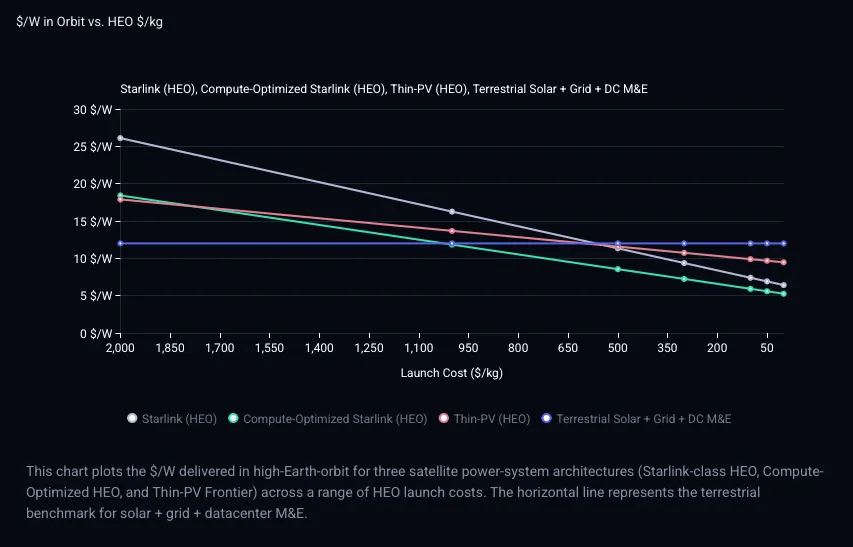
Comparison results:
- Compute-Optimized Starlink (HEO) becomes competitive with terrestrial data centres at a launch cost of around $500-1000 per kilogram. If the launch price decreases, space systems gain a significant advantage. At $100/kg, such a system provides $6-9 per watt — about half the cost of terrestrial data centres;
- Starlink-class (HEO) reaches parity with terrestrial infrastructure at a launch cost of about $500-600/kg. Further reductions in launch costs improve the economics, but not as significantly as in the previous variant;
- Thin-PV Frontier, with expensive launches ($2000/kg), is better but is expected to be more costly at 2030s prices due to high equipment costs.
Orbit — The Future
Analysts emphasized that orbital energy is the future of humanity. Space offers virtually unlimited solar flow and unlimited space for hardware placement. On Earth, both energy and space are becoming scarce.
However, the question remains of creating a well-thought-out architecture so that both equipment and launch costs become advantageous compared to terrestrial solutions.
Currently, the architecture that is optimal in terms of mass is not optimal in terms of cost, and vice versa.
In November, Google announced the creation of a satellite system in low Earth orbit to harness solar energy and power data centres.
In May, China launched 12 satellites as part of a project to build a network of orbital supercomputers.