



The NFT sector may be experiencing stagnation, but it is certainly not dead. This view was expressed by Yat Siu, co-founder of Animoca Brands, in an interview with CoinDesk.
According to him, wealthy investors continue to shape a vibrant and sustainable digital art market. The expert likened the community to clubs of painting, rare car, or watch enthusiasts.
“I am a big collector myself and share similar views with my colleagues in this field. […] For instance, a Picasso collector will feel a connection with everyone else who buys the artist’s paintings; you are kind of part of that club. The same goes for Ferrari, Lamborghini, or Rolex watches. It’s just the digital version,” said Siu.
He acknowledged that his personal NFT portfolio “has dropped by about 80%,” but considers these assets long-term and significant, rather than speculative.
Siu noted that the monthly trading volume of non-fungible tokens is currently around $300 million. Major investors like Adam Weitsman, who buys expensive NFTs such as Bored Apes and Otherdeed virtual land plots, now play a key role in the sector.
“Remember, five years ago this was a market with zero capitalization. So everything is relative and depends on the perspective. And, of course, the beauty is that all data is visible on the blockchain,” emphasized the Animoca Brands co-founder.
Many considered the cancellation of the flagship NFT Paris event as one of the final nails in the sector’s coffin. However, Siu attributed this not to market issues, but to changes in the regulatory climate and security problems in France.
Previously crypto-friendly, the country has tightened its policy on digital assets. Simultaneously, over the past year, there has been a series of kidnappings related to the industry within its jurisdiction.
“NFT Paris fell victim not only due to the inability to find sponsors. Many people, including myself, tried to avoid Paris a bit precisely because of security issues,” noted the expert.
What is Happening with NFTs?
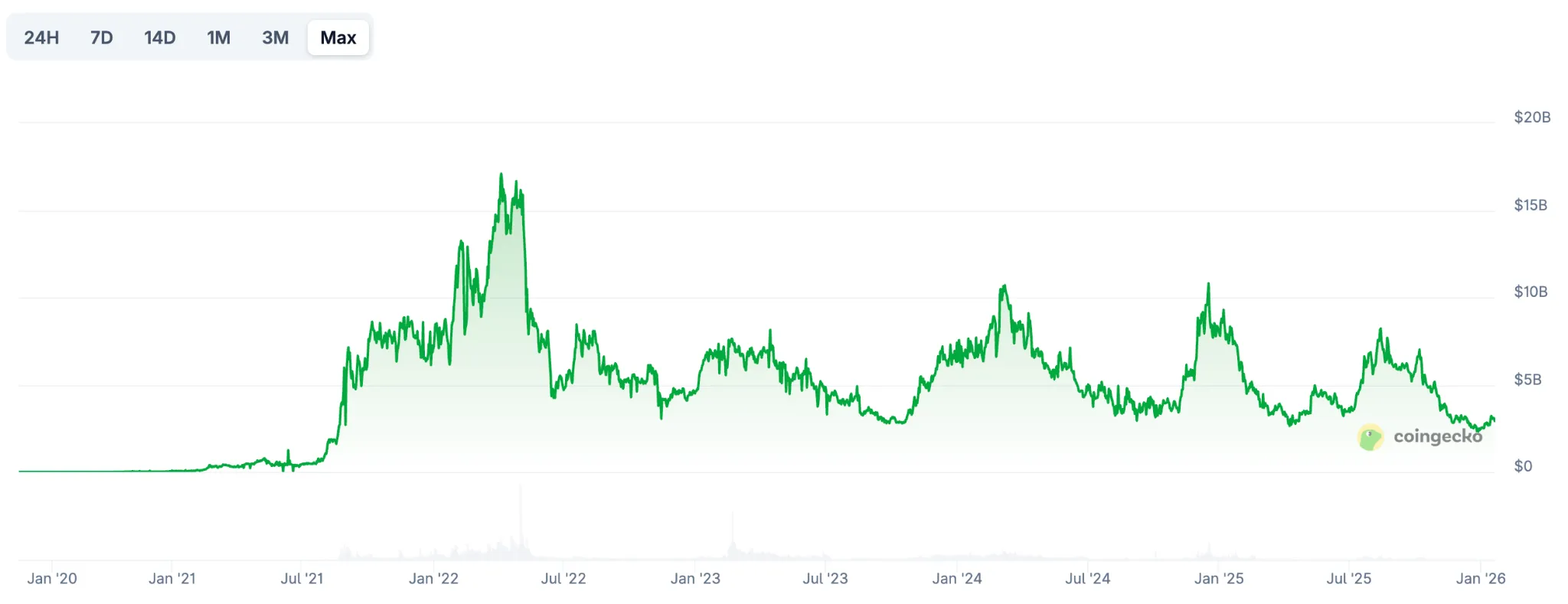
The peak of the non-fungible token frenzy occurred in 2021-2022. At its height, the sector’s capitalization exceeded $17 billion, but by the time of writing, it had fallen to $3 billion.


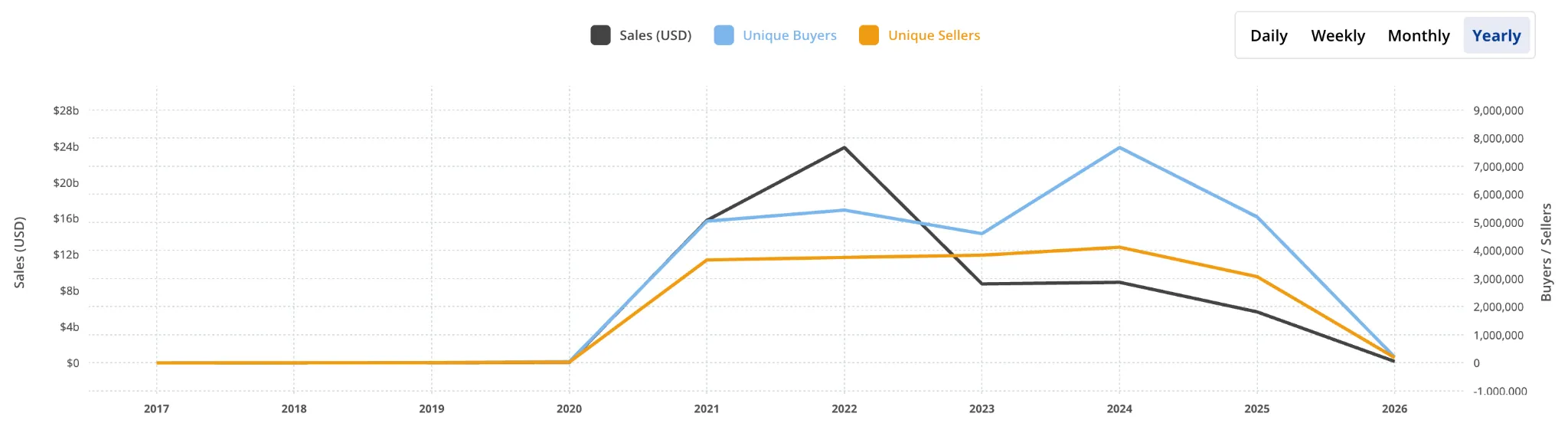
During that period, NFT sales volume exceeded $23 billion. As of January 2026, the figure stands at $123 million, indicating a drop of more than 18,000%.

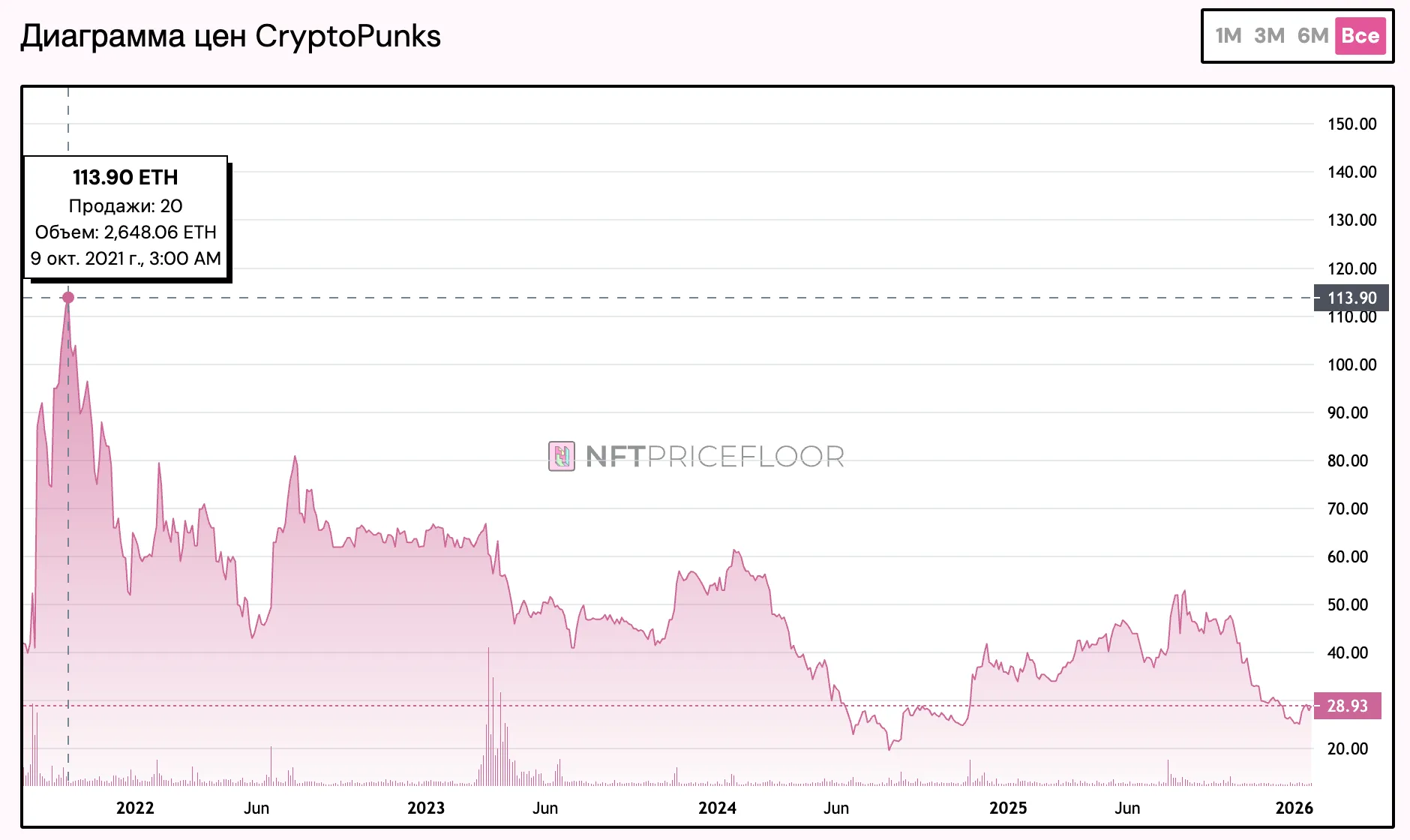
The floor price of the most popular collections has plummeted by tens of percent. At its peak, CryptoPunks were priced at 113.9 ETH, but by the time of writing, they had fallen to 28.3 ETH.

The Bored Ape Yacht Club price plummeted by more than 95% — from 128 ETH to 5.9 ETH. Similarly, the floor price of the third-largest collection by capitalization, Pudgy Penguins, dropped by 80% — from 25.2 ETH to 4.9 ETH.
Amid the extensive and prolonged correction, many crypto exchanges, including Bybit and Kraken, as well as larger companies like GameStop, closed their NFT trading platforms.
They were joined by the British auction giant Christie’s. The organization continues to sell digital art, but within the broader category of 20th and 21st-century art.
NFT marketplaces have reoriented their business. For example, OpenSea now positions itself as a multichain aggregator for trading a wide range of cryptocurrencies.
Recently, Magic Eden’s head Jack Lu announced a change in the company’s development vector. According to him, the platform will focus on the segment where “finance merges with entertainment.”
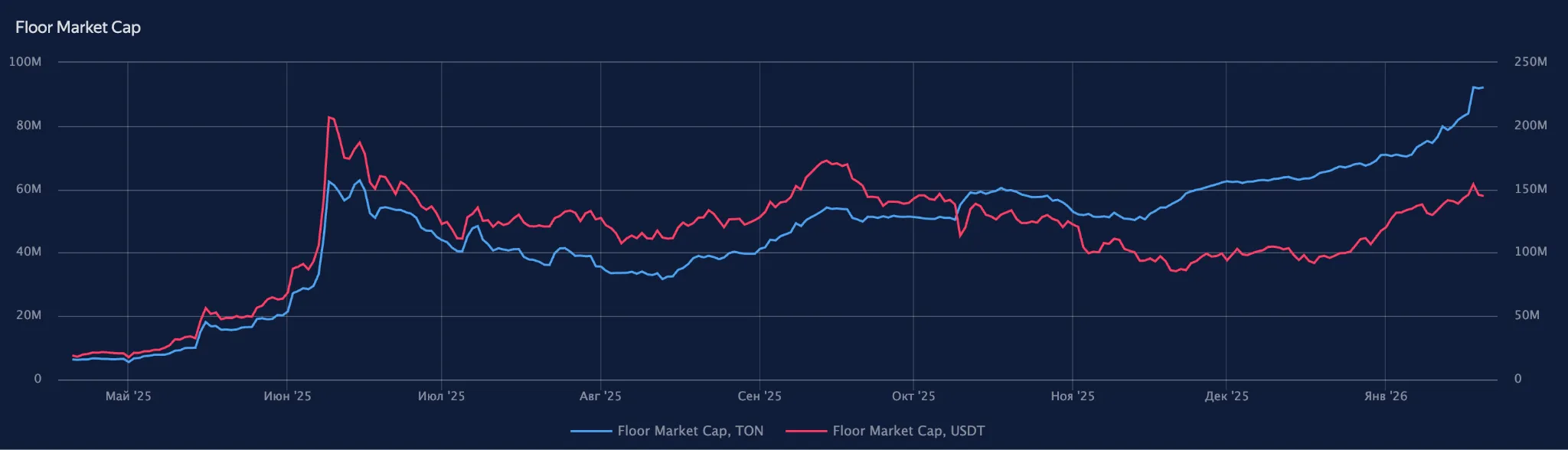
Currently, the only successful NFT segment is Telegram gifts. From April 2025 to January 2026, the capitalization of this direction grew from 6.3 million TON to 92.1 million TON.

Back in July, Solana Labs CEO Anatoly Yakovenko called meme coins and NFTs “digital junk.”