




- Arthur Hayes has forecasted a decline in Bitcoin prices below $35,000, citing the Federal Reserve’s policies and Middle Eastern conflicts as key factors.
- Other crypto experts are divided, with expectations ranging from $20,000 to $60,000.
The leading cryptocurrency faces the risk of falling below $35,000 due to global macroeconomic and political upheavals, according to former BitMEX CEO Arthur Hayes in his new essay Yellen or Talkin.
Hayes highlighted several factors that could negatively impact Bitcoin’s price:
- the policies of the Federal Reserve and “excessive” inflation;
- conflicts in the Middle East, including clashes in Yemen;
- the US presidential elections.
Risk assets, including cryptocurrencies, are anticipating a “pivot” from the Federal Reserve in March this year — a reduction in interest rates is expected to bring liquidity back to the market, the expert noted.
However, Hayes believes that due to the current political situation, shipping costs may rise, leading to a price surge in the third or fourth quarter. Meanwhile, the Federal Reserve and its chairman Jerome Powell will attempt to mitigate the consequences:
“Moderate inflation growth due to increased shipping costs could be exacerbated by rate cuts and the resumption of quantitative easing. The market has yet to price this in, unlike Bitcoin.”
The former BitMEX head emphasized that the risks from combating inflation are surpassed only by a potential financial crisis.
Considering these factors, the leading cryptocurrency might correct by 30% from a local high of $49,000 — down to $33,600.
“Bitcoin is forming support between $30,000 and $35,000. That’s why I bought a strike put for March 29, 2024, at $35,000,” Hayes added.
In his view, levels below $35,000 now represent a “buy-the-dip opportunity.”
Other Forecasts
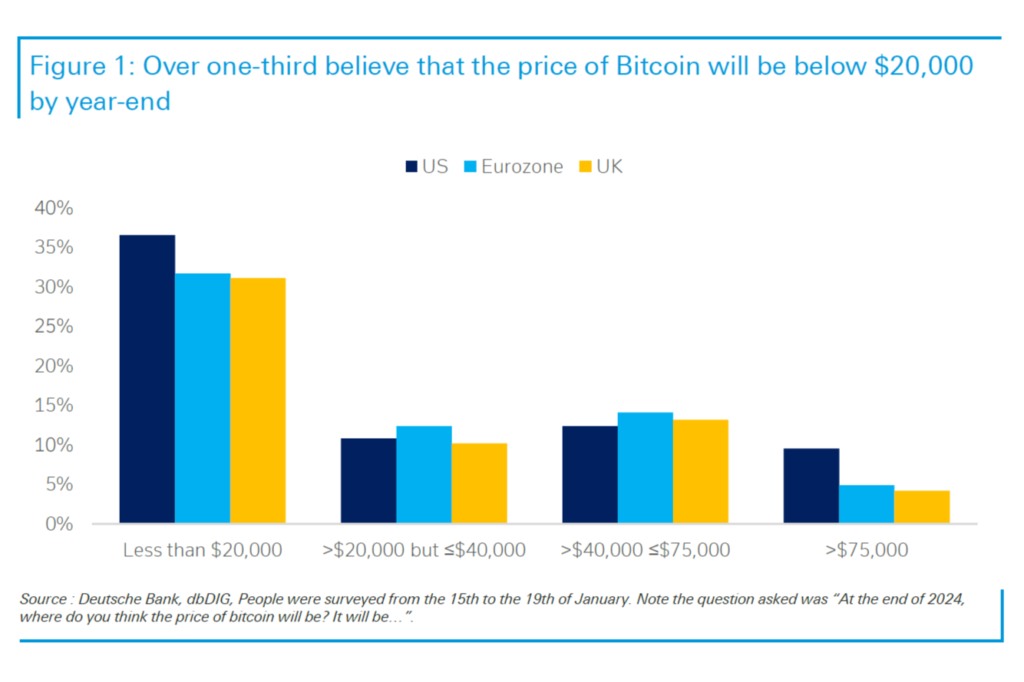
According to a Deutsche Bank survey of 2000 clients, more than a third of respondents expect Bitcoin to fall below $20,000 by the end of the current year. Meanwhile, 15% predict a price between $45,000 and $70,000.


Analysts Marion Laboure and Cassidy Ainsworth-Grace from the bank believe that spot Bitcoin ETFs will “expand the institutionalization” of the asset. However, the study shows that most inflows into exchange-traded funds came from retail investors.
Crypto influencer and Stock-to-Flow model creator known as PlanB has taken a more optimistic stance. In his view, the leading cryptocurrency has already consolidated around $40,000 and is preparing for a 50% rise — up to $60,000.
Bitcoin consolidating a bit around 40k, gaining strength for the next +50% jump towards 60k pic.twitter.com/9BMnGUKd5t
— PlanB (@100trillionUSD) January 23, 2024
Trader Robert Lucas noted that Bitcoin’s weekly cycle has already reached a local high. If a decline begins, the asset’s prices will fall to lows by mid-February and start recovering in March, the expert believes.
Technical analyst and Factor LLC head Peter Brandt observed that the price of digital gold “completed a right-angled broadening triangle with negation above $42,400, confirming a bearish breakout.”
General rule
Weekly chart more reliable than daily chart
Daily chart more reliable than intraday chart
Chart patterns fail more often than they work
Bitcoin has completed a right angled broadening triangle
Negated above 42,400 $BTC pic.twitter.com/oLI3rFZOHN— Peter Brandt (@PeterLBrandt) January 22, 2024
Earlier, Bitfinex experts pointed to risks of further Bitcoin decline to $36,000. According to the company’s report, bearish sentiments dominate the market.
An analyst known as Ali studied the price patterns of the first cryptocurrency’s last two cycles and also suggested a potential decline in the coin’s prices.