




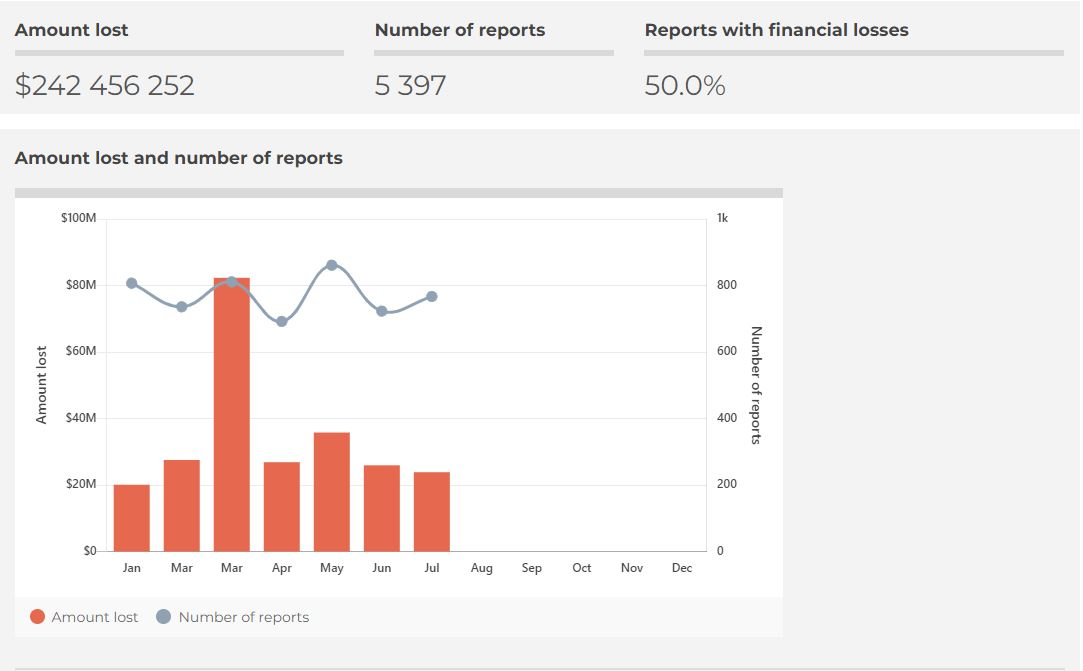
From January to July 2022, Australians lost AUD 242.5 million ($167 million) due to investment- and cryptocurrency-related scams. Data from Scamwatch, operated by ACCC, show this.
This figure is 36% higher than the total loss for the entire 2021 year, which amounted to AUD 178.2 million ($122.7 million).


The most vulnerable demographic was people aged 55 to 64.
ACCC representatives urged banks to invest in fraud-prevention programs.
According to the report by the Australian Broadcasting Corporation, advocacy groups are urging reforms requiring banks to verify whether the recipient’s name matches the account number when conducting online transactions.
“The key reform is to shift this responsibility from individual consumers to banks when it comes to losses from fraud,” said Gerard Brodie, executive director of the Consumer Action Law Center.
In turn, financial institutions are actively promoting the use of PayID technology. It allows clients to see the name attached to the bank identifier (BSB), and the account number.
Earlier, Australian Securities and Investments Commission (ASIC) commissioner Sean Hughes said that investing in digital assets is a form of “extreme risk,” because they are “very volatile and inherently complex”.
In May, the Commonwealth Bank of Australia, the country’s largest bank, indefinitely paused its second pilot program to offer cryptocurrency trading services and closed access to the first due to regulatory uncertainty.
In June, the mayor of the Australian city of Gold Coast, Tom Tate, did not rule out that residents could in the future pay taxes in digital assets taxes in digital assets.
Read ForkLog’s bitcoin news in our Telegram — cryptocurrency news, prices, and analysis.