




In Melbourne, Australia, trials have begun of an advanced brain implant that lets patients with ALS control a phone by thought, the Herald Sun reports.
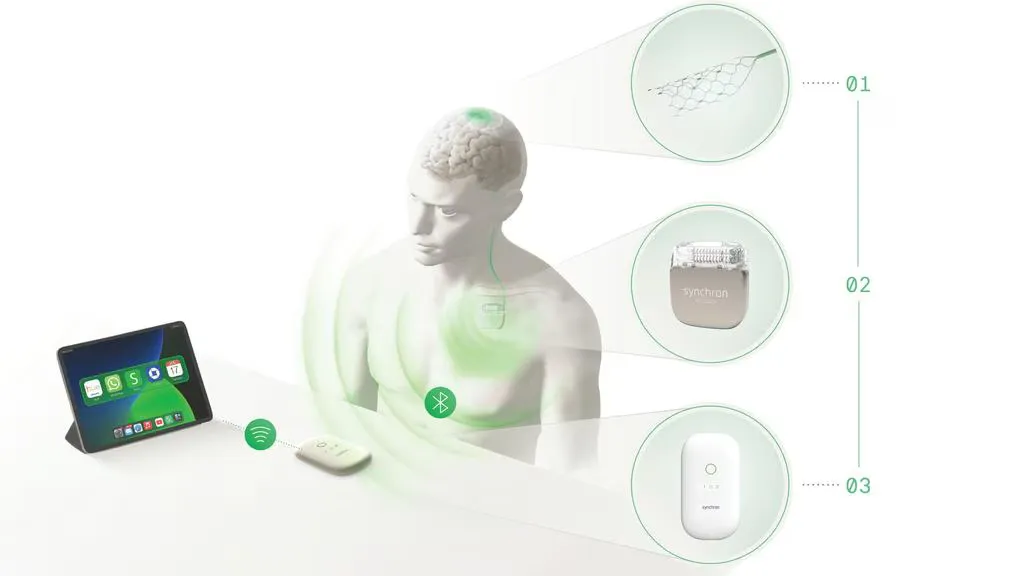
The Stentrode brain–computer interface was developed by Synchron. It records brain activity in the region that governs movement, then translates distinct ‘thoughts’ into actions on a phone or computer, such as moving a cursor.
Surgeries will begin in April — billed as the “world’s first” trial of Synchron’s newer, more advanced implant, the Australian daily noted.


One of the study leads, Peter Mitchell, said that over the past 20–30 years he has seen significant progress in surgery, but “nothing compares with this”.
“To convert nerve impulses and perform actions in the outside world purely by thinking — I can’t recall anything this advanced in neuroscience. It’s the most futuristic concept,” he said.
Brain–computer interfaces (BCIs) have advanced rapidly in recent years. One of the leaders in the field is Elon Musk’s Neuralink.
Synchron is the only company in the world to have successfully implanted a BCI into a human brain via blood vessels as part of clinical trials.
This approach is seen as a significant breakthrough because it is less invasive than open-brain surgery.
How it works
In a new study called FOCUS-AU, Synchron plans to enrol 10 patients with ALS. Surgeries will take place at the Royal Melbourne Hospital, the Royal Prince Alfred Hospital and the Royal Liverpool University Hospital.
Patients with other conditions are expected to be included in future.
The implant consists of three parts:
- tiny electrodes — capture brain activity;
- a small device — implanted near the collarbone;
- a thin connecting cable.
Synchron CEO Tom Oxley explained that the electrodes “listen to brain activity like an antenna”. They are “gently introduced through the neck into the brain via a blood vessel”.
“The system enters the brain through a procedure similar to placing a stent with a catheter. It is introduced into a vessel in the motor cortex, which controls the body,” Oxley said.
The device reads brain activity. For example, if a paralysed person tries to move a hand, the corresponding signal is transmitted. According to the CEO, this initially requires conscious effort, then becomes “more natural”.
“Thus people with paralysis or limited movement can operate devices independently without intermediaries. This will not solve issues of personal hygiene or mobility, but digital communication can significantly increase independence,” the scientist noted.
He added that the new model does not require an external module near the skin and can recognise up to 16 different commands.
Professor Mitchell, who performed the first-in-human operation in the 2020 trials, said the electrodes must be placed “within a few millimetres” of the target brain area.
“We simply follow the veins, turning left and right, until we reach the right vessel,” he said.
China lags behind
In August 2024, Neuralink’s second patient, Alex, learned to play video games and use 3D design software a few weeks after surgery.
After the system was connected to a computer, he began controlling a cursor by thought in under five minutes. Within hours he broke a world record for the speed and accuracy of BCI mouse control, Neuralink said.
In September, the firm disclosed plans to begin testing the Blindsight device, which aims to restore vision. Musk stressed that the gadget would enable sight even for those who have lost both eyes and the optic nerve.
China’s state-backed BCI startup NeuCyber Neurotech said its cutting-edge product is about three years behind Neuralink’s.
Beinao-2 is an invasive implant with flexible electrodes, designed to be fully integrated into the brain. It is now undergoing large-scale animal testing.
Neuralink’s advantage is that its surgical robot can insert hundreds of electrodes into the brain in minutes for the N1 chip.
“The benchmark for Beinao-2 is Neuralink. We have to admit the gap is about three years, since they already have more than 20 patients using the technology,” said NeuCyber’s rotating CEO, Li Yuan.
In mid-March, China’s regulator approved the country’s first neuroimplant for commercial use. The technology was developed by Shanghai-based Neuracle Technology, which works in brain–computer interfaces.
Beijing has included BCI among key strategic industries of the future in its latest five-year plan, alongside quantum computing, AI and nuclear fusion.
Earlier, two people with paralysis were able to type on a virtual keyboard thanks to an implant that decodes attempted finger movements.