




Marcus Hardt, co-founder of Balancer Labs, announced the closure of the company due to financial difficulties following the November $128 million hack.
— Marcus | Balancer (@Marcus_Balancer) March 23, 2026
“The past few months have been incredibly tough. The attack, the prolonged crisis response, difficult decisions, and painful conversations about what was and what was no longer sustainable. We also had to say goodbye to people we deeply respected. Not because they weren’t good enough, but because the structure around the protocol no longer made sense. That’s the crux of the problem,” he wrote.
Hardt stated that the firm was overspending to attract liquidity. The actual yield did not justify the costs. The dilution of BAL token holders’ shares was used to support a system that no longer benefited the protocol.
Project co-founder Fernando Martinelli added that Balancer Labs had become “more of a burden than an asset for the future of the protocol, and in its current form, it is simply unviable.”
According to him, the hack “created real and ongoing legal risks.” He described the continued existence of a corporate structure liable for past incidents as untenable.
The Future
The management of Balancer Labs proposed transferring control of the protocol to the Balancer Foundation and DAO. Hardt stated that the infrastructure is operational. The only issue lies in the economic model.
Key changes include:
- reducing BAL issuance to zero;
- restructuring fees to increase DAO revenues;
- maximizing team reduction and lowering operational costs.
“Balancer still generates real revenue — over $1 million in the last three months. That’s not zero. It’s a functioning protocol buried under broken tokenomics and a heavy cost structure. The problem isn’t that Balancer doesn’t work. The problem is the economics around it. This is fixable,” Martinelli emphasized.
DAO participants were invited to vote on two initiatives that propose potential changes in Balancer’s operational restructuring and BAL tokenomics.
The Hack and Its Aftermath
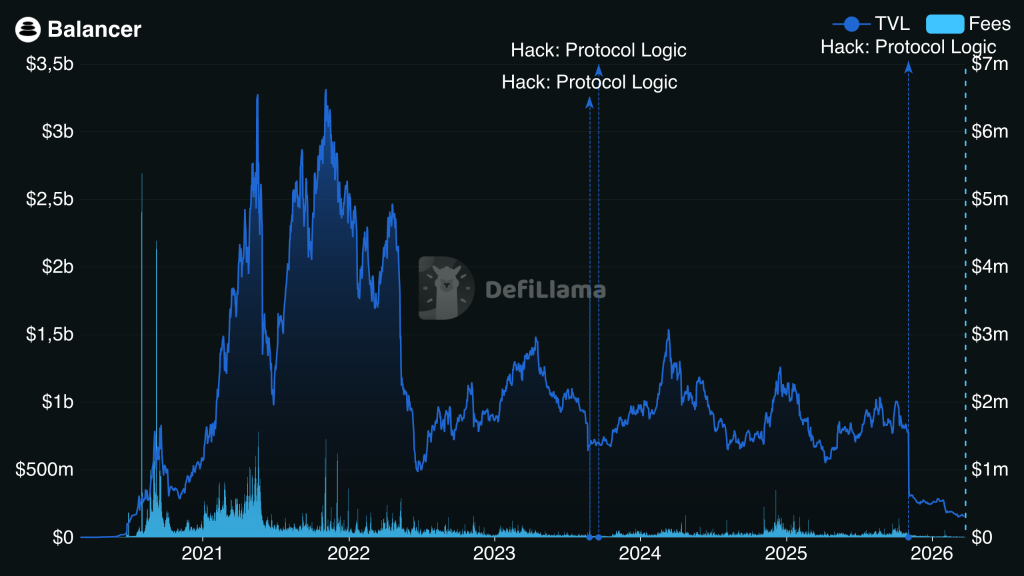
At the peak of the 2020-2021 bull market, Balancer was among the leading DeFi protocols, with its TVL exceeding $3.3 billion.
By October 2025, the figure had fallen to $800 million. In November, the hack slashed the locked value by another $500 million in just two weeks. The current figure stands at $157.8 million.


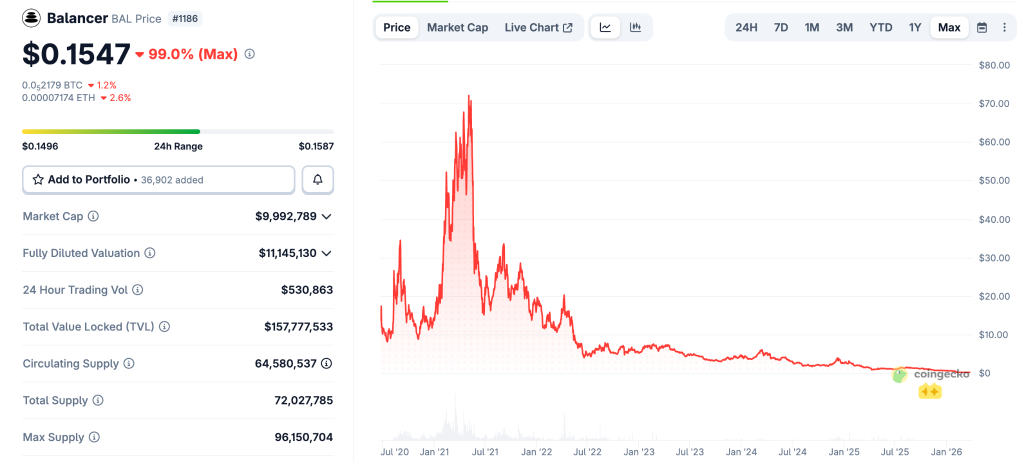
Since its peak in 2021, the price of the native BAL token has plummeted by 99% — from $72 to $0.15. Its market capitalization has decreased from $783 million to the current $9 million.


Earlier, the Balancer team proposed distributing approximately $8 million among community members affected by the hack.