



On April 15, the Berlin hard fork took place on the Ethereum mainnet at block #12,244,000. In the run-up to the event, the asset’s price rose to a new all-time high above $2,460, and open interest in futures reached a record $8.1 billion.
Berlin is here 🇩🇪 https://t.co/CvL9rWeOuc
— Tim Beiko | timbeiko.eth ☀️ (@TimBeiko) April 15, 2021
As part of the Berlin upgrade, имплементированы четыре предложения по улучшению Ethereum, including changes to the gas-cost calculation algorithm (EIP-2565 and EIP-2929), as well as new transaction types (EIP-2930 and EIP-2718).
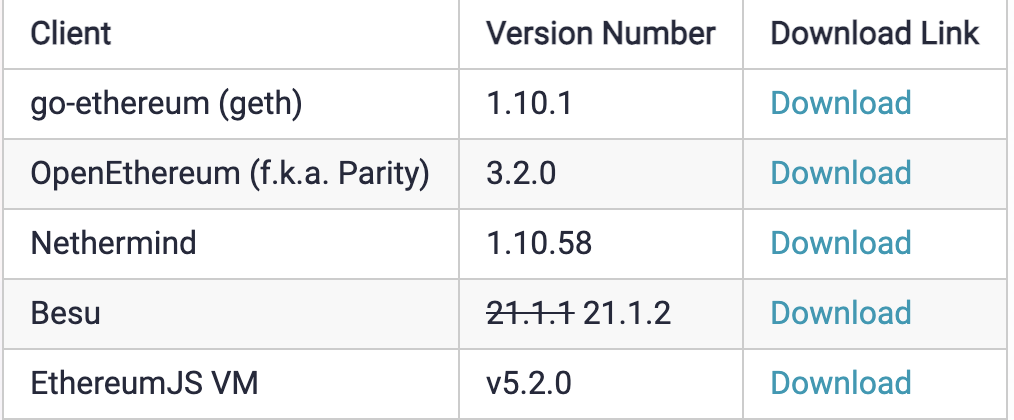
After block #12 244 294, the network reported issues with node synchronization using OpenEthereum 3.2.1.
According to Etherscan, the consensus error affected only this client. Developers are already studying the incident.
The majority of the network runs on the Geth client (82.6% of nodes). OpenEthereum is used mainly by data providers such as Etherscan and Coin Metrics.
Developers have identified the cause of the incident and have already devised a fix. It is currently being tested, but no timeline for the updated client version has been announced. This bug had not been observed before.
A fix has been released with OpenEthereum 3.2.3. The incident can be considered resolved.
We are pleased to release v3.2.3 which includes a fix for the Berlin Upgrade consensus error. https://t.co/h5B1bzrGA5
— OpenEthereum (@OpenEthereumOrg) April 15, 2021
According to ethernodes.org, at the time of the hard fork only 74.6% of nodes were compatible with the update. The service accounts for obsolete nodes running the Parity client, so the share of compatible nodes should be higher.


Gas prices were moderate at the time of the hard fork.
— Nick Schteringard (@schteringard) April 15, 2021
The Berlin upgrade did not include EIP-1559 in its final form, which would burn a portion of transaction fees. However, activation of this proposal is planned for the London hard fork, which is to take place in July.
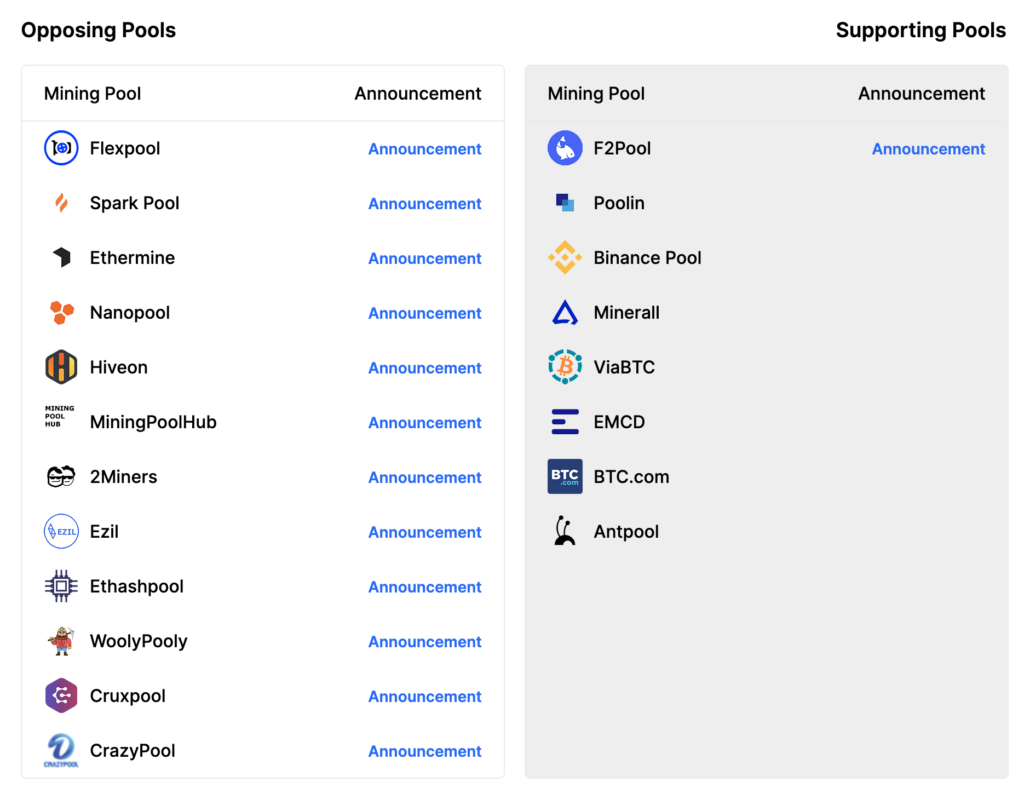
Opposition to the adoption of EIP-1559 came from major Ethermine and SparkPool pools, while the developers are in favour. Each side has solid arguments — the former seeks to earn less, the latter is trying to temporarily patch the scaling problem and reduce fees.


Technical details of Berlin are described in the blog. For example, EIP-2565 proposes lowering gas for the exponentiation operation modulo EIP-198, which introduces a suite of algorithms for RSA signature verification. EIP-2929 increases gas costs for the opcodes SLOAD, CALL, BALANCE, EXT and SELFDESTRUCT to reduce the risk of a large DoS attack on the network.
In March, Ethereum miners earned $1.37 billion. The share of transaction fees in their revenue stood at 47%. For comparison, Bitcoin’s share does not exceed 10%.
The activation of Berlin was delayed several times and sent back for refinement. Developers also feared node centralisation around the Geth client. The specifications were presented only in January 2021, and the exact date was announced in March.
Launch of Ethereum 2.0 Phase 0 took place on 1 December 2020.
Subscribe to ForkLog news on Telegram: ForkLog Feed — all the news, ForkLog — the most important news, infographics and opinions.