




- Bitcoin’s “flat” price movement post-halving benefits public miners.
- Major miners have opportunities to increase market share amid declining revenues.
- The sale of accumulated cryptocurrency reserves by miners remains possible.
Analysts at Bernstein believe that Bitcoin’s “almost flat” price movement is ideal for public miners in their competition for hash rate. This is reported by The Block citing the company’s report.
Gautam Chhugani and Mahika Sapra noted that they are currently not worried about a significant drop in digital gold.
“We expect Bitcoin to remain in a tight range and break upwards to continue its upward adoption trajectory, as there is fund allocation from RIA, asset management platforms, and other institutional funds in the spot ETF segment,” added Bernstein experts.
Hash Rate Decline Post-Halving as Predicted
On May 9, the difficulty of mining the first cryptocurrency decreased by 5.63%. This reduction was the most significant since December 2022 and was due to a drop in Bitcoin’s hash rate following the halving.
The halving of the block reward occurred on April 20. According to Glassnode, the network’s computational power (smoothed by a 7-day moving average) reached a peak of 649.7 EH/s the day before. At the time of writing, the figure stands at 587.7 EH/s — a decrease of 9.5%.
Bernstein analysts estimate that the twenty-day average fell from 627 EH/s to 604 EH/s, or by 3.6%.


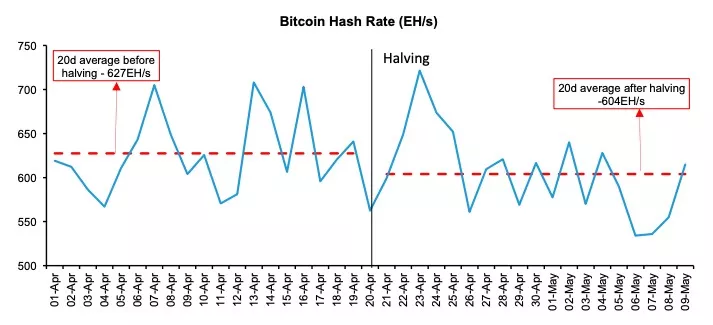
“Due to weaker price support and almost doubling of costs post-halving, more expensive mining equipment is being shut down, leading to a decrease in hash rate,” noted the analysts.
Previously, industry experts predicted a drop in capacity following the block reward reduction for economic reasons. Estimates varied from 15-20% by Galaxy Digital specialists to 5-10% by Hashlabs Mining co-founder Jaran Mellerud.
Are Public Miners Benefiting?
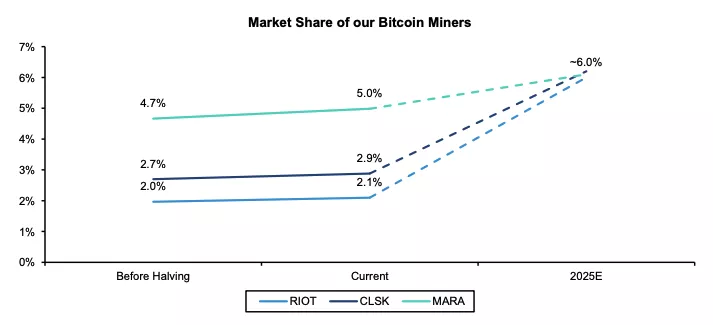
Chhugani and Sapra pointed out that with the overall decline in Bitcoin’s hash rate, the share of public miners Marathon Digital, Riot Platforms, and CleanSpark slightly increased — by 0.2%.
Analysts expect these companies to continue increasing this figure through organic expansion, including mergers and acquisitions, given their substantial Bitcoin balances and cash reserves.
In February, CleanSpark acquired three operational data centers with a combined hash rate of 2.4 EH/s in Mississippi for ~$20 million. In early May, the firm signed an agreement to purchase two mining facilities in Wyoming for $19 million. Once fully operational, the firm expects to add another 4 EH/s to its capacity.
Giddy up! $CLSK has entered into definitive agreements to acquire 75 MW of #bitcoin mining sites in Wyoming for $18.75 million, expecting to add over 4 EH/s in #hashrate once fully operational.??
This is now the third state in our portfolio of owned-and-operated bitcoin mining… pic.twitter.com/HGn5NnQ2BC
— CleanSpark Inc. (@CleanSpark_Inc) May 9, 2024
Marathon also recently acquired three new facilities for a total of approximately ~$265 million through deals concluded in December and March. Meanwhile, Riot is working on tripling the hash rate of its data center in Corsicana, Texas, added Bernstein analysts.
“Overall, a temporary pause in Bitcoin’s price is actually beneficial for existing miners with lower production costs, as hash rates remain constrained, and strong players can execute their aggressive capital investment and M&A plans to increase market share,” concluded Chhugani and Mahika Sapra.
Experts noted that otherwise, companies would have to spend resources to maintain their position. However, through expansion, when Bitcoin’s price rises, these miners will be able to achieve higher dollar revenues by increasing production, the analysts emphasized.
Kaiko Confirms Risk of Sell-Off
The market may be facing the risk of a large-scale sell-off of the first cryptocurrency by miners due to a sharp drop in revenues post-halving. This conclusion was reached by Kaiko specialists.
Following the reduction of the block reward from 6.25 BTC to 3.125 BTC, miners’ revenues were supported by a sharp increase in fees in the network, analysts recalled. Much of the spike was due to the excitement around the launch of the Bitcoin protocol Runes, which has since significantly subsided.


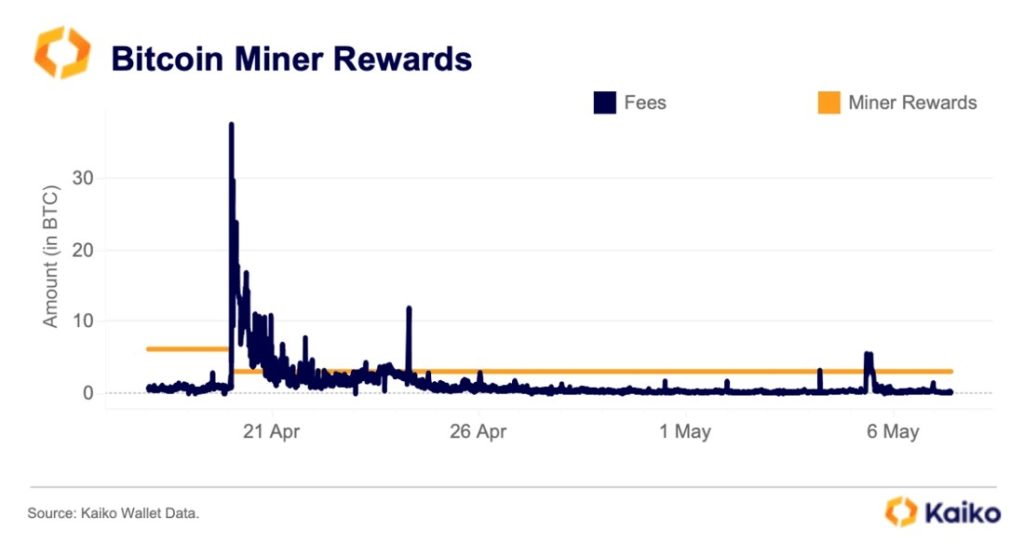
“For Bitcoin miners, halving is typically a sell event, as the process of creating new blocks entails significant costs, forcing sales to cover expenses,” noted Kaiko experts.
Amid the fee spike, their share, for example, in Marathon’s April cryptocurrency revenue was 16.5% compared to 4.5% the previous month. As fees return to pre-halving levels, pressure on miners is increasing, experts believe.
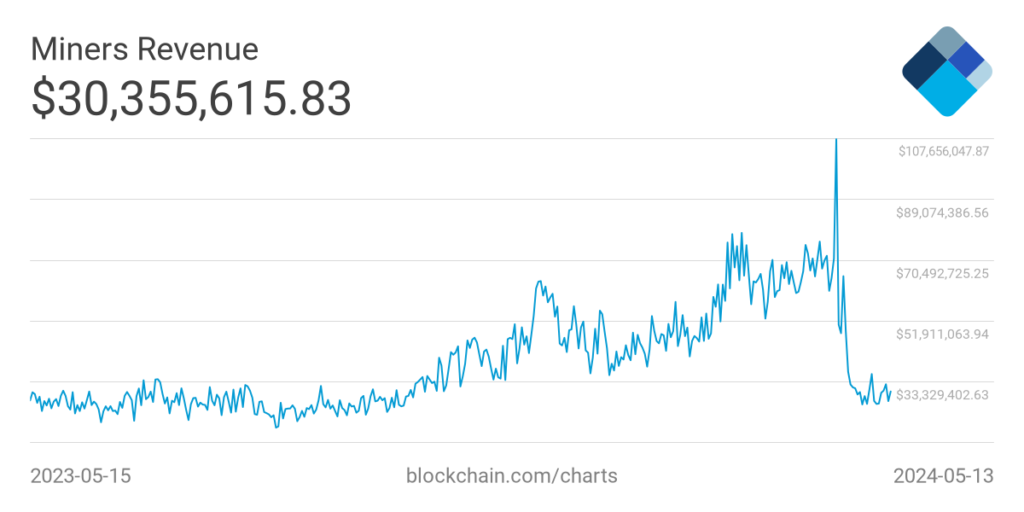
According to Blockchain.com, the average daily revenue of Bitcoin miners has reverted to 2023 levels. As of May 13, the figure was ~$30.4 million compared to ~$107.8 million on the day of the halving.


“For instance, Marathon holds 17,631 BTC worth just over $1.1 billion, and Riot Platforms holds another 8,872 BTC valued at over $500 million. If miners are forced to sell even part of their assets next month, it will negatively impact the markets,” wrote the company’s analysts.
They also noted that trading activity typically declines in the summer months, and liquidity decreases, which could amplify the impact of sales.
In April, the potential liquidation of Bitcoin reserves worth $5 billion by miners post-halving was warned by Marcus Thielen, head of research at 10x Research.