




Putative short-term correlations between bitcoin, gold and the Nasdaq are misleading, The Block reported, citing a Bernstein note.
Analysts at the investment firm led by Gautam Chhugani see the following as more accurate indicators:
- a decline in retail selling;
- a growing race for corporate accumulation;
- renewed inflows into exchange-traded funds.
All these factors lead to a “supply squeeze” in digital gold that will drive it to new highs, the experts believe.
Last week Cantor Fitzgerald, together with SoftBank, Tether and Bitfinex, unveiled Twenty One Capital, an investment firm focused on accumulating bitcoin. Its initial reserves are expected to be 42,000 BTC. In addition to contributions from the project participants, the vehicle plans to raise $385 million via convertible bonds and $200 million through a share sale ahead of a listing.
“Twenty One seeks to replicate Strategy’s bitcoin scenario, albeit with a lower capital base,” Bernstein noted.
Michael Saylor’s company raised about $22 billion in 2024 and another $8.6 billion this year using various financial instruments. Analysts see Twenty One’s advantage in its sponsors — Tether’s net income last year alone totalled $13 billion.
“In any case, the bitcoin accumulation game is becoming competitive,” the Bernstein specialists stated.
Institutions are accumulating digital gold. Are governments next?
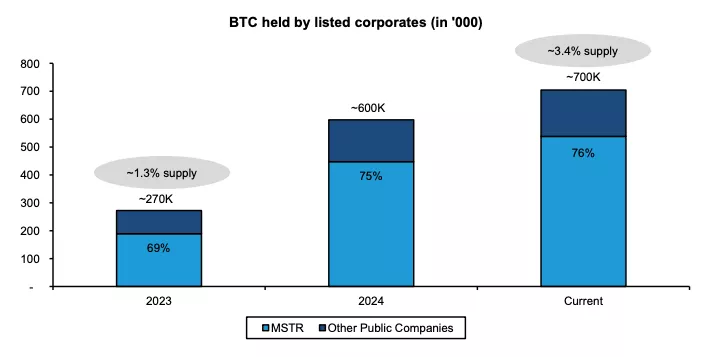
About 80 public companies currently hold a combined 700,000 BTC — 3.4% of the cryptocurrency’s theoretical issuance of 21 million coins.


After roughly two months of “sluggish flows” amid a 31% drop from the all-time high, spot ETF inflows turned positive again from early April. Last week the figure was $3 billion — the highest in five months, the analysts noted.
Coins held by exchange-traded funds amount to over 5.5% of total supply, equivalent to AUM of roughly $109 billion. Institutions account for nearly 33%, compared with 20% in September 2024.

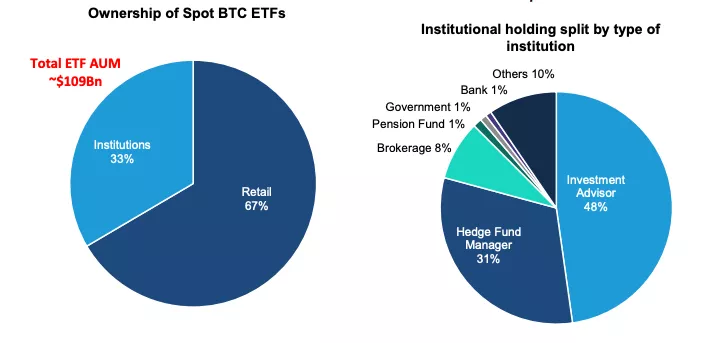
Among institutions, investment advisers hold 48% of bitcoin-ETF volumes, hedge funds 31%.
In total, nearly 9% of the first cryptocurrency’s supply is held in exchange-traded products and corporate reserves.
A recent US presidential order to create a bitcoin reserve could be a catalyst for adoption of digital gold beyond institutions and corporations, Bernstein’s experts believe.
Although the current momentum from corporate accumulation alone could push it to new highs in 2025, potential purchases by the US government are not priced in, they emphasized.
BTC exchange supply is shrinking
Bitcoin balances on exchanges have fallen to 13% of total supply from 16% at the end of 2023. But given the price increase over this period, the dollar value of coins held on trading platforms has actually risen, Bernstein acknowledged.
The co-founder and CEO of Satoshi Action Fund called shrinking exchange bitcoin balances a bullish signal. But analyst James Check, known as Checkmate, disputed that indicator.
Oh, we've seen it before.
Engagement farming with exchange balances is so 2021.
Hop on the M2 supply wagon instead. https://t.co/kmbFrokEvH
— _Checkmate ??⚡☢️?️ (@_Checkmatey_) April 26, 2025
In his view, what is often taken for outflows from platforms is the movement of assets between wallets for various reasons. Check believes it is more relevant to track global money supply — aggregate M2. Earlier, Bitwise noted that growth in the metric “has historically been a favorable condition” for risk assets such as bitcoin.
Bernstein analysts forecast that by the end of 2025 the cryptocurrency will reach the peak of the current cycle around $200,000. With inevitable bear phases, they expect $500,000 by 2030 and $1 million by the end of 2033.
“In the long term, we believe that bitcoin’s fundamentals are determined by its own demand trajectory and the mathematically proven unchanging supply of 21 million coins. Today 19.9 million BTC have been mined, and of the remaining 1.1 million almost 95% will be generated over the next 10 years,” the company’s specialists emphasized.
Traders expect a correction before the uptrend resumes
Several analysts think bitcoin will test established support before a rally to fresh highs.
$BTC Sunday update:
Interesting week ahead with earnings reports from Meta, Amazon & Apple, but also PCE inflation data and labour market data.
I'll keep de-risking my swing long trade from $77k by continue taking profits in this current zone. Spot bags are fine.
?↓ (1/4): pic.twitter.com/VK3jjseTtP
— CrypNuevo ? (@CrypNuevo) April 27, 2025
“It’s very simple — I don’t yet see momentum resuming. It is quite possible that we will see a third stage of growth to $97,000, when certain liquidity appears,” wrote the crypto trader known as CrypNuevo.
He also allowed for a retest of the 50-day exponential moving average on the four-hour timeframe, which stands at $91,850.
An independent analyst under the pseudonym Roman expects a deeper pullback — to $88,000. He cited the stochastic RSI indicator, signalling overbought conditions.
YouTube blogger Matthew Hyland agreed with Roman, but noted that a rise to $99,500 could precede the drop.
A trader known as Skew pointed to investor “indecision” behind the current price action. He recommended focusing on the $90,000-92,000 range.
At the time of writing bitcoin is trading around $94,500. Over the past 24 hours the price has barely changed.
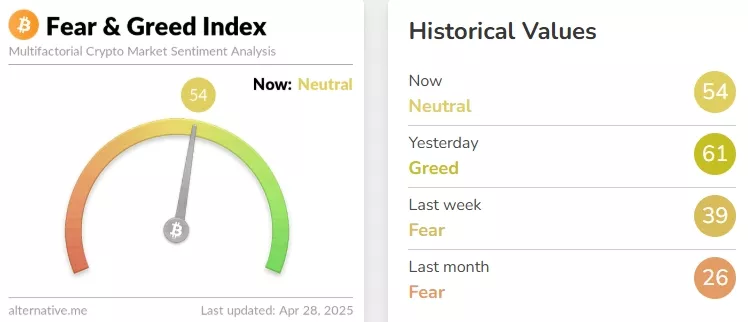
The crypto fear and greed index sits in neutral at 54, though on April 23 the reading reached 72.

ARK Invest has forecast the leading cryptocurrency could rise to $2.4 million by the end of 2030 amid adoption by institutions and sovereign wealth funds.