


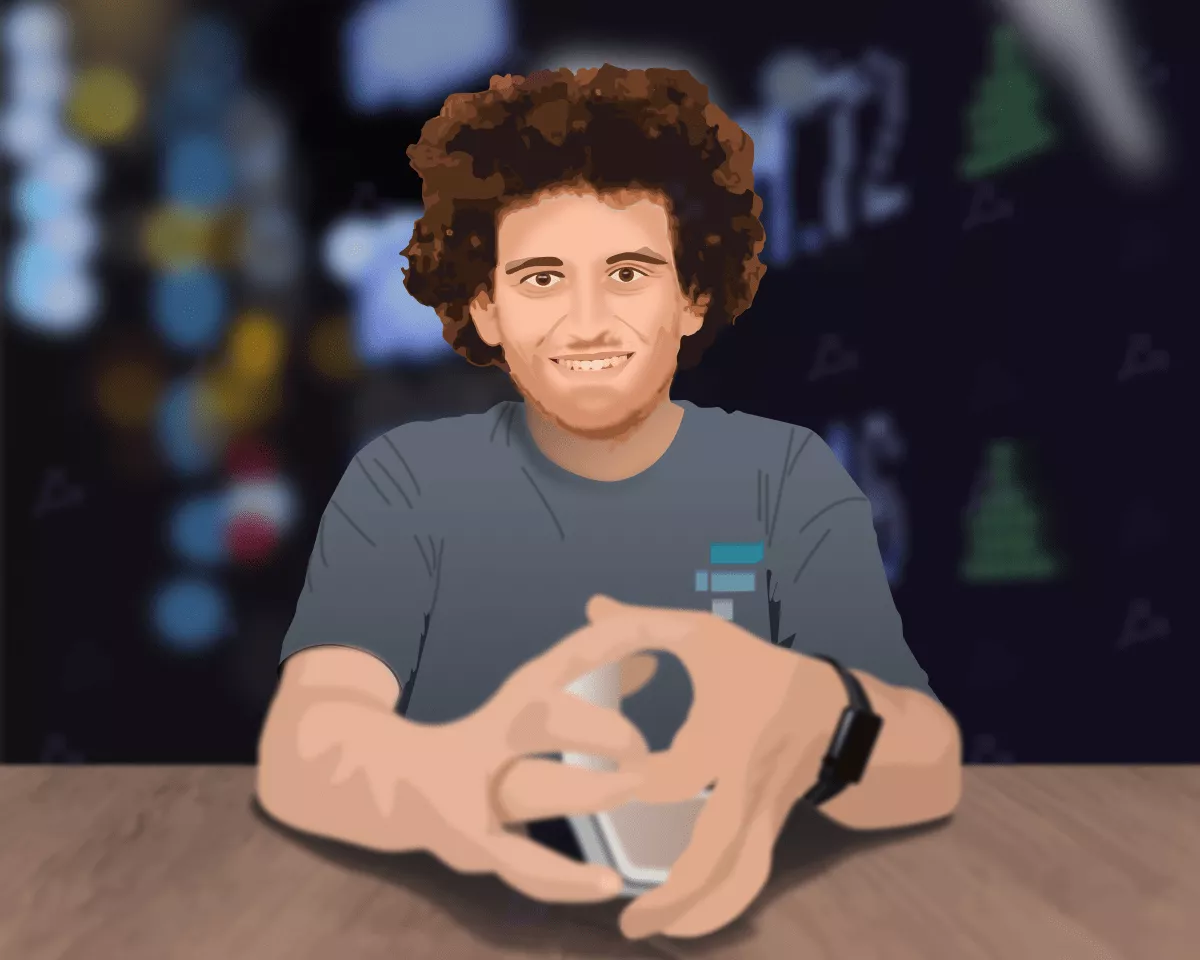
Billionaire Sam Bankman-Fried on tech threats and FTX culture — interview
A Massachusetts Institute of Technology graduate with a physics degree, Sam Bankman-Fried built a fortune of $8.7 billion in under four years, making him the richest person in the world under thirty.
Bankman-Fried began his career on Wall Street, where for three and a half years he traded ETFs at Jane Street. But he bears little resemblance to the traders we are used to seeing on the big screen. He adheres to the philosophy of effective altruism and follows utilitarian principles, constantly considering the maximum positive impact he can have on the world.
In an exclusive interview with ForkLog’s editor-in-chief Nikita Shteringard, the founder of the bitcoin exchange FTX and Alameda Research spoke about his worldview, building corporate culture, and business. The interview also discussed the environmental sustainability of Bitcoin mining and the technological race between the United States and China.
ForkLog: Hello, Sam! Some outlets say your first company Alameda earned capital from Bitcoin arbitrage against the Japanese yen, and others — with the Korean won, from the so-called “kimchi premium”. Where lies the truth?
SBF: Hi! We had various arbitrage trades, but more often it was the Japanese yen. In Korea there are strict restrictions on capital movements, so we could not operate with substantial sums. Japan, however, allowed scaling via traditional international transfers.
[In 2018 the price difference between Bitcoin in Japan and the U.S. fluctuated around 10%. For a period, Bankman-Fried’s team conducted operations up to $25 million daily — here and below an editor’s note].
ForkLog: Do you remember when you first heard about Bitcoin? Many crypto entrepreneurs are early adopters.
SBF: I think I heard about it as early as 2012, but did not pay it much mind until the 2017 rally. Back then, everyone talked about Bitcoin, so I became interested and began trading.
ForkLog: And now, after four years, you are the richest person in the world under thirty. In one interview you noted that your wealth is largely illiquid. What do you mean?
SBF: Yes, it’s a stake in FTX and some tokens. Mostly within the FTX ecosystem and the crypto industry.
ForkLog: In the valuation of $8.7 billion, did Forbes account for the latest round of investments?
SBF: No. I think the figure could still grow, perhaps by one and a half or even twice. Not certain, but I wouldn’t be surprised.
[On July 20 FTX closed a $900 million Series B round. The post-round valuation was $18 billion. It also became the largest in the history of the industry. As part of the deal, FTX repurchased its shares from Binance, which had backed the company in 2019].
ForkLog: In a recent Unconfirmed podcast you said that FTX lacks users. I applied the ratio between Coinbase’s monthly active users and unique visitors in Q1 to FTX. It turned out you have approximately 760 thousand users making at least one transaction per month. Are these figures close to the truth?
SBF: I don’t recall exact figures, but it sounds quite plausible. That’s why we’re pursuing major sponsorship deals now—to grow the user base.
We did indeed focus initially on professional traders, since we started as a derivatives exchange. We also launched later than other major players, so less crypto-savvy users may not have heard of us.
In addition to deals in sports sponsorship, we are thinking about other areas where we could reach tens of millions of people, but it’s too early to say.
[In the first quarter, Coinbase’s monthly active users stood at 6.1 million, and its average monthly unique visitors, according to SimilarWeb, were 16.9 million. The latter was 2.77 times larger than the former. For ftx.com in Q1, according to SimilarWeb, there were 2.1 million unique visitors per month].
ForkLog: As far as I know, you’re vegan. Explain your ethical choice. If evolution made us omnivores, doesn’t that mean we are predators by default?
SBF: Human evolution does not necessarily answer what is good for the world. It answers what is good for us. I try to think about the impact we have on the environment and how to maximise utility.
Evolution does not necessarily determine our actions. Many things that used to be permissible with regard to animals are now illegitimate. In other words, it is a matter of choice.
For myself, I have decided that it is wrong to eat meat, given how it is produced. Chickens are tortured for 6-8 weeks so that we can eat them in half an hour. It makes no sense.
We are seeing significant progress in the technology of lab-grown meat. Each year it becomes easier to avoid meat consumption.
I view this from an environmental perspective. Cows account for significant greenhouse gas emissions. Enormous energy is spent producing cattle for consumption.
ForkLog: On ecology. What do you think about the risks associated with Bitcoin mining?
SBF: I think participants should direct some of their resources to offset the negative impact of mining, and support a gradual transition of the sector to sustainable renewable energy sources. This is feasible, in my view; I see no obstacles.
ForkLog: China’s Xinjiang is the world center of solar panel production. Because of cheap coal electricity and cheap labour. So we effectively use the dirtiest energy to achieve environmental sustainability. What do you think about this paradox?
SBF: The logic holds if the energy produced by these panels greatly exceeds the energy spent to manufacture them. In that case, concerns about the cleanliness of the source can be set aside, since the share of dirty energy will ultimately decline.
ForkLog: You joined the ranks of the top donors to Joe Biden in the presidential elections. The White House sees China as the main global threat, particularly technologically. Will there be another Cold War?
SBF: I cannot predict the future, but I very much hope that since the end of the last Cold War we have learned to cooperate productively as a global community. I do not think such a war will happen.
ForkLog: Do you think the US government should spend more on R&D to compete in the tech race?
SBF: Yes, it is worth it. But that is only part of the story. The second component is regulation. It is encouraging to see governments embrace technology in general, but ignoring risks is unacceptable. I am talking about risks related to genetically enhanced diseases, advanced AI, and climate change. And that is just a few examples.
Yes, governments should support the development of technology not only domestically but globally, but must remember responsibility. There is much to worry about.
ForkLog: You donate to organisations addressing existential threats from AI, including OpenAI. What are these threats? Should there be regulation in AI, as with genetic engineering?
SBF: Undoubtedly, but with regulation it’s easy to go down the wrong path. This balance is hard to maintain without negative side effects.
The greatest threat comes from automated systems, whose influence on many processes grows every day. Yes, they can change the world, but not necessarily for the better. We must exercise maximum caution, account for consequences, and remember safety measures.
ForkLog: Many Chinese tech giants create gladiator-like working conditions, forcing employees to compete with each other. This leads to regular overtime, abuse and even direct harm to health, not to mention a toxic atmosphere. Do you think such an approach is justified in the tech race with the US?
SBF: I don’t think this is unique to China. Both approaches—American and Chinese—are widespread in the world. Many companies face a choice between a toxic culture and a form of laziness.
At FTX we, of course, encourage employees who put in the effort, but we try to focus on what we can do for the company together, not emphasizing who will take the laurels. The team has tasks to complete. Maintaining this balance is difficult, especially as the company grows.
In my view, many companies make a mistake when they hire too many people too quickly. I understand there are many tasks and they always burn, but growth must be managed and, crucially, not at the expense of company culture. Many fail at this.
ForkLog: Over the past decade, unprofitable companies have captured huge markets with blitzscaling strategies. Among them Uber, DoorDash, WeWork and others. Burning venture money, they killed many profitable businesses, with questionable business models. Is it normal to call a business “successful” if it does not make money?
SBF: Ultimately, a successful business must earn money. Not necessarily from day one, but overall. If that is not now or if it is unclear when it will be, one must understand why things will change. If you sacrifice profitability today so that tomorrow it is much higher, then there is a point.
If companies compete in unprofitability to exhaust rivals, that is an inefficient model. For owners of such companies, there may be meaning, but that is an unhealthy dynamic.
ForkLog: Tell us about difficulties you faced as an entrepreneur?
SBF: When we started FTX, I was confident that I knew how to manage the team. The reality was tougher—I knew how to manage when everyone is happy. But when views on important issues began to diverge, I realised I did not know how to proceed. I had to learn on the fly how to synchronise opposing points of view and find ways to resolve them.
The right organisational structure is the key to scaling the existing system. That is the conclusion I reached.
Interview conducted by Nikita Shteringard, 07.07.2021.
Рассылки ForkLog: держите руку на пульсе биткоин-индустрии!