




On July 23, Binance’s research division released a report on the structural factors behind BNB’s price surge. Experts attributed the recent rally to spot market demand and growing interest from institutional investors.
Spot Purchases
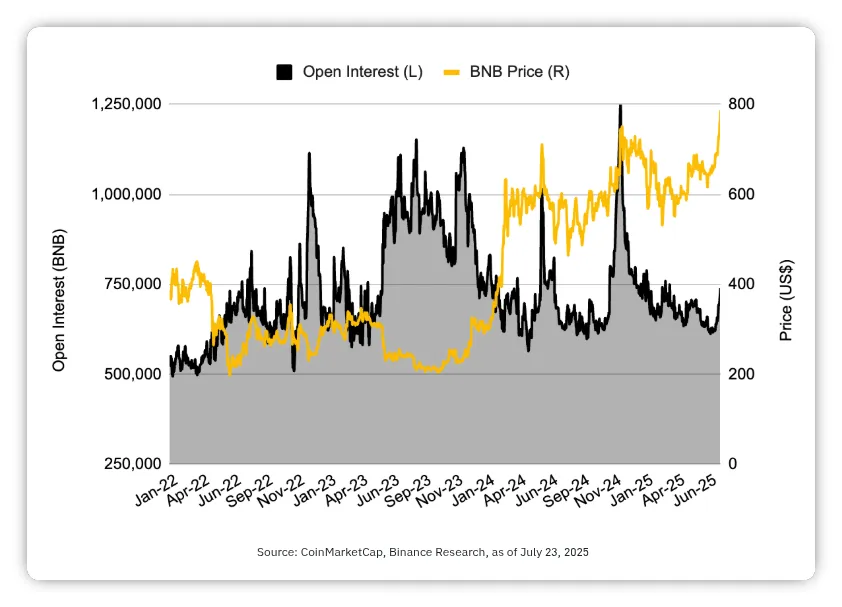
According to the report, the five-week price increase was primarily driven by spot market demand:
“From a capital movement perspective, this growth has a healthy foundation. […] The main driving force is the influx of new capital into the spot market to form long-term positions. This indicates genuine investor confidence rather than speculation using borrowed funds.”


Analysts also noted that BNB outperformed traditional market indices and other major cryptocurrencies in terms of risk-return ratio.

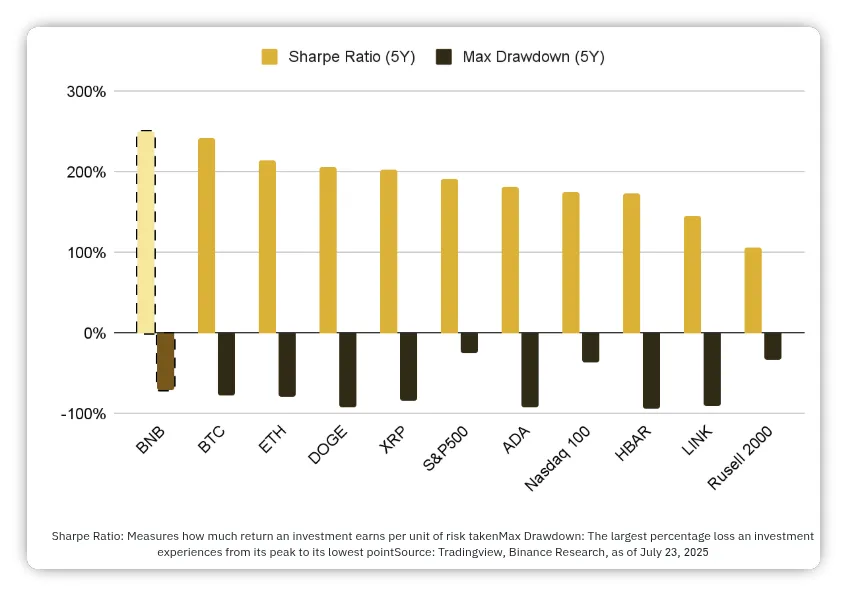
“The five-year Sharpe ratio reached 2.5. This means that for every dollar of risk taken, there was $2.5 in profit. This figure highlights BNB’s potential to deliver high returns with relatively stable risk levels,” analysts noted.
Institutional Interest
Analysts estimate that potential demand for BNB from large investors exceeds $1.2 billion.
“Even though only a few public plans have been disclosed so far, the total potential demand already exceeds $1.2 billion — a figure indicating high market confidence.
For comparison: public companies hold Ethereum (ETH) worth $3.7 billion, which is only 0.83% of its total capitalization. A $1.2 billion reserve in BNB means that public companies claim 1% of its supply, already surpassing the equivalent figure for the second-largest cryptocurrency by market cap,” the report states.
Nano Labs, Windtree Therapeutics, 10X Capital, and Build & Build Corp have announced plans to create reserves in BNB.
BNB’s value is supported by its use in centralized and decentralized services: discounts on trading fees on Binance, participation in token sales, and gas payments in BNB Chain, opBNB, and Greenfield networks.
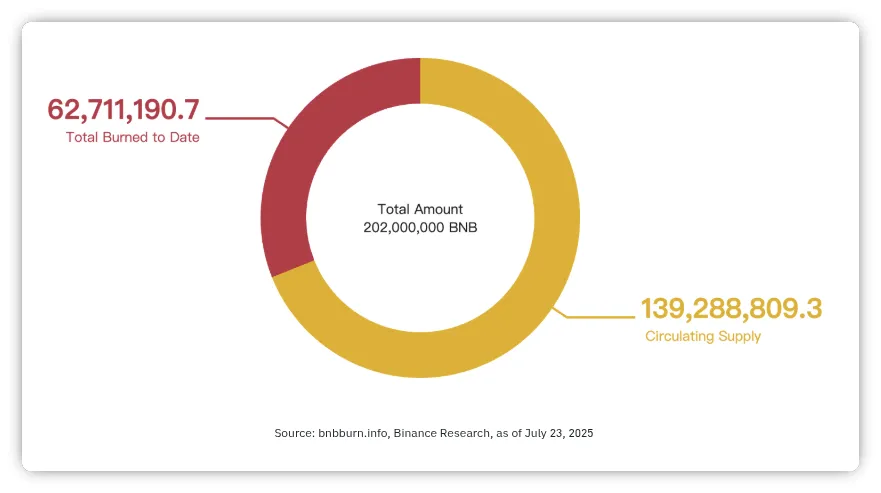
The deflationary model with a burn mechanism of nearly a third (31%) of the total token supply increases the asset’s scarcity.

Last week, the BNB Chain team unveiled a development roadmap for the network through 2026. Developers plan to “create a next-generation blockchain” capable of competing with CEX and TradFi platforms like Nasdaq.