




We have compiled the most significant news from the crypto industry over the past two weeks.
- Binance-controlled bitcoin exchange Tokocrypto in Indonesia has received a license from the local regulator.
- The teams of Ether.fi and Scroll will launch the Visa Cash credit card.
- tZERO has become the second regulated broker-dealer for digital securities.
- “Atomize” and Smart Engines have simplified working with digital financial assets through a document recognition system.
Binance-Controlled Bitcoin Exchange Tokocrypto in Indonesia Secures Local License
Binance-controlled cryptocurrency exchange Tokocrypto has obtained a Physical Crypto Asset Trader license from Indonesia’s Commodity Futures Trading Regulatory Agency.
The platform has become the third organization on this list. The license grants full rights to operate as a cryptocurrency trader.
Tokocrypto ranks first in trading volume of digital assets in Indonesia with a 43% market share. Competitors Indodax and Upbit Indonesia hold 42% and 15% of the market, respectively.
Ether.fi and Scroll Teams to Launch Visa Cash Credit Card
Developers of the Ether.fi liquid restaking platform and the Scroll L2 solution announced the launch of the Visa Cash credit card. The latter will serve as a settlement layer to minimize fees for its holders.
The card will allow users to borrow funds against digital assets and receive 3% cashback. Collateral can include “eETH, Liquid Vault LP tokens, and other yield-bearing assets,” according to the website.
Developers are testing the product within the protocol and preparing to distribute it to users on September 16, 2024.
The card can be added to Apple Pay or Google Pay payment services and used at terminals. Initially, the service will be available only to clients in Europe, with plans to expand to other markets later.
Additionally, the release of the Spend debit card in euros with seamless integration with crypto wallets was announced by payment giant Mastercard and fintech solutions provider Mercuryo. It is compatible with Ethereum, Solana, TON, Polkadot, NEAR, ZKsync, and other networks.
In July, ForkLog reported on Tezos Foundation’s plans to release an on-chain payment card in collaboration with Baanx and Mastercard on Etherlink — an Ethereum-compatible L2 solution for Tezos with transaction finality of ~500 ms.
tZERO Becomes Second Regulated Broker-Dealer for Digital Securities
SEC and FINRA approved tZero Digital Asset Securities as a special-purpose broker-dealer for digital securities.
The license allows the SEC-regulated alternative trading system operator tZero to perform custody, clearing, and settlement of digital securities without a third-party custodian. As a result, the company is ready to offer a full range of services from issuance to secondary trading of such assets.
The first to receive such status was Ember Capital, part of the Prometheum structure.
In July 2023, U.S. Republican Senator Tommy Tuberville urged the Department of Justice and SEC to investigate Prometheum’s activities. He suspected the platform’s CEO, Aaron Kaplan, of perjury during congressional hearings and violating securities laws.
“Atomize” and Smart Engines Simplify Digital Asset Operations with Document Recognition System
“Atomize” and AI company Smart Engines have agreed to integrate the latter’s document recognition and authentication technology into the operator’s IS platform for issuing DFA.
Thanks to the partnership with Smart Engines, “Atomize” has simplified the registration of new clients. All document recognition and verification operations are fully automated, eliminating human error and the risk of personal data leaks.
Smart Engines’ technology is used for recognizing QR codes, bank cards, Russian passports, and other documents from 220 countries and jurisdictions that verify a person’s identity, as well as business and accounting documents.
“The implementation of Smart Engines systems has allowed us to speed up the processing of documents required by regulators and further protect ‘Atomize’ clients from fraud. Now investors can more easily, conveniently, and safely explore new digital tools, and businesses can attract financing,” noted Dmitry Bulychkov, the company’s technology development advisor.
In September, it became known that the Bank of Russia is working on amendments that will allow DFAs to be transferred to trust management and included in mutual investment funds.
Key DeFi Segment Metrics
The total value locked (TVL) in DeFi protocols has plummeted to $81.9 billion. Lido remains the leader with $23.5 billion. Aave has returned to the second spot after a long hiatus with $11.4 billion, displacing EigenLayer ($11.3 billion).


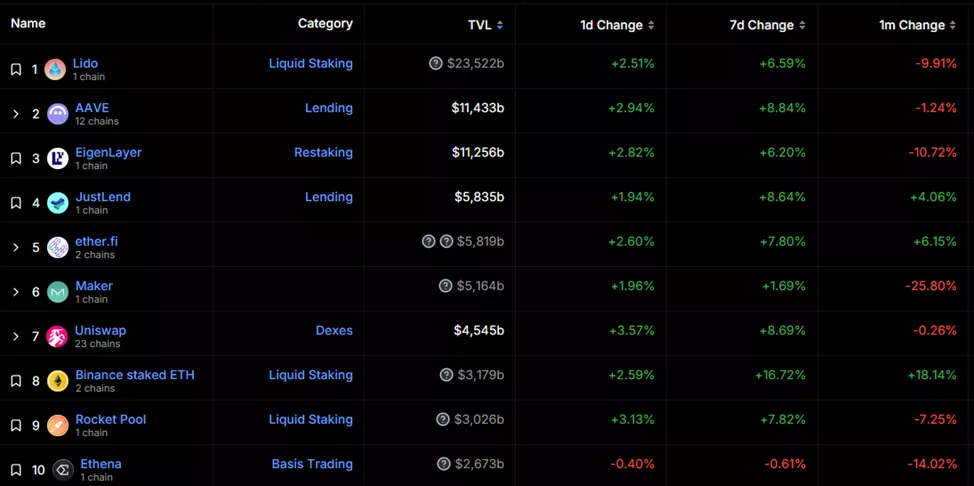
TVL in Ethereum applications dropped to $47.8 billion. Trading volume on decentralized exchanges (DEX) over the past 30 days fell to $101.6 billion.
Uniswap continues to dominate the non-custodial platform market, accounting for 44.9% of total turnover. The second DEX by trading volume is PancakeSwap (18.6%), followed by Aerodrome (8.5%), Dodo (6%), and Curve (5%) returning to fifth place.
Also on ForkLog:
- SEC fined investment platform eToro $1.5 million.
- Uniswap CEO denied charging fees for protocol deployment, CFTC fined DEX $175,000.
- Coinbase launched “wrapped” bitcoin.
- The Vega Protocol community supported the closure of the network and the VEGA token.
- PayPal and Venmo integrated Ethereum Name Service for crypto payments.
- Binance removed Changpeng Zhao from management.
- EigenLayer announced a second airdrop.
- The Polygon team began converting MATIC to POL.
What to Read Over the Weekend?
In August, the total trading volume on major centralized exchanges increased by 30%, while in the DeFi sector, the fees collected by protocols fell by 24.4%.
The Block analyzed the changing landscape of DEX, noting the impact of increased competition and innovation. Analysts also presented success strategies for new players in the “decentralized exchange war.”