



Tokenized money market funds and their integration with DeFi pose threats to the entire financial system, according to a report by the Bank for International Settlements (BIS).
Despite their digital form, these products retain the vulnerabilities of their traditional counterparts, experts believe. Essentially, they are similar to classic funds, offering investors the opportunity to earn returns from financial instruments directly on the blockchain.
“Tokenized money market funds generate risks that not only reflect but may also amplify the issues inherent in both traditional money market funds and stablecoins,” the document states.
The main issue remains the liquidity mismatch: the ability to instantly redeem tokenized shares contradicts the traditional settlement cycles (T+1/T+2) of underlying assets.
This structural vulnerability becomes particularly acute during periods of financial stress when there is a mass demand for liquidity. At such times, the digital funds market is left defenseless, as it lacks access to traditional emergency support mechanisms such as central bank lending.
The transparency of the blockchain exacerbates the threat—it acts as a catalyst for coordinated investor actions. Redemption operations are visible to all market participants in real-time, which can trigger a chain reaction of mass withdrawals and accelerate the development of a crisis.
Interaction with decentralized finance can exacerbate market stress through leverage and protocol interdependence. Given the integration with “stablecoins,” shocks can spread faster and cause more severe damage compared to traditional markets.
“Operational and technological risks are also inherent in tokenized funds. Dependence on public blockchain infrastructure exposes them to cyberattacks, smart contract vulnerabilities, and service disruptions, any of which could disrupt the functioning of the instrument or limit investors’ access to their shares,” analysts added.
Sector Growth
The warning comes amid the sector’s rapid growth. Over the past year, its capitalization has increased by 265% to $9 billion. Key players include BlackRock, Circle, Franklin Templeton, and Ondo Finance.


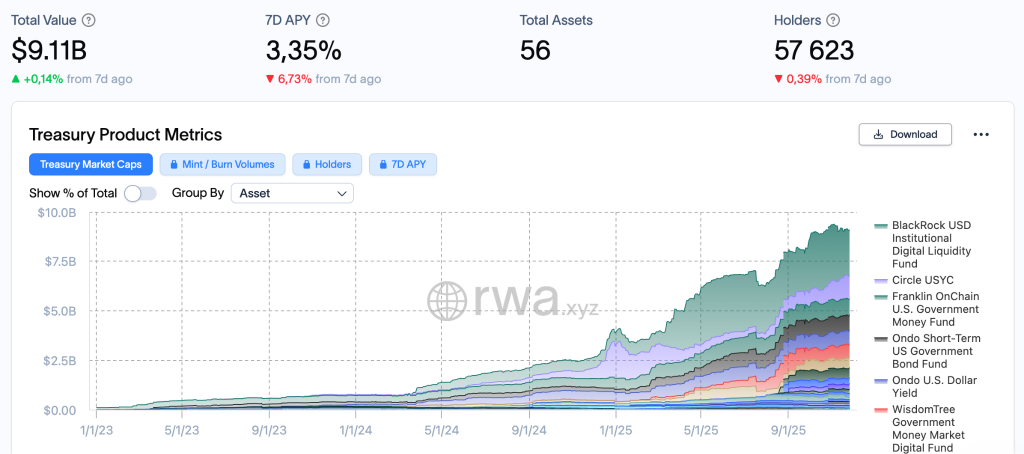
BIS acknowledged the potential for further market value growth in this segment, stating that these crypto products could become the “backbone of the global financial system.” However, experts pointed to the need for proactive measures to limit risks before they escalate into systemic threats.
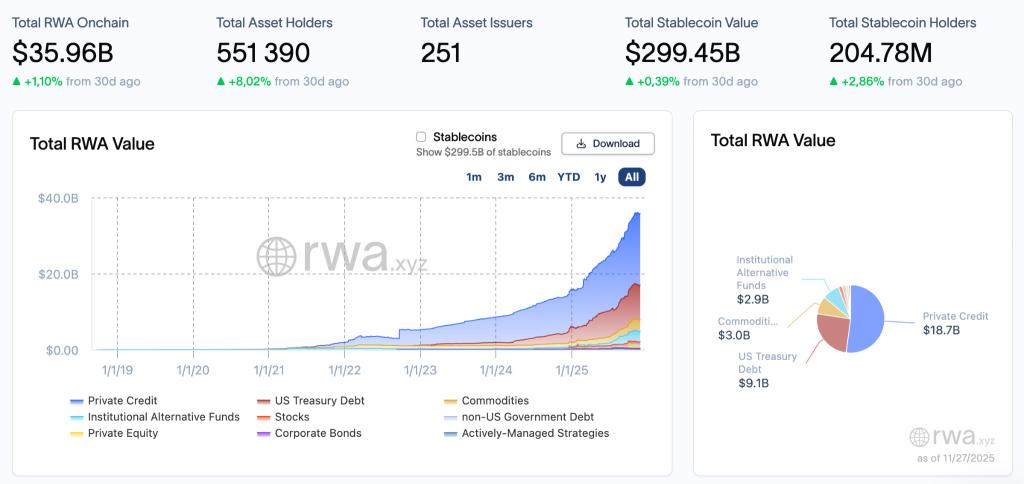
The total capitalization of RWA has nearly reached $36 billion. According to analysts at Standard Chartered, this figure could grow to $2 trillion by 2028.
The majority of the market value consists of tokenized private loans—$18.7 billion.


Back in November, banks DBS and Kinexys from JPMorgan announced work on a platform for interbank RWA transfers. It will support multiple blockchains.