



On Sunday, November 15, the planned hard fork in the sixth-largest cryptocurrency by market capitalization, Bitcoin Cash, took place. However the largest client of Bitcoin Cash ABC until recently did not secure community support, and the Bitcoin Cash blockchain split into two incompatible chains.
The update was scheduled for 12:00 UTC, but its activation occurred with a delay of almost two hours. It happened at 14:13 UTC on block 661,447, which became the last common block for Bitcoin Cash ABC and BCHN.
Four minutes later, Antpool found block 661,448, which supports BCHN exclusively. The next block in the Bitcoin Cash ABC chain remained unfound.
BCH has split into two separate chains — BCHN and BCHABC — with BCHN mining the first block and leading for the #BCH ticker. pic.twitter.com/Og6rKzKjgu
— Bitcoin Cash | P2P Electronic Cash (@bch_pls) November 15, 2020
Update 1: An hour after the upgrade activation, at 15:13 UTC, the BCHN chain moved five blocks ahead. The BCHABC chain still had no new blocks.
Update 2: The first post-hard fork block in the BCHABC chain was found at 15:55 UTC. The BCHN chain, by that moment, was at block 661,663.
Update 3: As of 21:00 UTC, the BCHN network is ahead by 37 blocks, which finally confirms the split of Bitcoin Cash into two separate chains.
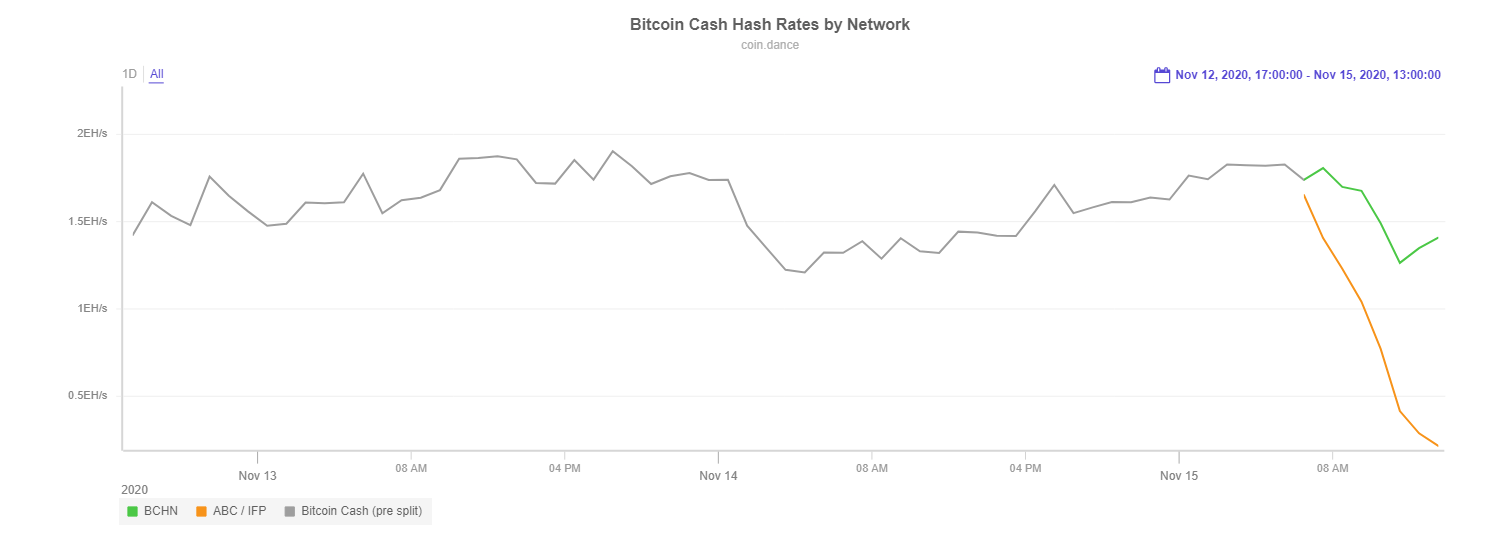
The BCHABC hash rate, as shown in the graph below, fell to a sharp low of 0.22 EH/s. The corresponding BCHN figure, after a small dip, rose to 1.41 EH/s.


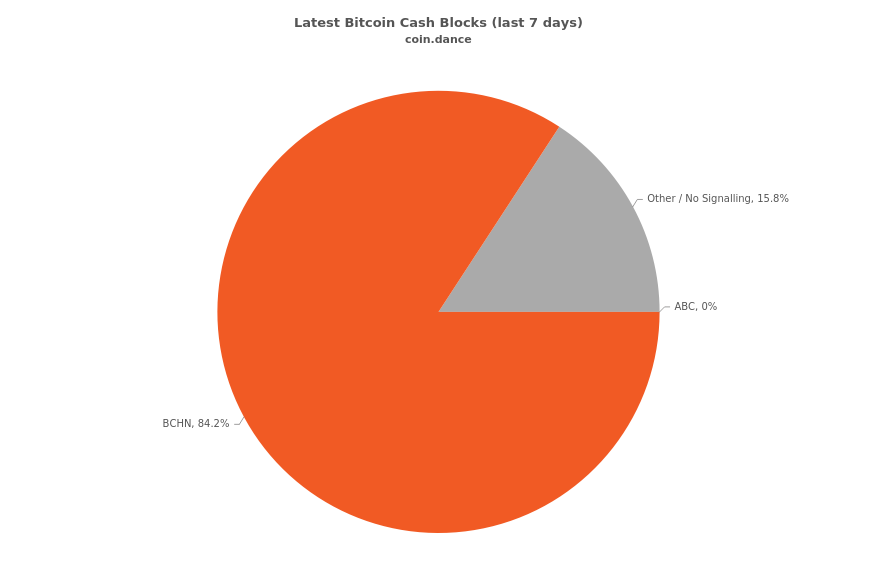
In the past seven days, 84.2% of nodes signalled support for BCHN, 15.8% remained undecided, and there were no supporters for the ABC Bitcoin Cash client.


Futures markets likewise support BCHN as the dominant chain after November 15. Before the hard fork, BCHN futures traded at 0.94 BCH, and BCHA at 0.06 BCH.
In the lead-up to the hard fork, Bitcoin Cash price experienced heightened volatility, falling from around $260 to $245 over three blocks before activation and then rebounding to levels above $250 just ahead of the event. In addition, block generation delays were observed, with a pause of nearly an hour at one point.
Amaury Sechet announced the network upgrade in August this year. As of today, all nodes would have had to update their software to avoid remaining on the alternative chain.
The update introduces a new difficulty-adjustment algorithm called ASERT. It is expected to eliminate the problem of delays in block formation.
Another feature of Bitcoin Cash ABC is the Coinbase Rule, which rejects blocks that do not contribute a portion of the rewards to the Bitcoin Cash development fund. This aspect sparked the main disagreements—much of the community did not agree with such a proposal, releasing in response the BCHN client without support for this option.
One of Bitcoin Cash’s leading supporters and the executive chairman of Bitcoin.com, Roger Ver stated in an interview with CoinDesk that if the payments company PayPal had known about the contentious hard fork, it would likely have withdrawn support for the asset.
In the run-up to the upgrade, most exchanges froze trading as well as deposits and withdrawals, though their policies regarding the fork vary.
Bitfinex, having taken a snapshot of the network at the moment of the upgrade, will open the BCHABC/USD and BCHN/USD spot markets as soon as this becomes possible. Deposits and withdrawals in BCHABC and BCHN will be unavailable until the exchange is confident that the respective chains are in a stable state.
The corresponding confirmation, despite BCHABC blocks not being found, came shortly after the upgrade activation:
📣#Bitfinex has completed the support for Bitcoin Cash hard fork!
All $BCH balances on #bitfinex have been credited both as Bitcoin Cash ABC (BCHABC) and Bitcoin Cash Node (BCHN).
Trading is now live for BCHABC/USD and BCHN/USD pairs. pic.twitter.com/SRdbUr1w2Y
— Bitfinex (@bitfinex) November 15, 2020
Binance previously announced that it would support the longer chain and would credit the coins on a 1:1 basis in the event of a chain split.
Representatives of Kraken stated that, regardless of the outcome, the exchange would favour BCHN:
“Bitcoin Cash Node tokens on our platform will be named Bitcoin Cash and ticker BCH. We will support Bitcoin Cash ABC only if the ABC network’s hash rate constitutes at least 10% of the computational power of Bitcoin Cash Node.”
Similar positions were taken by Bitstamp and Coinbase, which announced their support for BCHN.
The wallet provider Blockchain.com also warned that it would favour the Bitcoin Cash Node chain, which would bear the ticker BCH, and reserves the right not to recognise the BCH ABC fork if it does not receive substantial backing.
Hardware wallet developers took a somewhat different stance. Trezor stated that they would continue to support the current Bitcoin Cash ABC implementation, while noting that depending on user consensus they might favour Bitcoin Cash Node.
Representatives of Ledger took a wait-and-see stance.
Bitcoin Cash appeared on 1 August 2017 as a result of a Bitcoin hard fork.
Subscribe to ForkLog news on Telegram: ForkLog FEED — the full news stream, ForkLog — the most important news and polls.