




- Glassnode identified a “risk zone” in the on-chain indicators system.
- Increased net inflow into spot Bitcoin ETFs has underpinned market recovery.
- Technical analysts warned of strong resistance at $50,000.
Several on-chain indicators have entered what is termed a “risk zone,” potentially signaling the early stages of a bull market, according to Glassnode.
Discover more in our latest research report below ?https://t.co/lG9iyLblLV
— glassnode (@glassnode) February 9, 2024
The analysis is based on a group of indicators that consider a wide range of data and investor behavior categories. Their combination often provides a more comprehensive picture of the market’s state, covering both short-term and long-term cycles.
The accompanying chart presents them as a heatmap of varying risk levels over the past five years, showing significant alignment of metrics with notable price extremes.


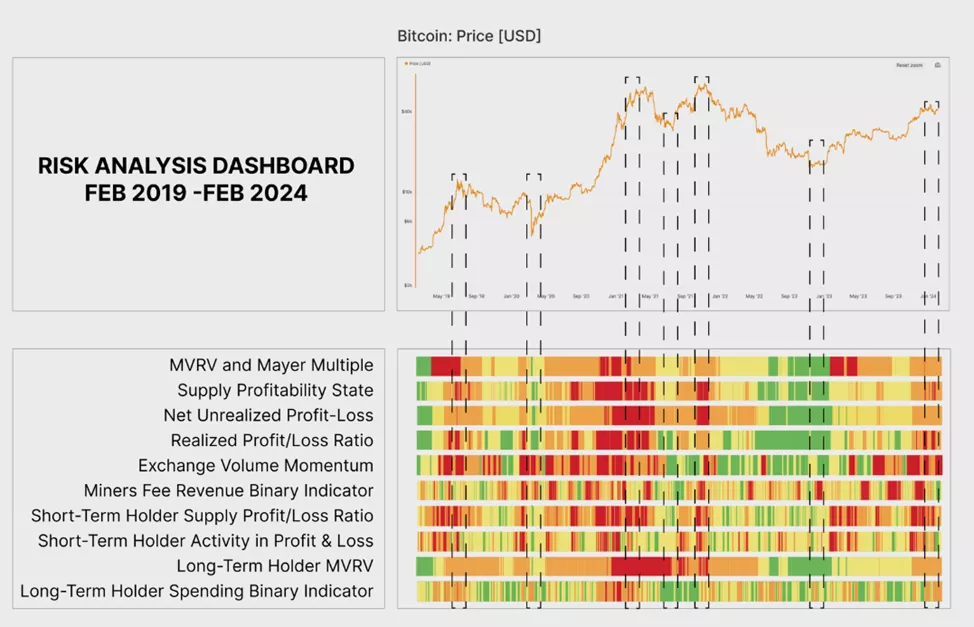
According to experts, a high risk level is typically observed in the early stages of a Bitcoin bull market. It indicates a return by hodlers to a “significant level” of profitability, which may prompt them to start taking profits.
ETF News Eases Overheating
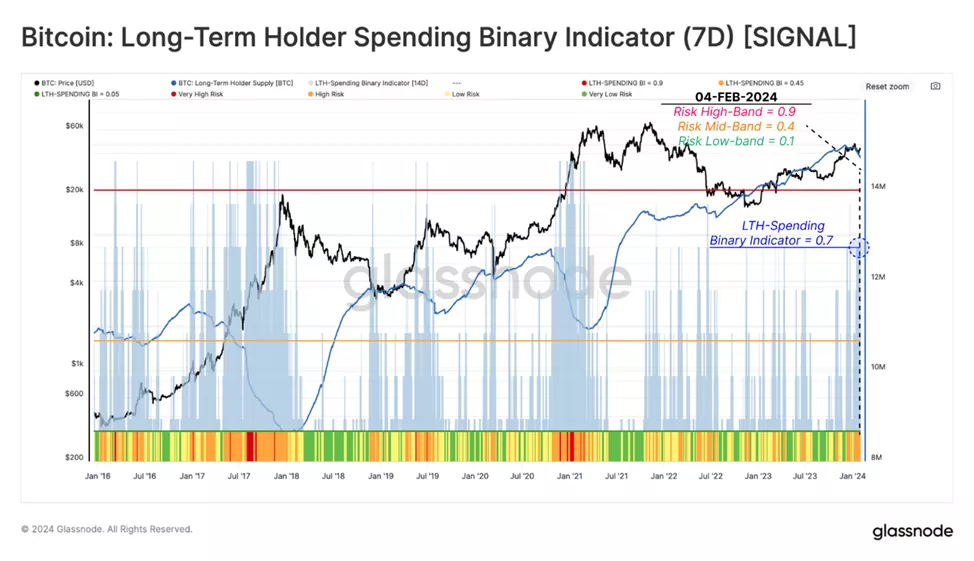
Specifically, the MVRV indicator for long-term investors has approached this critical zone. Such a high value (2.06) has not been seen since the collapse of FTX.
A similar “high” and “very high” risk status currently characterizes six of the remaining nine metrics. This indicates a relatively low level of realized profits given the active price growth in recent weeks, experts explained.
Moderate “unloading” of coins by hodlers following the approval of spot Bitcoin ETFs has moved their spending indicator out of the “risk zone.”

On February 11, the price of the leading cryptocurrency held above $48,000. The continuation of positive dynamics coincided with an increase in net inflow into digital gold-based exchange-traded funds to a record $541.46 million (February 9). The assets under management of these products reached $32.4 billion.

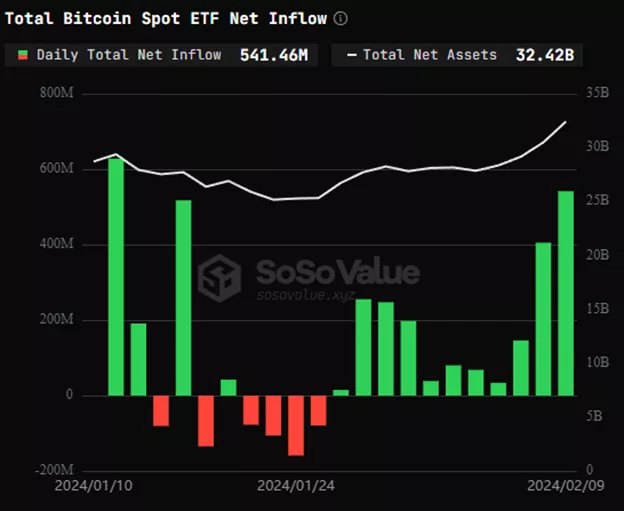
The improvement in dynamics was also made possible by a reduction in outflows from the GBTC to the lowest levels since the registration of the ETF — $51.81 million.
Lowest outflow day yet for $GBTC — $51.8 million https://t.co/YK5Wplyil8
— James Seyffart (@JSeyff) February 9, 2024
Resistance at $50,000
In comments to ForkLog, trader Artem Zvezdin noted the end of sales following the ETF approval in early February. The expert sees the current dynamics as a return of institutional investors, who are increasing their risk exposure in portfolios in anticipation of a reduction in the Fed’s key rate.
“If Bitcoin does not hold above the psychological mark of $50,000 in the coming week, a slight technical correction to the $44,000-45,000 range and subsequent growth can be expected. The main factors will be expectations of [changes in] Fed policy and halving. In my view, the first cryptocurrency will not fall below $40,000 this year. In the coming months, a rise to $60,000 can be expected,” wrote Zvezdin.
Resistance near $50,000 was also noted by Material Indicators co-founder and CEO Keith Alan. He referred to the volume of orders placed and pointed out the unfavorable “profit/risk” ratio for short-term buyers at current levels. The specialist emphasized the lack of changes in positive expectations for hodlers.
Something to consider before you FOMO into #BTC at this level.
There is ~$175M in #BTC ask liquidity (aka resistance) stacked between here and $50k, and only ~$50M in bid support down to $43k. As a #DataVisualization tool, #FireCharts illustrates it perfectly.
The Weekly close… pic.twitter.com/fERqqRA2U7
— Keith Alan (@KAProductions) February 9, 2024
Trader Vladimir Cohen, in a conversation with ForkLog, linked the current price recovery to seasonality — February coincides with the celebration of the Lunar New Year in China. Local businesses invest part of their profits from increased turnover into digital gold, the expert noted.
“In the $49,000–52,000 range, there are large blocks of sell orders. Above $50,000, over 90% of holders will be in profit. A test of $52,500 is possible, but it is unlikely that prices will hold at this level. We are more likely to see a corridor of $46,500–51,500, as it suits major players,” the specialist predicted.
As an additional driver, he mentioned the issuers of Bitcoin ETFs aiming to raise the price of the first cryptocurrency to stimulate buyers.
According to Cohen, the market expects a correction in March, followed by a resumption of growth. The trader anticipates a return to ATH in October-November after rate cuts and liquidity injections from leading central banks worldwide.
Back in a previous statement, former BitMEX CEO Arthur Hayes suggested that in the short term, Bitcoin could fall to $35,000 amid “excessive” inflation.
Experts at DecenTrader predicted a sell-off after the halving and a new ATH in the fourth quarter.