




In January, Bitcoin exchange-traded funds (ETFs) from BlackRock and Fidelity ranked among the top ten US ETFs by asset inflows, collectively amassing $4.8 billion.
Two spot bitcoin ETFs among top 10 of *all* ETF inflows in January…
Never thought I’d see the day.
via @MorningstarInc pic.twitter.com/o7L5CEu5Ef
— Nate Geraci (@NateGeraci) February 3, 2024
According to Morningstar, the iShares Bitcoin Trust saw a net inflow of $2.6 billion, ranking eighth. The Fidelity Wise Origin Bitcoin ETF secured the tenth spot with $2.2 billion.
The Grayscale Bitcoin Trust ETF (GBTC) experienced the second-largest net outflow of the month, totaling $5.7 billion.
Nate Geraci, president of the investment advisory firm ETF Store, noted that BlackRock and Fidelity’s products represent a “clear race between two leaders” among nine new Bitcoin funds.
Geraci categorized the joint ETF from ARK Invest and 21 Shares, as well as the Bitwise fund, as “solid middle class.” He predicts that assets under management for each will soon reach $1 billion, having already surpassed $650 million by early February.
In the last trading week of January, net inflows into nine new Bitcoin ETFs exceeded the prolonged outflows from the Grayscale fund. The outflow from the former trust slowed, reaching the second-lowest daily minimum of $144.6 million on February 2.
Bitcoin Spot ETF Flow data
Up to 2nd Feb 2024 pic.twitter.com/gN2GKLedxn
— BitMEX Research (@BitMEXResearch) February 3, 2024
The previous week, GBTC recorded a peak loss of $2.23 billion, while investors withdrew $431.8 million from other funds.
Bloomberg analyst Eric Balchunas described the renewed inflows into the “nine” as “noteworthy.” This volume from January 26 to February 2 surpassed the outflows from the Grayscale fund.
“Typically, after a highly publicized launch, there is a slow decline. A strong third week (with daily inflows) indicates that these ETFs have a future,” the expert emphasized.
The US Securities and Exchange Commission (SEC) approved the launch of 11 spot Bitcoin ETFs on January 10. Trading volume for these products exceeded $11 billion in just the first four days, with approximately 90% attributed to Grayscale, BlackRock, and Fidelity products.
GBTC Outflows Expected but Not Endless
Experts had highlighted the 1.5% management fee set for GBTC before the funds’ launch. Most other issuers offered a zero rate for the initial period. JPMorgan suggested this was one reason for the shift of funds from the former trust to new ETFs.
Grayscale CEO Michael Sonnenshein predicted that ultimately only “two or three” of the 11 launched products will gather significant critical mass, presumably including the company’s Bitcoin ETF.
Regarding the fee size, Sonnenshein stated that it is justified by “10 years of successful operations” and a “diversified investor base.” He believes other issuers lack Grayscale’s reputation as cryptocurrency specialists.
As of February 2, GBTC held 473,180 BTC (~$20.4 billion). The net outflow since its conversion from a Bitcoin trust to a spot ETF amounted to 143,559 BTC (~$6 billion).
Bitcoin Spot ETF Flow data
Up to 2nd Feb 2024 pic.twitter.com/gN2GKLedxn
— BitMEX Research (@BitMEXResearch) February 3, 2024
According to The Block, the start of trading in spot Bitcoin products saw transaction volumes on the cryptocurrency’s blockchain reach $1.21 trillion in January, the highest since September 2022.


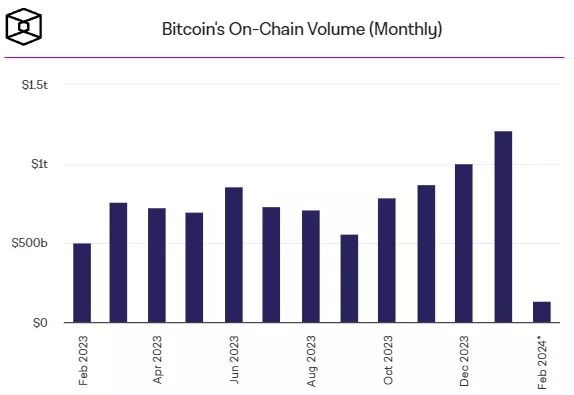
The figure showed growth over four months, although the total number of transactions in January decreased compared to December.
In the first month of the year, large Bitcoin transfers were not solely due to the shift from GBTC. Reports emerged of FTX, undergoing bankruptcy proceedings, liquidating its position in the fund for ~$908 million to replenish the bankruptcy estate. The exchange’s management reportedly capitalized on neutralizing the discount to net asset value alongside other investors.
Experts identified profit-taking from GBTC as one reason for Bitcoin’s correction following the launch of spot ETFs.
Analysts at Coinbase believe these negative factors for the digital gold’s price and the market are “beginning to wane.”
“We expect macro factors for the digital asset class to become more favorable in the coming weeks, supporting returns,” the report states.
TradFi’s Entry
Earlier, Coinbase experts stated that the launch of spot Bitcoin ETFs in the US opened the door for cryptocurrency to enter the mainstream.
However, major players in traditional finance reacted differently to the new products. For instance, Citi and UBS plan to offer clients access to crypto funds.
Merrill Lynch, Edward Jones, UBS, and Northwestern Mutual took a more conservative stance, considering decisions after further study of the instrument. Vanguard described Bitcoin as an “immature asset class” that does not align with the company’s philosophy.
One of the largest independent brokers, LPL Financial Holdings, plans to complete a comprehensive review of spot Bitcoin ETFs within three months. This is necessary to assess the possibility of offering products to 19,000 financial advisors managing $1.4 trillion in assets, reports Bloomberg.
Following the launch of spot Bitcoin ETFs in the US, South Korea’s Financial Supervisory Service warned local firms against mediating in the product. The agency’s head announced plans to meet with SEC Chairman Gary Gensler for detailed information, as the instrument impacts global financial policy, reports Hankyung.
In Hong Kong, which is on the path to launching spot Bitcoin funds, lawmakers urged to expedite the initiative’s implementation.