




Spot exchange-traded funds (ETFs) based on the leading cryptocurrency in the United States have recorded net outflows for the fourth consecutive month. Since October 2025, the assets under management of bitcoin-ETFs have declined from $170 billion to $84.3 billion.


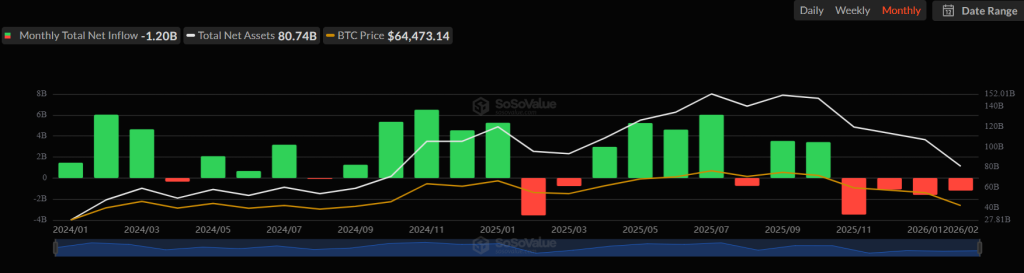
The total net inflow has decreased from a record $63 billion to $54 billion. Since July 2025, the funds have attracted only $5 billion.
ETF balances have fallen from a peak of 1.36 million BTC to 1.26 million BTC. Market leaders are also losing cryptocurrency: BlackRock’s IBIT reserves have dropped by 6% (to 759,000 BTC), while Fidelity’s FBTC has decreased by 12.6% (to 186,000 BTC).


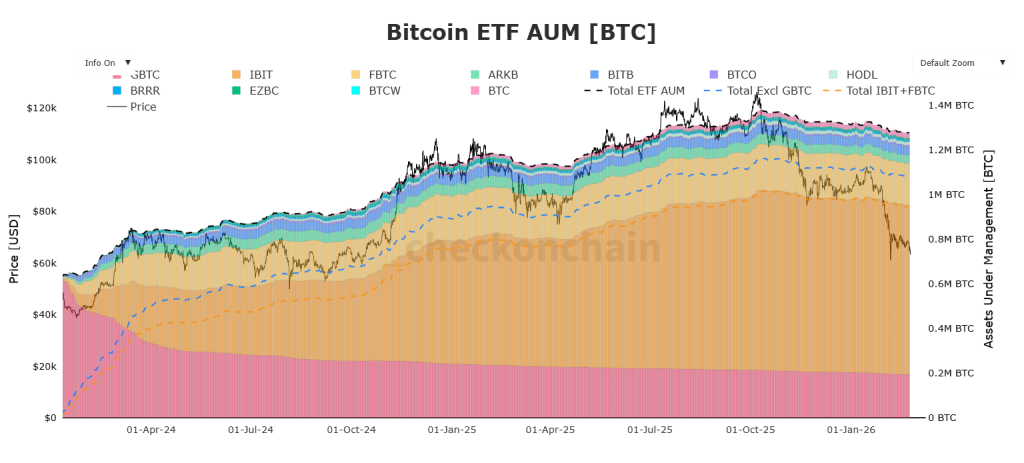
Analyst Axel Adler Jr. calculated that from February 12 to 19, investors withdrew 11,042 BTC from the funds. The worst day was February 12, with an outflow of 6,120 BTC.
Institutions aren’t buying. They’re selling. −11,042 BTC left ETFs in 7 days. Exchanges are flooded with supply.
Full breakdown in ☕️ Morning Brief 109 👇https://t.co/UdFRkbxj7r pic.twitter.com/LzPkaOj4vH
— Axel 💎🙌 Adler Jr (@AxelAdlerJr) February 19, 2026
For a trend reversal, ETFs need to close in the positive for at least three consecutive sessions, the researcher believes. Until this happens, the funds are exerting selling pressure.
Capital is moving from cryptocurrency to more stable assets. From March to October 2025, demand for bitcoin ETFs declined, while inflows into gold funds increased significantly.


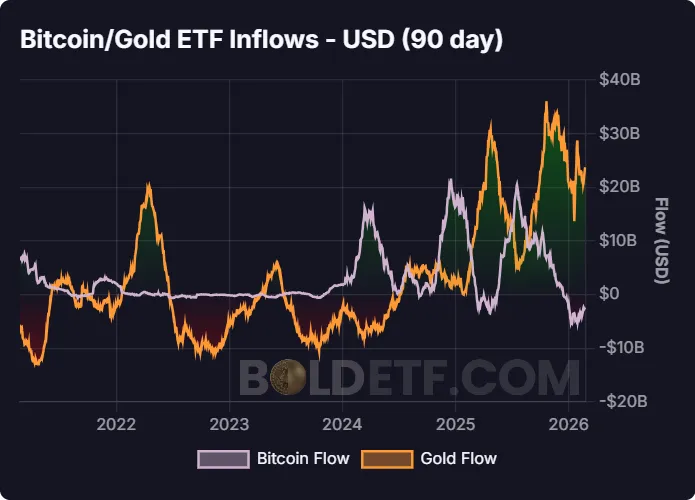
In October, inflows into gold-based ETFs reached $36 billion over 90 days. By mid-February 2026, the figure remained high at $21 billion. During the same period, bitcoin funds showed negative dynamics. In a risk-off phase, investors choose gold due to its lower volatility and long history as an asset.
Macroeconomic Pressure
Benjamin Cowen, founder of ITC Crypto, described the first quarter of 2026 as a phase of “restrictive recession” for stock and cryptocurrency markets.
In December 2025, the Federal Reserve halted its quantitative tightening program. However, monetary policy remained tight. The federal funds rate exceeds the yield on two-year Treasury bonds. For ten-year bonds, this figure holds around 4.1%, and in real terms, it is 1.7-1.8%.
A positive real rate allows for profit adjusted for inflation in traditional instruments, making bitcoin ownership less attractive.
Cowen emphasized that stable demand for ETFs arises only when real yields fall or the Federal Reserve eases its policy. These conditions have yet to materialize.
Back in the fourth quarter of 2025, Goldman Sachs reduced its positions in spot funds based on bitcoin and Ethereum.