



Shares of bitcoin miners rose after the release of Nvidia’s results. The company reported revenue of $81.6bn for the first quarter of fiscal 2027—85% higher than a year earlier.
Data-centre revenue reached $75.2bn.
For the current quarter Nvidia guided to about $91bn in revenue, announced an additional $80bn share buy-back and raised its dividend to $0.25 a share.
Markets are betting on AI infrastructure again
The main catalyst for mining stocks was not Nvidia’s growth per se but confirmation of durable demand for AI infrastructure. Investors again focused on companies with access to electricity, sites for data centres and infrastructure for high-performance computing.
Against this backdrop, the market began to re-rate Core Scientific, Cipher, IREN and others not merely as bitcoin miners but as potential beneficiaries of the AI-compute boom.
At the close on May 20:
- IREN rose by about 10.4%;
- MARA—by 5.6%;
- CleanSpark—by 4.9%;
- Riot—by 4.4%;
- Cipher—by 3.6%;
- Core Scientific—by 1.2%.


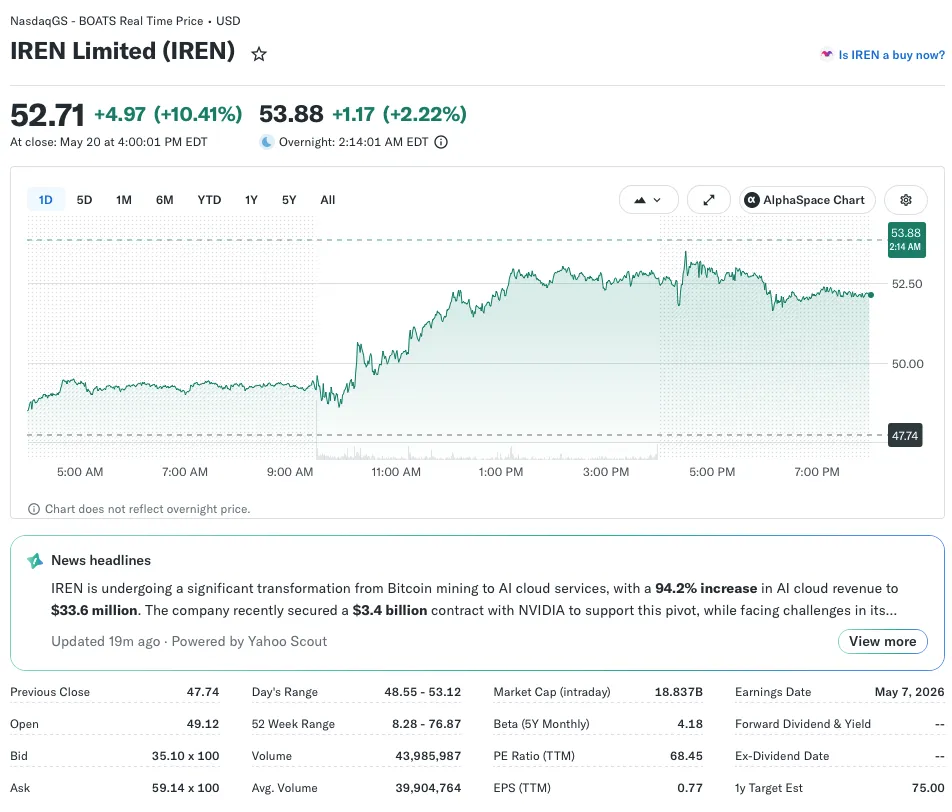
Nvidia’s own shares ended roughly flat after intraday swings, suggesting the market reacted more to the report’s infrastructure implications for related companies.
A key driver was the data-centre segment. Nvidia’s CFO, Colette Kress, said that large companies accounted for more than half of quarterly revenue. The remainder came from ACIE, which includes cloud providers, industry and enterprise customers.
Core Scientific and IREN are already pivoting to AI hosting
For some miners, the shift to AI infrastructure has crystallised into concrete projects. In 2025 CoreWeave signed a definitive agreement to acquire Core Scientific, valuing it at $9bn.
Core Scientific’s total potential alternative compute capacity was put at nearly 500MW. It is one of the clearest examples of miners monetising not just hashrate but land, cooling and grid connections.
IREN has gone further. In March the company said it plans to expand its AI cloud to 150,000 GPUs. Deployment is expected in the second half of 2026.
The firm forecasts more than $3.7bn in annual revenue. In May Nvidia and IREN also announced a strategic partnership to deploy up to 5GW of AI infrastructure.
AI as a valuation driver
Previously, miners’ valuations hinged chiefly on bitcoin’s price and post-halving economics. Now some enjoy a second multiple—as owners of scarce AI infrastructure.
The more convincingly Nvidia demonstrates durable demand for accelerators, cloud storage and enterprise AI roll-outs, the more actively markets reprice such assets at former “pure-play” miners. Not all will benefit.
Investors are prioritising players with:
- ready-to-use sites;
- substantial power capacity;
- a clear HPC and AI-hosting strategy;
- access to data-centre infrastructure.
Nvidia’s strong quarter showed that AI infrastructure remains one of miners’ key development avenues alongside bitcoin mining.
Not so straightforward
In a conversation with ForkLog, Arseniy Grusha, founder of the Dataprana data centre in the US, said that miners’ pivot to AI does not spell the end of crypto mining.
“Mining is not going anywhere, but the industry is undergoing a major transformation. Over the past five years we have seen industrialisation and the arrival of large public companies, which triggered a rally in Bitcoin network difficulty. Today giants have entered the AI market, and they need enormous capacity. The profitability figures in this sector work much better, so miners are massively refitting their data centres for new tasks. This process will only gain momentum,” he said.
He said refitting mining data centres for AI is very difficult and costly because entirely different builds are required. The main value miners hold is pre-allocated power and a legal grid connection. Everything else has to be built from scratch with a different approach.
“The difference in costs is colossal: a bitcoin data centre averages $400,000 per MW, whereas an AI facility costs about $10m per MW. The 20–25-fold increase is due to strict requirements for 100% redundancy. AI needs full backups: massive batteries and diesel generators ready to take over the load within seconds,” he noted.
The design and liquid-cooling systems for GPU capacity are also more complex. All these systems require professional engineering and strict certification to ensure uninterrupted operation. He noted that the payback for traditional mining is faster.
“As a business, traditional mining hosting lets you recoup investment in three to four years, which is very fast. Investments in an AI data centre cost 25 times more. Therefore their payback period reaches six to seven years,” Grusha stressed.
He added that mining is a niche business with high instability due to its dependence on bitcoin’s exchange rate, where contracts run for at most a couple of years. AI is a global market with long contracts. A 10-year deal with, say, Microsoft offers the stability that makes it easy to raise bank financing for such projects.
Back in November 2025, MARA CEO Fred Thiel predicted tough times for miners amid rising competition and shrinking margins.
