



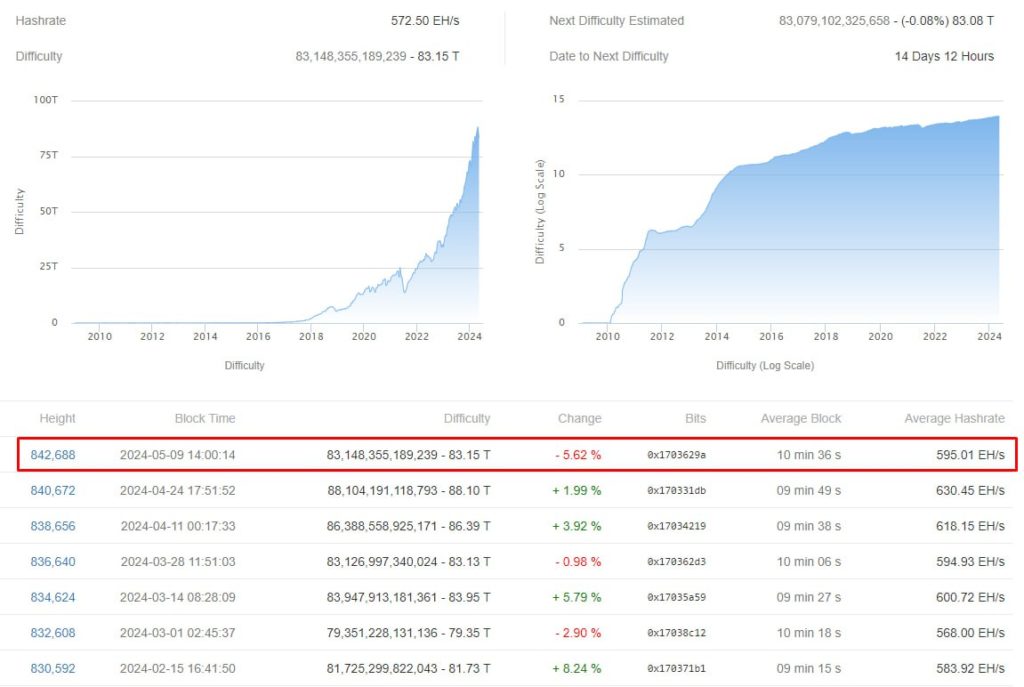
The latest recalibration has seen the difficulty of mining the leading cryptocurrency fall by 5.63% to 83.15 T. This decline marks the most significant drop since December 2022.


At that time, Bitcoin was in a bearish market phase, largely driven by a series of bankruptcies, including the collapses of Terra and FTX.
Since the previous adjustment, the average hash rate over the roughly two-week period was 595 EH/s, down from 630 EH/s. This suggests miners may have shut down equipment that became unprofitable post-halving.
The halving of the block reward from 6.25 BTC to 3.125 BTC occurred on April 20 at block height #840,000.
On April 25, mining difficulty reached a new high of 88.1 T. However, experts had previously predicted a drop in computing power post-halving for economic reasons. Estimates varied from 15-20% by Galaxy Digital specialists to 5-10% by Hashlabs Mining co-founder Jaran Mellerud.
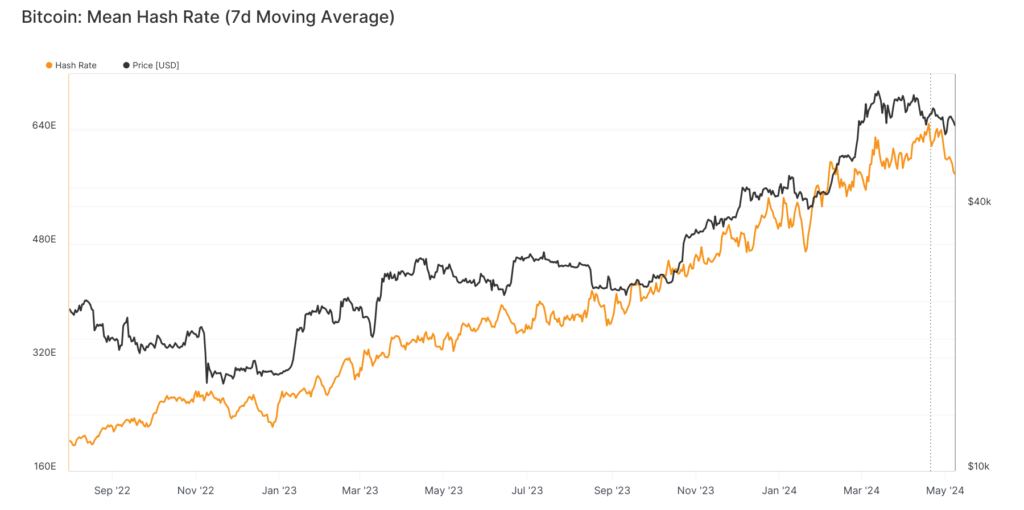
According to Glassnode, the smoothed 7-day moving average hash rate fell to 578.9 EH/s after reaching a record 649.7 EH/s on April 19 — a decrease of approximately 11%.


On halving day, miners earned $107.75 million, marking their highest daily revenue ever. This was largely driven by fees for issuing tokens on the Runes protocol.
However, by early May, daily revenue for Bitcoin miners had fallen to levels seen in October 2023.
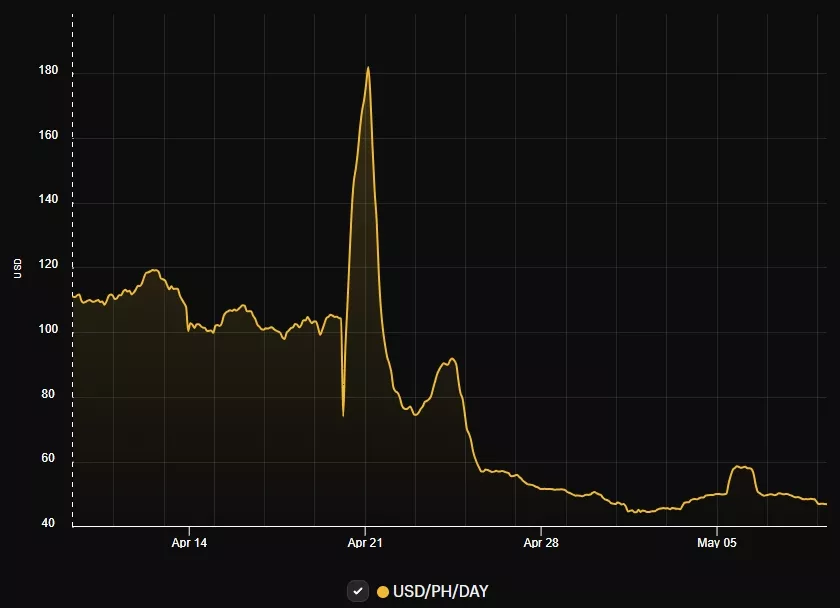
According to Hashrate Index, hashprice dropped to $47 per PH per day. Before the halving, it ranged from $100 to $120.


In early April, CryptoQuant CEO Ki Young Ju estimated that the cost of mining Bitcoin with the Antminer S19 XP would rise from $40,000 to $80,000 following the block reward reduction. The expert considered the most energy-efficient model in the S19 lineup, which still generates a significant portion of the network’s computational power.
A similar estimate of $75,000 was given by Mellerud. Both experts focused on the U.S. market, which accounts for nearly 38% of the global hash rate, according to the Cambridge Centre for Alternative Finance.
Earlier, Marcus Thielen, head of research at 10x Research, suggested that miners might begin selling off $5 billion in Bitcoin reserves to sustain their operations.