



Bitcoin Mining Profitability Declines by 7%
Bitcoin mining profitability fell by over 7% in September, with daily revenue dropping.
In September, the profitability of mining the leading cryptocurrency fell by over 7%, with daily revenue per 1 EH/s of hashrate dropping from $56,000 to $52,000. This was reported by CoinDesk, citing a report from Jefferies.
Analysts at the investment bank identified the main causes of the decline in mining profitability as a 2% drop in the price of Bitcoin over the month and a roughly 9% increase in the network’s total computing power.
At the start of the fourth quarter, the hashrate slightly decreased, reducing competition, but a sharp correction in the asset increased pressure on the economics of its mining, experts noted.
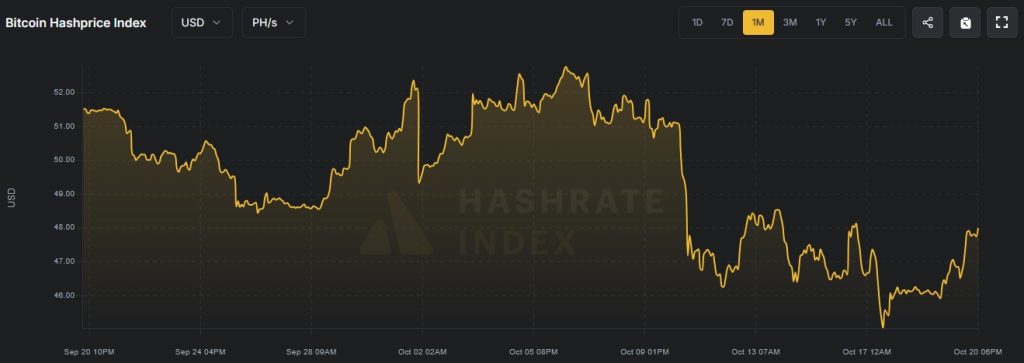
Their assessment is confirmed by data from the Hashrate Index. Following a major market correction on October 11, the hashprice has consistently remained below $49 per PH/s per day. Lower metric values this year were recorded in April, when Bitcoin’s price fell below $90,000.
US-based public mining companies generated 3,401 BTC in September, compared to 3,576 the previous month.
MARA Holdings led the way, mining 736 BTC, followed by CleanSpark with 629 BTC. These firms also have the highest deployed hashrate — 60.4 EH/s and 50 EH/s, respectively.
However, despite the decline in mining profitability, miner stocks are rapidly rising. According to a report by TheMinerMag, the market capitalization of the 15 largest American industry companies reached $90 billion by mid-October. Since September 15, Bitfarms’ shares have surged by 162%, Canaan’s value increased by 149%, and CleanSpark’s by 125%. During this period, Bitcoin fell by 3.7%.
Experts attribute this sharp divergence in trends to the “AI pivot” of cryptocurrency miners. The advantage for cryptocurrency miners amid the boom in high-performance computing lies in their existing access to energy resources and ready infrastructure.
Miners Expand Diversification into AI Computing
One of the largest deals in this direction was the acquisition in July by AI hyperscaler CoreWeave of mining center operator Core Scientific for $9 billion.
In August, Google increased its stake in TeraWulf to 14% by expanding financial guarantees to $3.2 billion for a deal between the miner and cloud AI platform Fluidstack. In September, the mining company announced raising approximately $3 billion for building data centers through a structure supported by the tech corporation.
In the same month, Google helped Fluidstack secure a lease agreement with another cryptocurrency miner — Cipher Mining. The corporation guaranteed the English startup’s obligations amounting to $1.4 billion in exchange for 5.4% of the miner’s shares.
In August, IREN announced the expansion of its AI Cloud computing division, investing around $193 million in NVIDIA Blackwell B200 graphics processors. At that time, the company was among the top four mining companies with a hashrate of at least 50 EH/s, alongside MARA, CleanSpark, and Cango. TheMinerMag noted that of this quartet, only IREN had begun expansion into AI.
On October 20, CleanSpark announced its transition from “pure mining” to high-performance computing (HPC).
Monetize every megawatt. https://t.co/5JGWnrSACd
— Harry Sudock (@harry_sudock) October 20, 2025
The company appointed industry veteran Jeffrey Thomas as Vice President of AI-based data centers.
Bitdeer, in its report on operations for September, announced plans to repurpose a mining facility in Norway to provide services in the HPC segment. For this purpose, the firm will expand its existing AI capabilities in Southeast Asia and the US.
Back in August, experts at GoMining predicted a wave of institutional investments in Bitcoin mining amid the AI computing boom.
Рассылки ForkLog: держите руку на пульсе биткоин-индустрии!