



Bitcoin recovers weekend losses, tests $70,000
Bitcoin tops $70,000 as ETFs attract inflows; leverage falls amid macro jitters.
On 10 March, bitcoin rose above $70,000, clawing back the weekend’s decline.
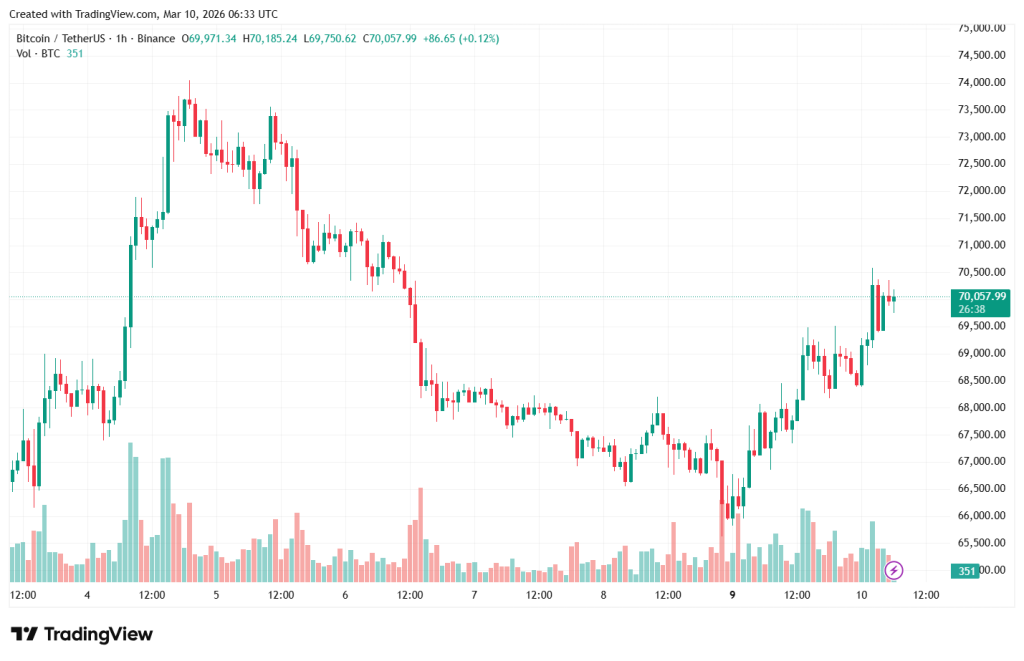
The rebound coincided with oil slipping to $93 and a rise in equity indices. According to the market maker Enflux, the cryptocurrency “easily weathered” high volatility in the commodities market. Through the turbulence, bitcoin held up noticeably better than traditional stocks.
Institutional demand and ETFs
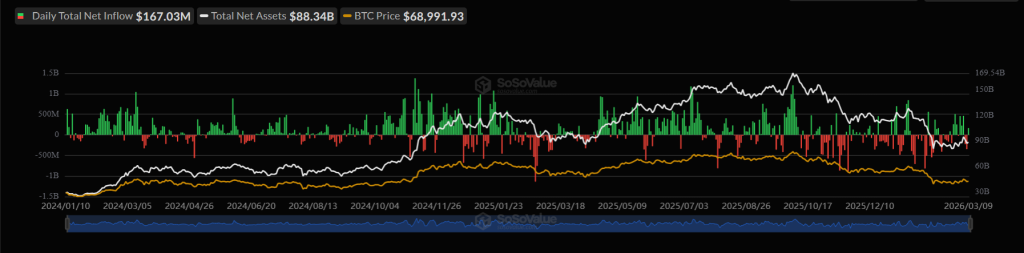
Inflows into the sector continue. Over the past week, investors put about $568 million into US spot bitcoin-ETFs. Total inflows into these products have exceeded $55 billion.
Crypto-market activity persisted despite weak US macro data. After figures showing a loss of 92,000 jobs, investors began to pull money from the S&P 500. Global Settlement head Ryan Kirkley noted that the bitcoin price dip offered institutions an attractive entry point.
Analysts at Glassnode also see stabilisation: demand for funds is rising and profitability is returning. On Polymarket, the probability of bitcoin reaching $75,000 by the end of March rose from 34% to 55%.

Altcoin dynamics
Large-cap tokens followed bitcoin higher. Ethereum cleared the psychological $2,000 mark, rising to $2,046 (+2.8% over 24 hours). FxPro analysts reckon the coin needs to hold above $2,500 to confirm a durable uptrend.
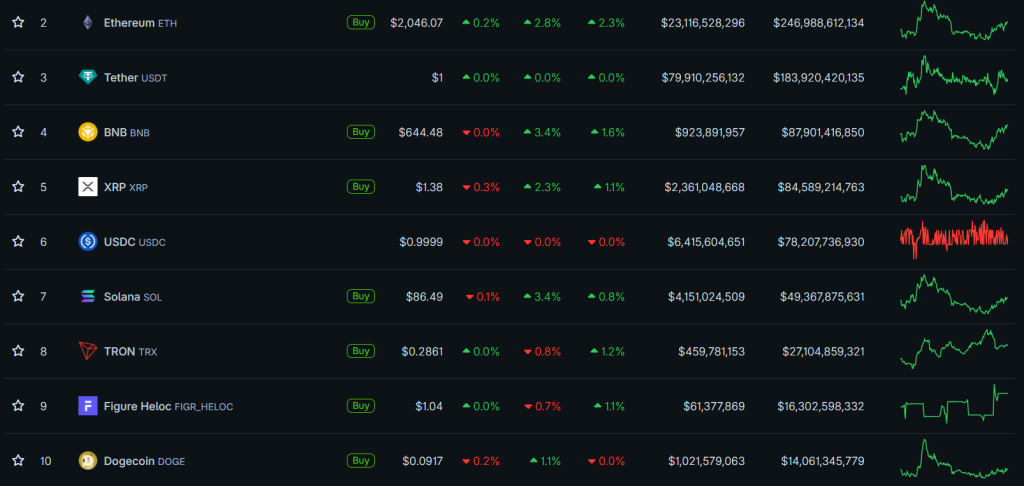
Solana rose 3.4% to $86.49. Despite the local uptick, the asset still trades 70.5% below its all-time high of $293.31. With meme-token activity ebbing, the “people’s cryptocurrency” has become more sensitive to the broader macro backdrop.
Other top-10 coins also advanced:
- BNB gained 3.4% to $644;
- XRP added 2.3% to $1.38. Throughout March, the token has held a tight range between $1.3 and $1.45.
The next test for the market will be the Fed meeting on March 17–18. Bitcoin’s correlation with the S&P 500 has reached 0.78 — the highest since mid‑2022.
Such high dependence on the stock market means any signals from the regulator about a possible key‑rate increase could trigger a sell-off in digital assets.
Deleveraging
Amid macroeconomic uncertainty, investors are cutting back on borrowed funds en masse, noted the analyst known as Darkfost.
🗞️Bitcoin leverage reset after market volatility
“Since February, Bitcoin’s Estimated Leverage Ratio on Binance has dropped from 0.198 to 0.152, representing a significant and rapid decline. This type of move is typically observed after periods of strong volatility and major… pic.twitter.com/q1MVOR5CZa
— Darkfost (@Darkfost_Coc) March 9, 2026
Instability in global markets is sapping traders’ appetite for risky assets. The trend shows up clearly in bitcoin’s estimated leverage ratio on Binance. The metric reflects the ratio of futures open interest to the platform’s bitcoin reserves.
Since February, the indicator has fallen from 0.198 to 0.152. Such a rapid drop is typical of periods of high volatility. Against this backdrop, bitcoin’s price corrected from $96,000 to $69,000.
Sharp price swings are forcing investors to act cautiously. Some traders close margin positions voluntarily; others are forced out by liquidations. As a result, open interest contracts quickly and the derivatives market undergoes large-scale deleveraging.
If the leverage ratio does not start to rise amid bitcoin’s consolidation, the spot market will become the main driver of prices.
The analyst stressed that deleveraging phases are healthy for the industry. Cutting the share of borrowed funds removes systemic pressure and stabilises prices ahead of a new trend.
On 9 March, Darkfost called rising oil an unfavourable factor for bitcoin.
Рассылки ForkLog: держите руку на пульсе биткоин-индустрии!