




Bitcoin shows resilience amid bearish selling, while Solana faces transaction processing difficulties. ForkLog compiles the latest news and expert opinions on the market situation.
Bitcoin’s Strength
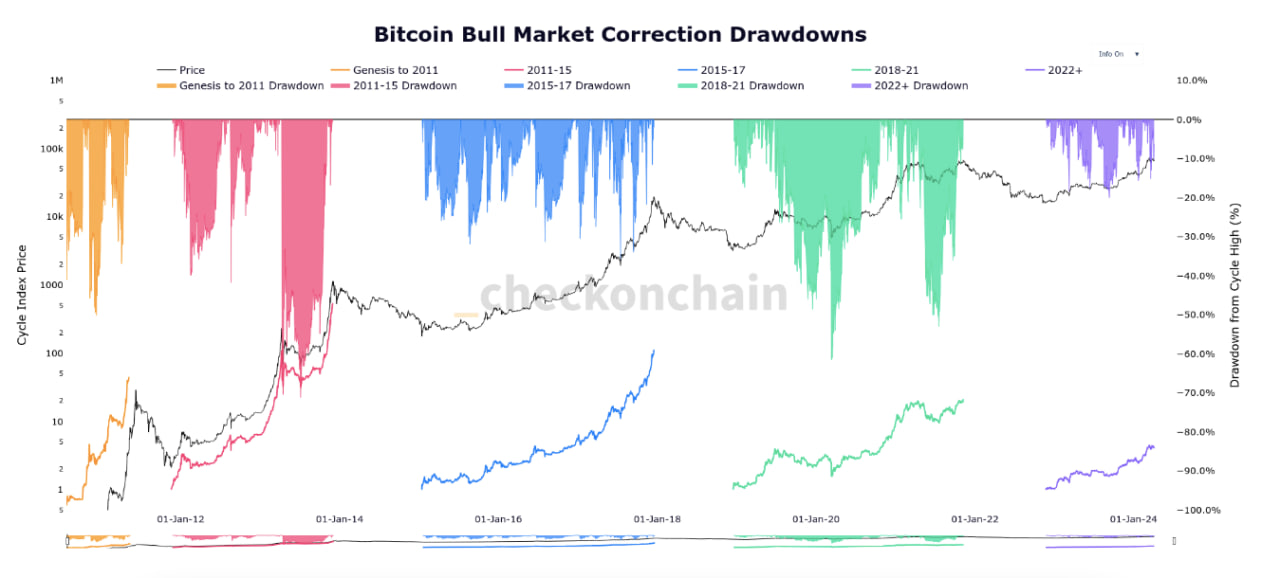
The leading cryptocurrency holds steady at $66,000-$67,000 despite trader pressure. Sellers have failed to trigger a classic bull market correction in this cycle, according to analyst Checkmate.
Still my favourite #Bitcoin chart of this cycle.
Market is absorbing hundred million dollar sell-side days, and the bears still haven’t managed a 20% pullback.https://t.co/y9FSJ128xh pic.twitter.com/LjY6fLwtCE
— _Checkɱate ??⚡☢️?️ (@_Checkmatey_) April 5, 2024
“[Bitcoin] is absorbing hundred million dollar sell-side days, and the bears still haven’t managed to pull it back by more than 20%,” the expert noted.
According to Checkmate’s chart, during the previous bull cycle of 2019-2021, there were two major pullbacks of approximately 50% and 60%.


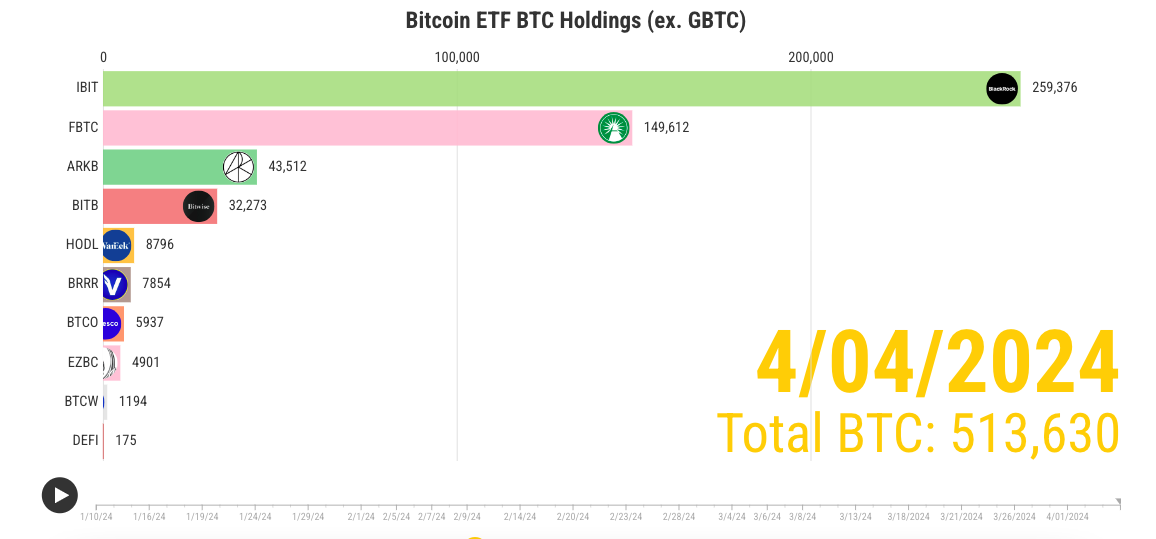
The current market has significantly changed with the arrival of institutional investors and the launch of spot Bitcoin ETFs in the US. According to Apollo, issuers of exchange-traded funds based on digital gold hold 513,630 BTC (~$34.3 billion at the time of writing).

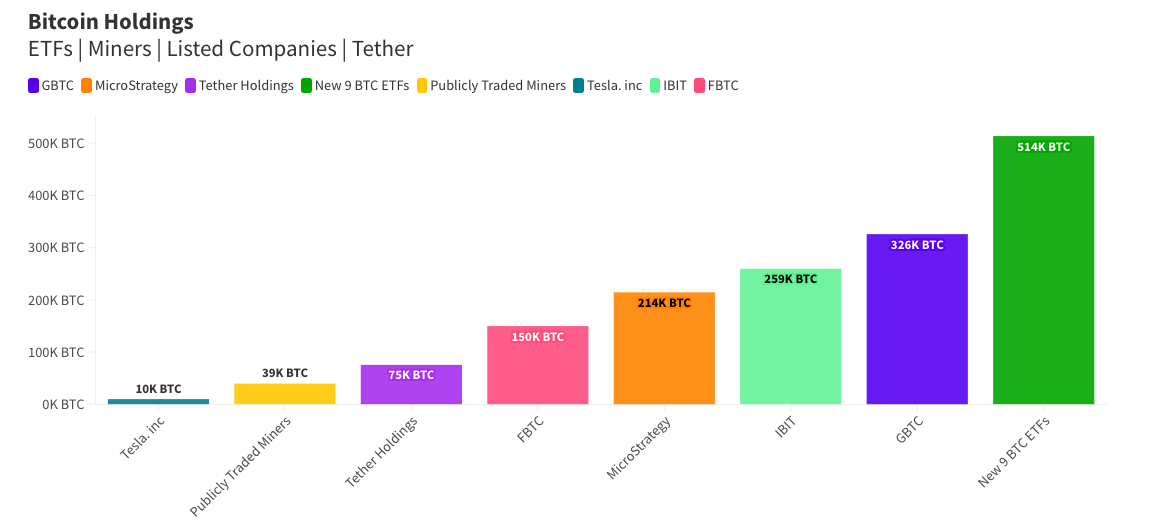
Besides asset managers, mining and other companies hold significant reserves of the first cryptocurrency. MicroStrategy controls about 214,000 BTC (~$14.2 billion), while Tether, the issuer of USDT, holds 75,000 BTC (~$5 billion).

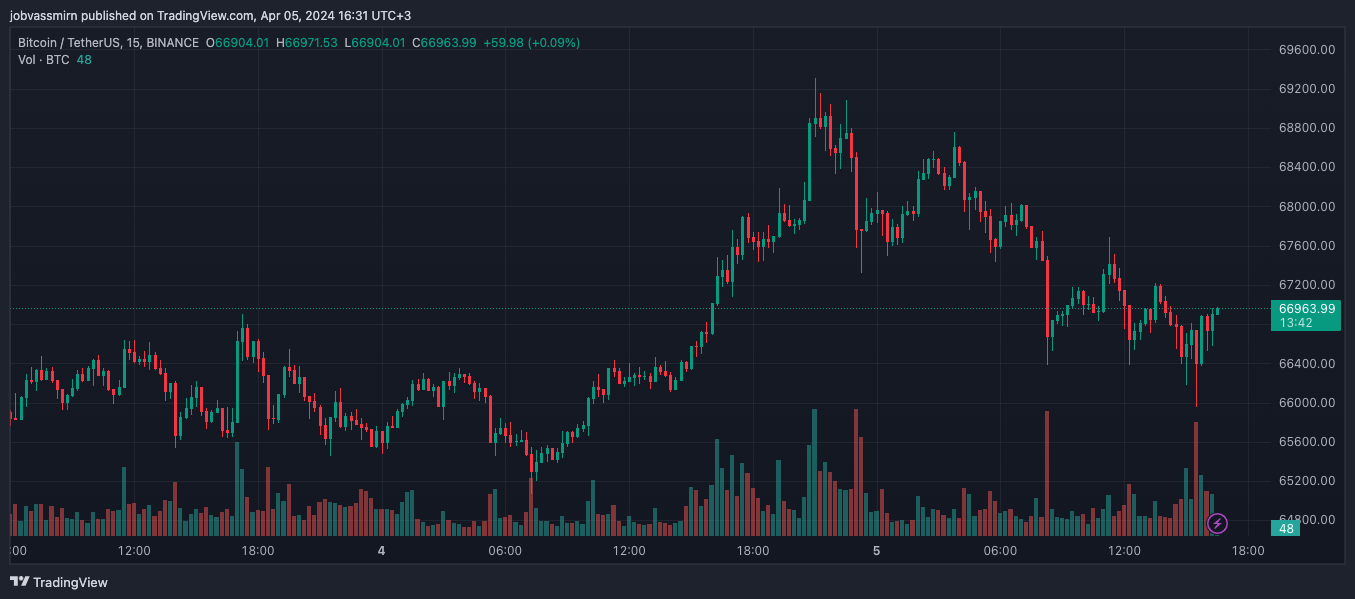
As for short-term prospects, trader Skew highlighted a key resistance level at $69,000.
$BTC Binance Spot
Above here spot supply increases considerablyStructurally $69K is important; overall trend fight occurs here
— Above bulls push for control
— bears will try fight here imoKey flow points will be how significant passive sell pressure is (limit selling) & how… pic.twitter.com/mgCpcWlVgR
— Skew Δ (@52kskew) April 4, 2024
“Here, a trend battle occurs: bulls above strive for control, bears will try to resist. Key flow points will depend on passive sell pressure (limit selling) and the resilience of spot rates,” he explained.
At the time of writing, the leading cryptocurrency is trading at $66,960. Its market capitalization stands at $1.31 trillion with a trading volume of $42.7 billion.

Solana’s Classic Struggles
According to the Dune dashboard, on April 4, 76% of all Solana transactions (excluding votes) were not included in blocks, marking the highest rate in history.

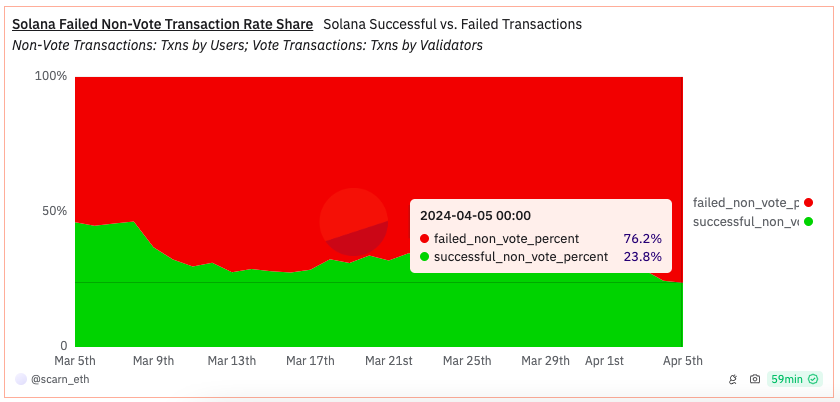
Meanwhile, many users continue to complain about ecosystem failures. Trader Altcoin Sherpa pointed out transactions stuck in the network.
cant do anything on the chain, no tx going through
— Altcoin Sherpa (@AltcoinSherpa) April 4, 2024
“As much as I consider Solana the retail network of this cycle, the [user] experience is severely lagging,” he noted.
Amid these issues, blockchain co-founder Anatoly Yakovenko lamented the difficulties in addressing protocol congestion problems.
dealing with congestion bugs sucks so much more than total liveness failure. the latter is one and done, bug is identified and patched and chain continues. the former has to go through the full release and test pipeline. shipping fast is impossible ???
— toly ?? (@aeyakovenko) April 5, 2024
“Dealing with congestion bugs is much worse than a total liveness failure. The latter is straightforward, the bug is identified and fixed, and operations continue. The former requires going through the full release and testing pipeline. Fast integration is impossible,” he stated.
However, Solana advocate and Helius CEO Mert Mumtaz noted that the statistics on Solana’s failed transactions are “misleading.”
there is a stat going around CT about failed transactions on Solana
it is misleading and 90% of the people using it don’t know what it means
I will explain (for non-technical folks only)
first, an example of how a usual interaction in web2 works:
— you go on twitter and click… pic.twitter.com/SBcZRDOkD5
— mert | helius.dev (@0xMert_) March 24, 2024
“This is usually not a big issue for users, as your wallet simulates [the transaction] and informs you in advance that it will be executed,” he emphasized.
According to him, 95% of transactions in this statistic are trading bots “failing in arbitrage.”
Mumtaz added that due to increased spam activity, manually increasing fees does not help. Users will only waste extra money without speeding up the transaction, the expert warned.
The Helius head noted the need for “network fixes” but doubted that the upcoming Solana 1.18 network update would solve these issues.
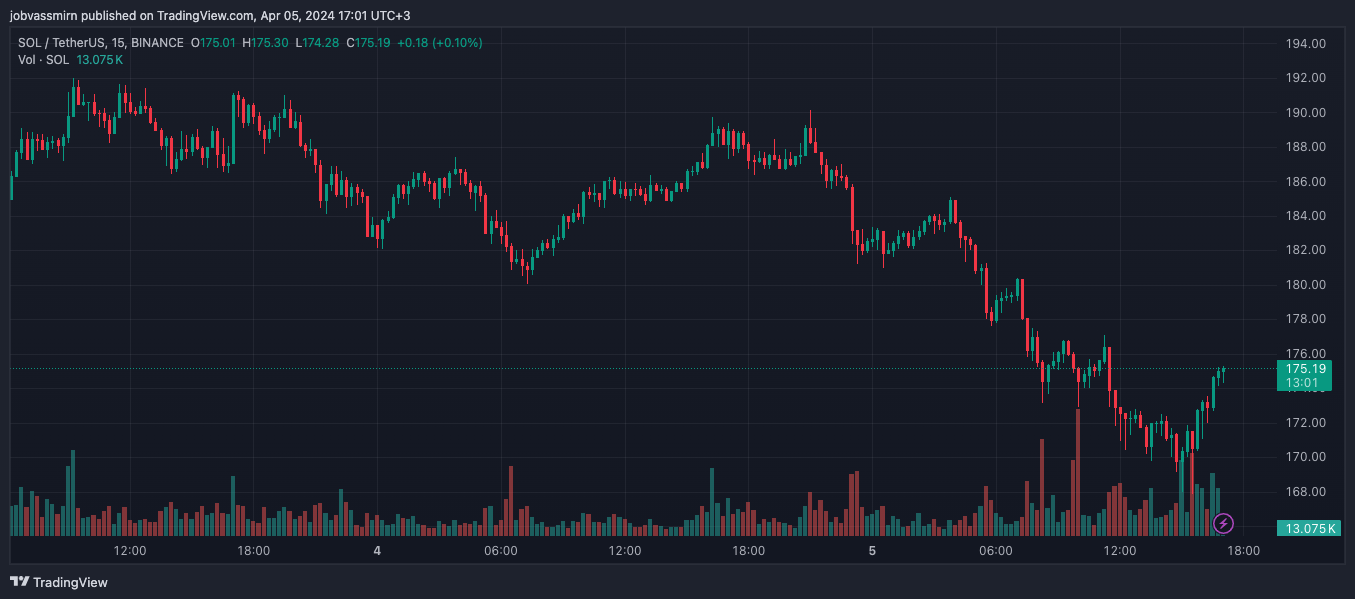
Over the past 24 hours, SOL has fallen by about 7% — from $190 to $175. Its market capitalization is $78 billion.
DeFi’s Strength
The total trading volume of the decentralized exchange (DEX) Uniswap has surpassed $2 trillion.

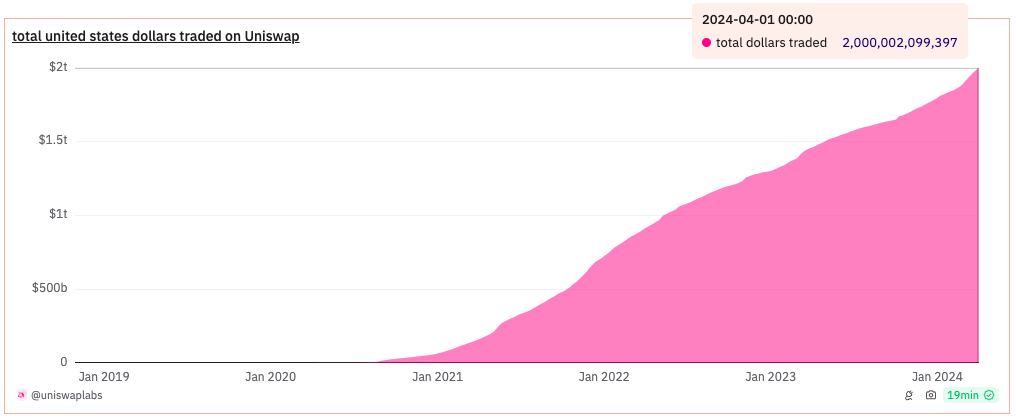
The platform achieved this milestone in five and a half years since its launch in November 2018.
Data was sourced from several blockchains supporting Uniswap, including Ethereum, Polygon, Optimism, Arbitrum, Celo, BNB Chain, Base, Blast, and Avalanche.
For comparison, Uniswap’s trading volume exceeds the gross domestic product of Australia, Brazil, and South Korea — a measure of the market value of finished goods and services produced within a country.
Uniswap remains the largest DEX by trading volume, accounting for about 54% of the total decentralized exchange turnover. Over the past week, its volume reached $21.5 billion.

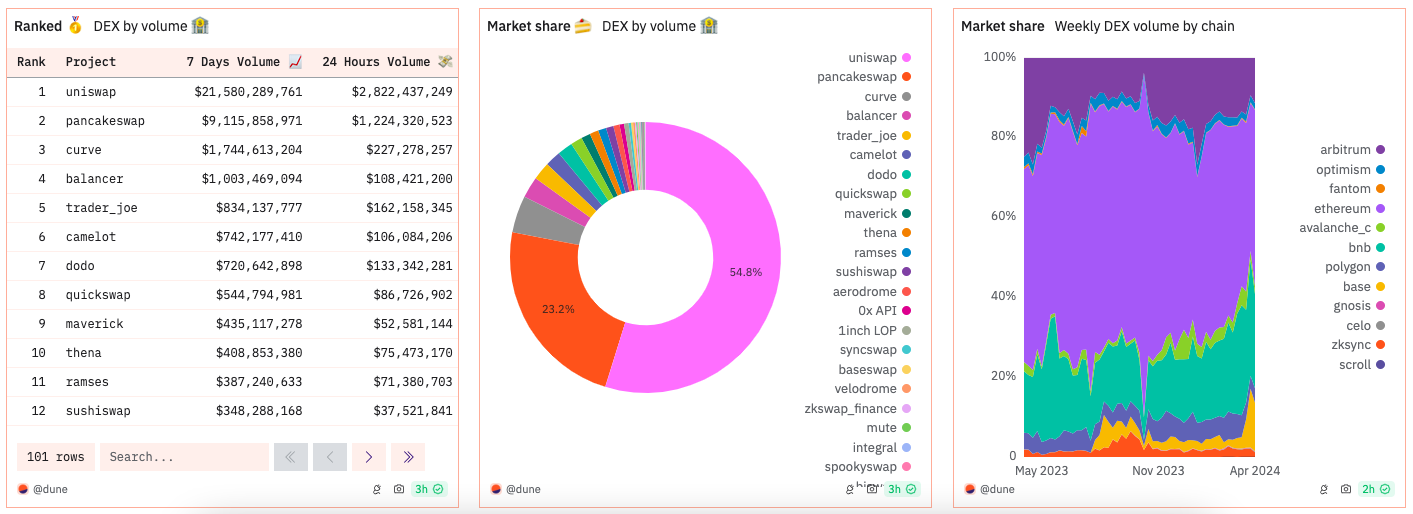
PancakeSwap ranks second with a weekly volume of $9.1 billion (23%), followed by Curve at $1.7 billion.
According to DeFi Llama, since the beginning of the year, the total volume of funds locked in DeFi protocols has grown by 94%, from $56 billion to $94 billion.

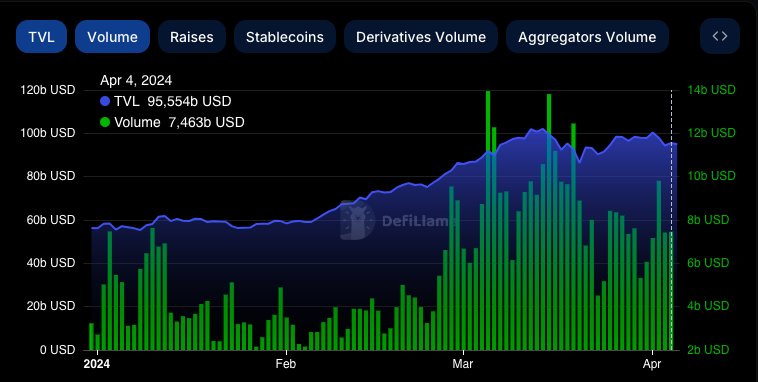
The top three are Lido Finance (~$30.8 billion), EigenLayer (~$11.9 billion), and Aave (~$10.4 billion).
In late March, tokenized “real-world” assets began gaining popularity. The cumulative capitalization of the sector increased by 81% over seven days to $8 billion.
Santiment identified the most popular tokens that “reflect market sentiment and spark discussions.” The list includes Wormhole (W), Ethena Labs (ENA), and Waves (WAVES).