




On 15 January, a popular market‑sentiment gauge flashed “greed” for the first time since October. The reading rose to 61 after a protracted spell of “fear” and a $19bn cascade of liquidations.


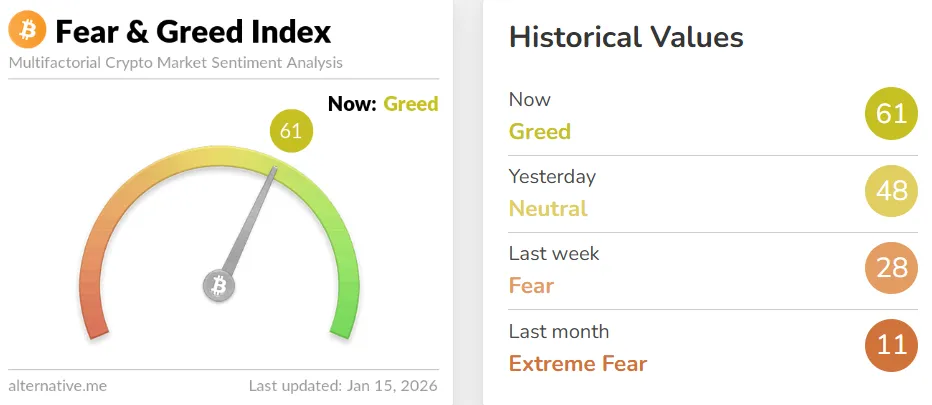
A day earlier the gauge sat in neutral territory at 48.
The improvement in sentiment coincided with a recovery in the leading cryptocurrency’s price. Bitcoin climbed to $97,704 — a two‑month high (according to CoinGecko). It last traded above $97,000 in mid‑November, when the market was in “extreme fear” after a sharp pullback from record highs.
Santiment analysts observed retail investors exiting the asset. Over three days, the number of addresses with a non‑zero balance fell by 47,244.
🥳 Bitcoin has roared back to a 2-month high of $97.5K. Over the past 3 days, there is a net drop of -47,244 holders, indicating that retail had been dropping out due to FUD & impatience. This price bounce has also been supported by a 7-month low 1.18M $BTC on exchanges. 👍 pic.twitter.com/KtoRIBgChy
— Santiment (@santimentfeed) January 14, 2026
Experts called the departure of the “impatient crowd” and the decline in exchange balances to a seven‑month low (1.18m BTC) a bullish signal.
A return to $100,000
Santiment argues that mounting pessimism on social media could fuel a rally to new all‑time highs.
😒 According to social data, the commentary toward Bitcoin across social media has interestingly turned more and more bearish as prices have bounced this week. With markets typically moving the opposite direction of retail sentiment, the most FUD seen in 10 days may propel $BTC… pic.twitter.com/BbcFai1Sd5
— Santiment (@santimentfeed) January 15, 2026
Prices are recovering even as user commentary grows increasingly “bearish”.
Markets typically move against crowd expectations. Right now, fear, uncertainty and doubt are at a ten‑day peak.
In Santiment’s view, the distrustful mood sets the stage for a move back to $100,000, for the first time since mid‑November.
Underlying market strength
The current upswing is anchored in on‑chain metrics rather than speculation, says CryptoQuant analyst Carmelo Aleman.
Bitcoin Breaks Resistance as Holders Refuse to Sell
“Historically, when Bitcoin’s price rises while VDD remains low, the market tends to be in a healthy expansion phase, where demand absorbs the available supply without generating structural selling pressure.” – By @oro_crypto pic.twitter.com/soss3JTgU0
— CryptoQuant.com (@cryptoquant_com) January 15, 2026
The expert pointed to the behaviour of the Value Days Destroyed (VDD) indicator. The metric gauges coin movement, weighting transactions by volume and dormant time. High readings signal spending of older coins; low readings point to the circulation of recently bought coins.
In January 2026, VDD fell to 0.53 — a historically low level indicating that chiefly “young” coins are moving on‑chain.
Long‑term holders are refraining from taking profits despite rising prices. The market is in a healthy accumulation phase: demand is absorbing supply without selling pressure from “old” capital.
Aleman stressed that the breakout is driven by genuine market strength. The backdrop should remain favourable while VDD stays low; a sustained rise in the metric would signal long‑term investors beginning to sell.
Global derivatives deleveraging
The 31% drop in bitcoin derivatives open interest since October points to a broad market clean‑up of excess leverage, according to CryptoQuant analyst Darkfost.
Deleveraging signal as BTC OI drops by 31%
“Historically, they have often marked significant bottoms, effectively resetting the market and creating a stronger base for a potential bullish recovery.” – By @Darkfost_Coc pic.twitter.com/JkYoKfg4Ql
— CryptoQuant.com (@cryptoquant_com) January 14, 2026
He says that deleveraging has historically marked significant bottoms, resetting the market and creating a base for a potential bullish recovery.
He added that if bitcoin continues to fall, open interest could decline further, implying a deeper correction. For now, the dynamics point to a more positive scenario.
Why it matters
Rising prices alongside falling open interest typically indicate forced or voluntary covering of short positions (a short squeeze). Traders who had bet against the market book losses and exit, easing selling pressure.
In such cases, rallies are fuelled by real spot buying rather than speculative capital. Since the start of the year, bitcoin has risen by almost 10%, underscoring the trend’s resilience.
According to CoinGlass, aggregate open interest across exchanges is about $65bn — 28% below the early‑October peak ($90bn), consistent with CryptoQuant’s calculations.
Optimism is also evident in options. On Deribit, the largest concentration of positions is concentrated at the $100,000 strike — traders are betting on further gains.
Despite the optimism, the derivatives market has not yet shifted into a full‑blown growth phase, Greeks Live noted.
Bitcoin successfully broke through the $9,5000 resistance level, breaking out of its nearly two-month consolidation range. Since falling below this key threshold in mid-November, Bitcoin had been trading sideways at lower levels.
Ethereum saw a larger percentage gain but its… pic.twitter.com/zl0YOIGhIk— Greeks.live (@GreeksLive) January 14, 2026
“The current trading structure looks more like a reaction to a sudden price jump; the long-term outlook has not yet shifted toward a bull market,” the analysts noted.
Earlier, Glassnode reported that institutions have resumed buying bitcoin amid the risk of explosive volatility.