




In 2024, ViaBTC entered the top five pools mining Kaspa (KAS). By September its hashrate on the network reached 70 PH/s.
At the same time, a Power Law Theory (PLT) emerged in the community, projecting bitcoin’s price in line with the power law. It quickly gained traction as an alternative to the much-criticised stock-to-flow model.
Together with the ViaBTC team, we outline PLT for bitcoin and explain why the power law may also apply to Kaspa.
Power law in bitcoin
PLT was devised by Giovanni Santostasi, a PhD in astrophysics. In March 2024 he published The Bitcoin Power Law Theory, setting out the model’s foundations.
“I started studying bitcoin 12 years ago. Instead of journals, I chose Reddit as the place to publish my research. I wanted to reach the broader bitcoin community rather than publish a paper that only professional scientists would read,” the article said.
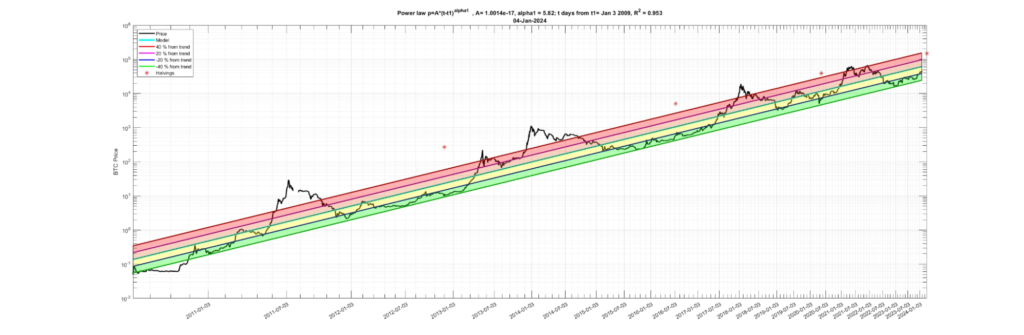
Santostasi saw a link between bitcoin and the power law when he noticed the cryptocurrency’s price traced a straight line on a logarithmic chart. In January 2024 he posted on r/Bitcoin.
“Five years ago I made a post in this subreddit showing that BTC is a power law: price = A * days ^ n, (days since the genesis block), n = 5.8. Many did not believe me and said that the past does not predict the future. Well, five years later it turns out that BTC continues to behave according to a Power Law with a similar exponent. The power law is not yet another formula or model, but the same mathematical behaviour that underlies the formation of rivers, the growth of mountains, the development of cities, the relationship between GDP and population, the speed of metabolism. Like bitcoin, all the most important things follow a power law,” he said.


As an illustrative example of the power law, Santostasi cited the harmonic law:
“Kepler spent many years searching for a mathematical law that could describe the orbits of planets. He tried everything known at the time, for example fitting Platonic solids to each orbit and using many other esoteric mathematical tricks, which led nowhere. But he was convinced there was great harmony in the motion of the planets. Newly invented logarithms were very fashionable at the time, so in desperation he decided to plot the dependence of a planet’s orbital radius on the time it takes the planet to go around the Sun. He was astonished to find that on this strange chart everything looked like a straight line.
The same chart is shown above. Of course, it is much cleaner and more precise for planets, given that the Solar System is a deterministic system, not a stochastic one like bitcoin. But the overall trend of BTC also seems deterministic and predictable.”
Giovanni’s son, Saverio Santostasi, posted a video on YouTube demonstrating bitcoin’s adherence to the power law. According to the model, bitcoin will reach $1m no later than 2036.
There’s a line that bitcoin’s price shall not pass. A lower bound on price, a power law.
Time contours tell us how long it will be before the support forces current prices upwards.
For 12 years, every bear market has returned to this support line.
The support passes one… pic.twitter.com/Jfz98ef1eQ
— apsk32 (@apsk32) June 23, 2024
Bitcoin enthusiast Gianluca Tassara created BitcoinFairPrice, a calculator that estimates bitcoin’s “fair price” on a given date according to PLT.
Kaspa and the power law
Kaspa is a Proof-of-Work (PoW) cryptocurrency implementing the GHOSTDAG protocol, “true to the spirit of bitcoin”. At the time of publication it ranked 26th on CoinGecko with a market capitalisation of about $4bn.
The Kaspa blockchain launched in January 2021 with no premine and a capped supply of 28.7bn KAS. Thanks to GHOSTDAG, the network produces one block per second while preserving PoW security. In future this could rise to 10 or even 100 blocks per second.
Some in the Kaspa community, such as Plan K, argue it is the only cryptocurrency, alongside bitcoin, that conforms to a power law.
In February 2024 a user going by Chancellor published a detailed analysis of applying PLT to Kaspa.
“As a rule, altcoins move in tandem with bitcoin, and since bitcoin has been in a bear market for the past two years, it is quite surprising that Kaspa has shown such huge growth,” he noted.
As of 10 September 2024, KAS was trading at $0.16. Over the past year the cryptocurrency gained 360%.


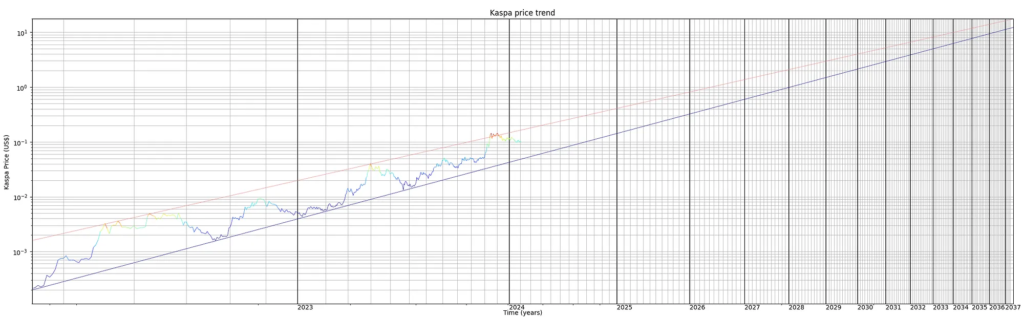
According to Chancellor, Kaspa’s price will reach $1 no earlier than 2026 but no later than the end of 2027, and $10 between 2034 and 2036.
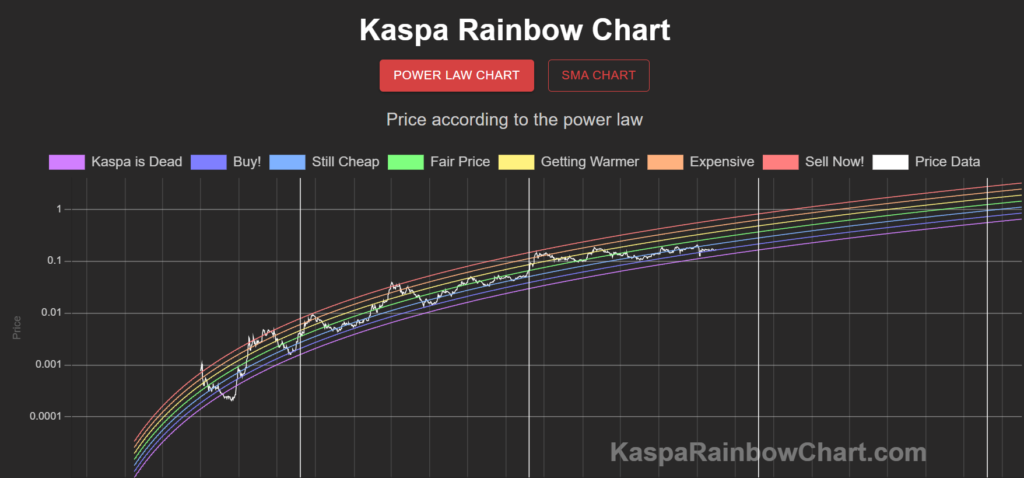
In June 2024 a developer known as xetur launched a counterpart to BitcoinFairPrice — the KaspaPowerLaw calculator, which estimates KAS’s “fair value”. He also created the Kaspa Rainbow Chart, which tracks KAS’s price in line with PLT.


According to ViaBTC CEO Haipo Yang, Kaspa is one of the most interesting PoW cryptocurrencies.
“We have devoted a lot of time and resources to mining KAS, which allowed us to take a leading position in producing this coin quite quickly. Among the ten largest Kaspa pools, we are the only one to offer the PPS+ payout model,” he said.
Conclusions
Giovanni Santostasi has proposed an intriguing model for bitcoin’s price, making him a popular figure in the community. He often gives interviews explaining the elegance of PLT.
Bear in mind that past performance does not guarantee future results — markets are inherently unpredictable. Any model can be broken by unforeseen events. Even so, the power law can serve as one guide to the future of bitcoin and, perhaps, Kaspa.