



Bitcoin’s Volatility Poised for a Surge, Analysts Predict
Bitcoin's volatility has reached a historic low, with Bollinger Bands at a record narrow range.
The volatility of digital gold has reached a historic low. Weekly Bollinger Bands have contracted to a record narrow range, noted the analyst known as Mr. Anderson.
#Bitcoin’s weekly Bollinger Bands are now the tightest in history.
What does that mean? On the weekly scale, each candle represents a week, and when volatility compresses this tightly, expansion always follows.
Bollinger Bands measure volatility by tracking two standard… pic.twitter.com/I41cwuHFF5
— Mr. Anderson (@TrueCrypto28) September 23, 2025
He added that once expansion begins, the price of the leading cryptocurrency almost always quickly tests the outer bands.
An analyst under the pseudonym Frank pointed out that Bitcoin’s one-month implied volatility remains near historic lows at 30.9%.
One-month implied volatility for $BTC remains at historic lows of 30.9%.
The closest parallel was the 2023 “Stablecoin Summer” when BTC chopped sideways between $26k and $29k for what seemed like eternity. pic.twitter.com/03tvveE1PH
— Frank (@FrankAFetter) September 20, 2025
He drew a parallel with the “Stablecoin Summer” of 2023, when the price of the leading cryptocurrency moved sideways between $26,000 and $29,000 for an extended period.
Nassar Achkar, the strategy director at CoinW exchange, agrees, describing the situation as the “calm before the storm.” In his view, negative funding rates, seasonal trends, and institutional inflows into ETFs tilt the odds in favor of an increase.
“Such a strong compression rarely passes quietly,” noted Langerius, founder of Hunters of Web3.
However, Glassnode researcher CryptoVizArt holds a different view. He stated that overall volatility is decreasing because Bitcoin is becoming “larger” over time.
I truly believe there is a connection between lack of knowledge in math/statistics and blindly utilizing technical indicators as predictive tools.
Bollinger bands ~ Realized Volatility
Bitcoin has been becoming larger and larger, hence less volatile. No matter weekly, monthly,… https://t.co/02WdbxjfWx
— CryptoVizArt.₿ (@CryptoVizArt) September 23, 2025
Therefore, the narrowing of Bollinger Bands is merely an observation without real predictive value, the expert noted.
Historically, strong compression has been followed by growth. In early July, the bands were very narrow when the asset was trading around $108,000. A few days later, volatility increased, and the price of digital gold reached a new all-time high above $122,000 by July 14.
Julio Moreno, head of research at CryptoQuant, explained the price weakening by whale activity.
One reason why Bitcoin prices have weakened.
Whales are net selling:
🔸 -147K Bitcoin since August 21.
🔸Total balance declining at the fastest monthly rate of the cycle. pic.twitter.com/w7mTI37BF2— Julio Moreno (@jjcmoreno) September 23, 2025
According to him, since August 21, large holders have sold 147,000 BTC. The total balance of whales is declining at the fastest monthly rate in the current cycle.
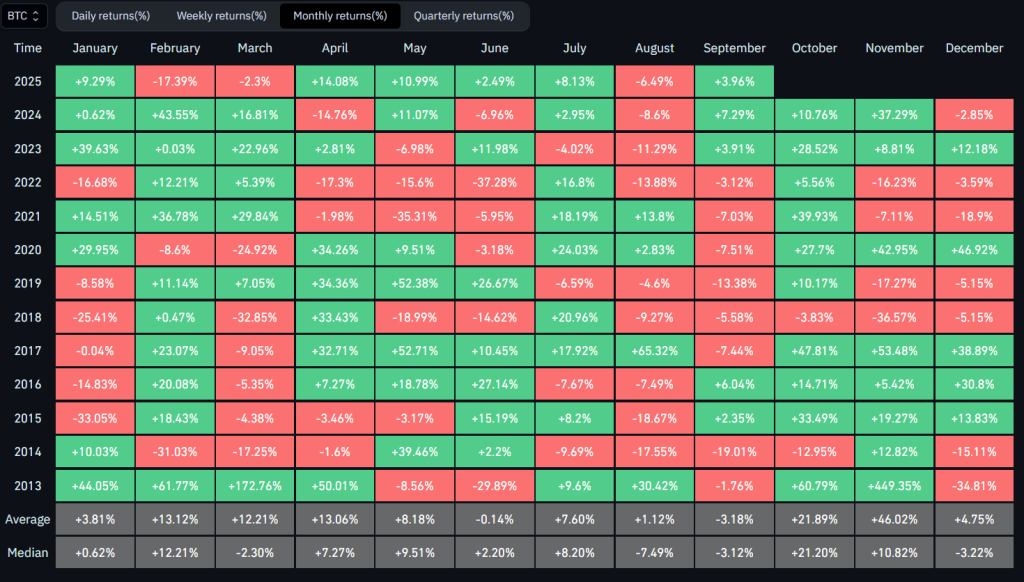
Other experts cite CoinGlass data: Bitcoin has risen in price in 10 of the last 12 Octobers and in eight of the last 12 fourth quarters.
Earlier in September, CryptoQuant analyst Maartunn identified a worrying signal: many key bull market indicators have turned bearish.
Later, Glassnode experts identified the cost of coins held by short-term holders as a key support level for digital gold.
Рассылки ForkLog: держите руку на пульсе биткоин-индустрии!