



Bitwise: Iran Conflict Positions Bitcoin as a Real Settlement Medium
Experts consider a $1 million price level as "baseline" for the cryptocurrency.
The resilience of digital gold during the war in Iran aligns with risk aversion, according to Bitwise’s investment director Matt Hougan and the company’s head of research, Ryan Rasmussen.
Bitcoin is apolitical money. When nations fight, the incentive to use apolitical money goes up.
Since the Iran conflict began in late February:
— Bitcoin: +12%
— S&P 500: -1%
— Gold: -10%Expect bitcoin increasingly to act as a hedge against geopolitical chaos. pic.twitter.com/JrzXMW0zNd
— Bitwise (@Bitwise) April 14, 2026
Since the onset of the Middle East conflict, Bitcoin’s price has risen by 12%, while the S&P 500 and gold have fallen by 1% and 10%, respectively.
This trend contradicts the notion that during geopolitical shocks, the leading cryptocurrency behaves as a high-risk asset. However, experts have deemed this perspective erroneous.
“Chaos is a ladder,” they wrote.
According to them, Bitcoin’s rally is a consequence of the conflict: cracks in the global financial system enhance the appeal of non-sovereign money.
Two Bets in One
Hougan and Rasmussen described the first cryptocurrency as “two bets in one.” The first is well-known: competing with gold for the status of a store of value. The second, as a settlement currency in international trade, once seemed unlikely but is now rapidly gaining momentum.
The experts linked this shift to the weaponization of financial infrastructure. Following Russia’s disconnection from SWIFT in 2022, trade increasingly occurs through alternative systems, particularly Chinese ones.
As a result, the dollar is gradually losing ground on the periphery, creating a niche for non-dollar payment systems.
Recent events have only strengthened this trend, the specialists noted. Reports of Iran’s readiness to accept Bitcoin as payment for oil transit signal a desire to bypass traditional systems, even if only experimentally.
Bitwise acknowledged that sanctions remain in place, and blockchain transparency limits illegal use. However, the broader signal is more significant: geopolitical fragmentation is pushing countries to seek apolitical alternatives.
$1 Million as a Starting Point
Experts believe these changes directly impact Bitcoin’s valuation. They compared the cryptocurrency’s currency scenario to an out-of-the-money call option: its price rises with the likelihood of adoption and global volatility.
“The probabilistic part is simple: a call option to buy a stock at $120 becomes more expensive when the stock rises from $100 to $110. Volatility is more complex, but the principle is the same: if a $100 stock becomes twice as volatile, the probability of reaching $120 increases—simply due to stronger fluctuations,” Hougan and Rasmussen explained.
Both conditions are met: the conflict has undermined the global currency order while simultaneously bringing Bitcoin closer to the role of a real settlement medium.
The role of digital gold is changing: Bitwise expects Bitcoin to become a hedge against geopolitical chaos, rather than just a speculative asset dependent on liquidity.
This also alters long-term expectations. If the asset establishes itself as a store of value and a unit of account, current price targets may be underestimated. Experts now consider a $1 million rate as a baseline, not a ceiling.
At the time of writing, the leading cryptocurrency is trading around $75,200—the highest since early February. Over the past 24 hours, the coin’s quotes have jumped by 4.5%.
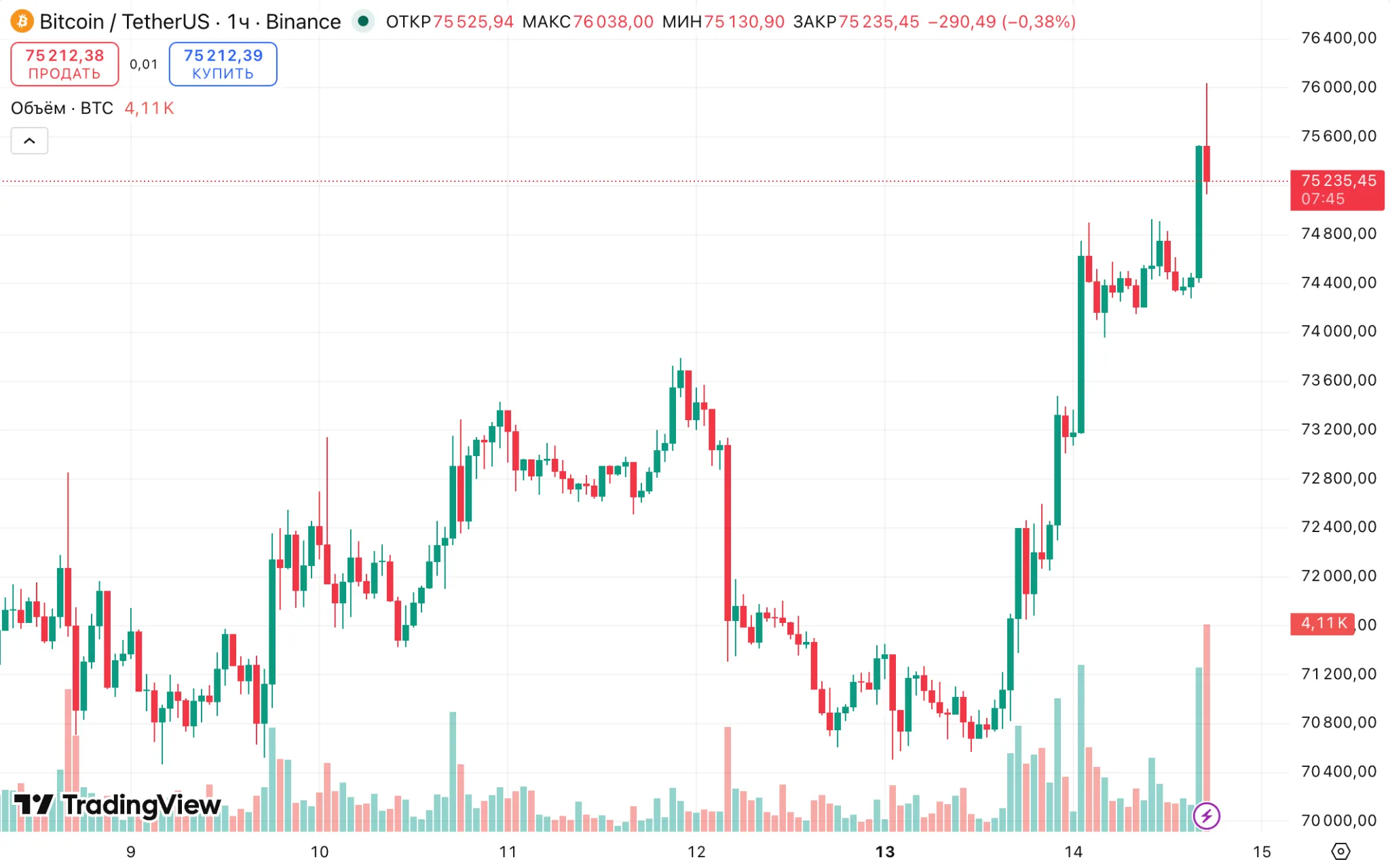
Macro analyst Jordi Visser identified breaking the $76,000 mark as a key condition for establishing a bullish trend.
Рассылки ForkLog: держите руку на пульсе биткоин-индустрии!